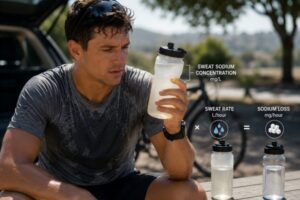
A salty taste after a hard workout can seem like a small detail until you start noticing the other clues. A dark shirt dries with pale rings around the collar. Your forehead feels gritty after a long summer run. A cap develops white streaks after repeated training sessions. Sweat that reaches your lips tastes unmistakably salty, and suddenly a basic observation turns into a string of useful questions about sodium, hydration, exercise duration, and electrolyte replacement. The interesting part is that two people can complete the same workout and finish with very different amounts of salt on their skin.
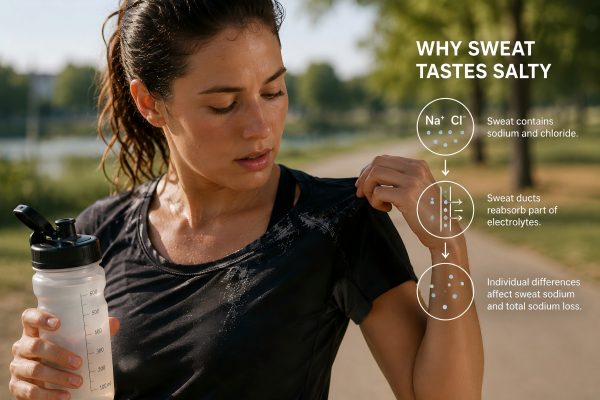
Sweat tastes salty mainly because it contains sodium and chloride. Sweat glands initially produce a mineral-containing fluid, then reabsorb part of those electrolytes as the fluid travels through the sweat duct. The amount that finally reaches the skin varies substantially among individuals, so both sweat volume and sweat sodium concentration determine how much sodium a person actually loses during exercise or heat exposure.
That difference becomes especially important once sweating lasts for an hour, two hours, or an entire afternoon outdoors. A person who produces a large volume of moderately salty sweat may lose more sodium than someone whose sweat tastes extremely salty but whose total sweat volume is low. Understanding that distinction helps separate useful hydration decisions from common assumptions such as “saltier sweat always means dehydration” or “the electrolyte powder with the most sodium must be the best choice.”
Medical Disclaimer: This article provides general educational information about sweat, sodium, hydration, and supplement-label comparison. It is not individualized medical advice. People who are pregnant or nursing, take medication, manage a health condition, or have concerns involving kidney, cardiovascular, fluid, or electrolyte balance should discuss personal hydration and supplement decisions with a qualified healthcare professional.
What Makes Sweat Taste Salty?
Sweat tastes salty because sodium and chloride are major electrolytes in eccrine sweat. The fluid produced inside the sweat gland is modified before it reaches the skin, with part of its sodium and chloride being reabsorbed along the duct. Final sweat therefore contains less salt than the original secretion, but usually enough sodium and chloride to create the familiar salty taste and dried mineral residue.
What Is Sweat Made Of?
Sweat is mostly water, but it is not simply water leaking through the skin. Eccrine sweat glands produce a fluid that contains electrolytes and small quantities of other dissolved compounds. Sodium and chloride are the dominant minerals involved in the salty character of sweat, while potassium is present at lower concentrations. Calcium and magnesium are also lost in sweat, although their concentrations are generally much smaller than those of sodium and chloride.
Whole-body sweat studies illustrate the difference in scale. In one frequently cited study of healthy adults exercising under warm, humid conditions, mean sweat concentrations were approximately 50.8 mmol/L sodium, 46.6 mmol/L chloride, 4.8 mmol/L potassium, 1.3 mmol/L calcium, and 0.5 mmol/L magnesium. These figures are study averages rather than fixed values for every person, but they show why sodium and chloride dominate discussions of salty sweat.
| Sweat Component | Example Mean Concentration | Relative Importance in Salty Sweat |
|---|---|---|
| Sodium | 50.8 mmol/L | Major electrolyte loss |
| Chloride | 46.6 mmol/L | Major contributor to salty taste |
| Potassium | 4.8 mmol/L | Present at much lower concentration |
| Calcium | 1.3 mmol/L | Smaller mineral loss |
| Magnesium | 0.5 mmol/L | Smaller mineral loss |
The composition of final sweat changes with physiology and circumstances. Exercise intensity, sweat rate, environmental heat, body size, heat acclimation, and individual differences can all affect what appears at the skin surface. For that reason, the table is most useful as a comparison of relative mineral concentrations rather than a formula for estimating a specific person’s losses.
Which Electrolytes Are Found in Sweat?
Sodium, chloride, potassium, calcium, and magnesium can all be found in human sweat, but they do not occur in equal quantities. Sodium and chloride normally deserve the greatest attention when discussing prolonged sweating because their concentrations and total losses can be considerably higher than those of magnesium or calcium. This is an important distinction when evaluating electrolyte supplements, since the number of minerals listed on a label does not automatically indicate how closely the formula relates to actual sweat losses.
Individual sodium concentration varies widely. Large datasets involving standardized sweat testing have reported whole-body sodium concentrations spanning roughly the high teens to above 100 mmol/L in some participants. A 2022 analysis involving 1,944 sweat tests from 1,304 individuals found substantial variation that could only partly be explained by factors such as sweating rate, body mass, exercise type, energy expenditure, sex, and season.
To put the units into more familiar supplement-label language, one millimole of sodium is approximately 23 mg. A sweat sodium concentration of 40 mmol/L therefore equals roughly 920 mg of sodium per liter of sweat, while 60 mmol/L is approximately 1,380 mg/L. Those conversions describe concentration, not a universal replacement recommendation. A person still needs to know how many liters of sweat are being produced before estimating total sodium loss.
How Do Sweat Glands Handle Sodium and Chloride?
An eccrine sweat gland has a secretory portion that produces precursor sweat and a duct that carries that fluid toward the surface of the skin. Sodium and chloride in the original secretion are partially reabsorbed while the fluid moves through the duct. This conservation mechanism is one reason the sweat reaching the skin usually contains a lower sodium concentration than the fluid initially formed deeper in the gland.
The process also helps explain why final sweat can become saltier when sweating rate rises. When fluid moves through the duct more rapidly, there may be less opportunity to reabsorb sodium relative to the amount of fluid being secreted. The result can be a higher sodium concentration at the skin, although the relationship is not identical in every person and cannot be predicted accurately from exercise intensity alone.
Controlled studies continue to show how large these individual differences can be. In one recent laboratory investigation involving healthy young men exercising at progressively greater intensities in heat, measured whole-body sweat sodium concentrations ranged from roughly 14 to 81 mmol/L. Everyone was completing the same general protocol, yet their sweat composition differed substantially. That is a strong reminder that salty sweat is not simply a reflection of how fit someone is or how much dietary salt was eaten that day.
What Makes Some People Lose More Salt in Sweat?
Total salt loss depends on both how much a person sweats and how much sodium is contained in each liter of sweat. Someone can lose a large amount of sodium because their sweat concentration is high, because their sweat rate is high, or because sweating continues for several hours. Exercise intensity, environmental heat, acclimation, body characteristics, and individual physiology can all influence those variables.
How Do Sweat Rate and Sweat Sodium Differ?
Sweat rate describes fluid volume, usually expressed in liters per hour, while sweat sodium concentration describes the amount of sodium contained in each liter. Confusing these two measurements is one of the most common mistakes in discussions about “salty sweaters.” A person can have relatively salty sweat but lose less sodium overall if the total volume of sweat remains low.
Consider two people training for one hour. Person A sweats 0.6 L/h at approximately 60 mmol/L sodium, while Person B sweats 1.5 L/h at 35 mmol/L. Person A has the higher concentration, but Person B produces much more fluid. When both concentration and volume are calculated together, Person B can finish the hour with greater total sodium loss even though the sweat itself is less concentrated.
Sports research has reported typical whole-body sweat rates commonly around 0.5 to 2.0 L/h, although substantially higher values can occur under demanding heat, equipment, workload, or body-size conditions. A large athlete may also produce more total sweat than a smaller athlete without necessarily having a higher sodium concentration. That is why judging electrolyte needs by body size, visible salt, or workout type alone can be misleading.
A more useful way to think about sweating is to track three separate pieces of information: liters of sweat per hour, sodium concentration per liter, and the number of hours spent sweating. Once those variables are separated, total sodium loss becomes much easier to understand.
Do Heat and Exercise Increase Salt Loss?
Exercise raises metabolic heat production, while a hot environment adds heat from outside the body. Sweating helps remove some of that heat through evaporation, so harder work and warmer conditions commonly increase sweat production. When sweat volume increases, total sodium loss can rise even when the sodium concentration in each liter changes very little.
Controlled research provides a useful example. In one experiment comparing exercise workloads at approximately 45% and 65% of VO₂max, the higher workload produced a substantial increase in whole-body sodium and chloride loss. Total losses rose by roughly 150%, primarily because the participants were producing considerably more sweat and accumulating greater electrolyte loss over the exercise period.
Duration can make the difference even larger. A demanding 30-minute workout may produce less total sodium loss than three hours of moderately intense cycling. Outdoor construction, landscaping, warehouse work without climate control, hiking, football practice, endurance cycling, and long-distance running can all produce very different fluid-loss profiles even when each situation is loosely described as “heavy sweating.”
Research involving long work periods in moderate heat has shown that average daily sodium losses can reach several grams under certain occupational conditions. Those findings should not be turned into a universal supplement target, but they illustrate how different a ten-hour hot-work environment is from a short recreational workout.
Does Heat Acclimation Change Sweat Sodium?
Heat acclimation is the series of physiological adjustments that develops after repeated exposure to hot conditions. Over time, a person may begin sweating earlier, distribute sweat more effectively across the skin, and sometimes produce a greater total sweat volume when thermal stress is high. At the same time, the sweat glands generally become more efficient at conserving sodium, so sodium concentration in final sweat can decrease.
That adaptation is useful, but it does not automatically mean total sodium loss becomes smaller. Imagine that someone initially sweats 1.0 L/h at 50 mmol/L sodium. After acclimation, concentration may fall while sweat rate rises to 1.4 L/h. Even if each liter contains less sodium, the larger fluid volume can partly offset the improvement in sodium conservation.
Seasonal studies support the same general pattern. Warmer-season training and repeated heat exposure are often associated with higher sweat output and somewhat lower sweat sodium concentration. This means a sweat estimate obtained in cool spring weather may not perfectly describe the same athlete during an August training block, particularly after several weeks of heat adaptation.
For active people who spend long periods in hot conditions, it is more useful to think of sweat rate and sodium loss as variables that can shift with the season rather than permanent personal constants. Rechecking fluid loss under representative conditions can provide more practical information than relying on an old result indefinitely.
How Can You Tell If You Are a Salty Sweater?
Repeated white salt marks on clothing, visible crystals on the skin, a gritty feeling after exercise, and strongly salty-tasting sweat can suggest meaningful salt loss. However, these observations cannot measure sodium concentration accurately. A better assessment combines visible clues with measurable information such as workout duration, approximate sweat rate, environmental conditions, and standardized sweat testing when greater precision is genuinely useful.
What Do White Salt Marks Mean?
White marks on a dark shirt, running cap, backpack strap, sports bra, or cycling jersey appear after the water in sweat evaporates and dissolved substances remain behind. Sodium and chloride contribute substantially to that residue, which is why recurring white rings or visible crystals are commonly associated with people who describe themselves as salty sweaters.
The amount of residue does not tell you the exact concentration of sodium. A person producing 1.8 liters per hour of moderately salty sweat can leave more total mineral residue than someone producing only 0.5 liters per hour of very concentrated sweat. Fabric type, airflow, humidity, evaporation rate, washing habits, and the places where sweat collects can also influence how obvious the marks become.
The observation becomes more useful when it appears consistently in similar situations. Someone who repeatedly develops salt crust around the temples and heavy white marks on a cap after long summer runs probably has a stronger reason to examine fluid and sodium losses than someone who notices one faint mark after a single workout.
Visible salt is best treated as a clue rather than a measurement. It can justify paying closer attention to the conditions under which sweating occurs, but it cannot tell you whether sweat contains 30, 50, or 80 mmol/L sodium.
Is Stinging Sweat a Sign of High Salt Loss?
Sweat can sting the eyes because its electrolyte composition differs from the tear film and because evaporation may make facial sweat more concentrated before it reaches the eye. Still, eye irritation is not a reliable way to estimate sodium concentration. Sunscreen, cosmetics, skin-care products, dust, wind, facial sweat volume, and the amount of evaporation can all change how intense the sensation feels.
The same caution applies to gritty skin. Mineral crystals around the forehead or cheeks indicate that dissolved substances remained after sweat evaporated, but a regional skin observation does not automatically represent whole-body sweat composition. Scientific studies have shown that sodium concentration can differ by body location, which is one reason sweat samples collected from a single patch require careful interpretation.
For people who regularly train for several hours, visible signs can be paired with objective data. Body mass before and after exercise can help estimate fluid loss, while properly collected sweat samples can provide additional information about sodium concentration. The combination is much more useful than deciding someone is a “high sodium sweater” because their eyes sting badly during one run.
For ordinary recreational exercise, however, complicated testing is usually unnecessary. The goal is simply to recognize when repeated heavy sweating may deserve more thoughtful hydration planning rather than turning every uncomfortable workout into a laboratory exercise.
How Reliable Is the Taste of Sweat?
Taste is useful for confirming something obvious: salt is present. It is poor at quantifying how much sodium is being lost. Human taste perception differs from person to person, and sweat near the mouth can become more concentrated as water evaporates. Facial sweat also does not necessarily have exactly the same composition as whole-body sweat.
| Observation | What It Can Suggest | What It Cannot Measure Reliably |
|---|---|---|
| Salty taste | Sodium and chloride are present | Exact sodium concentration |
| White clothing marks | Minerals remained after evaporation | Milligrams lost per hour |
| Gritty skin | Dried mineral-containing sweat | Whole-body sodium concentration |
| Soaked clothing | Sweat volume was substantial | How salty the sweat was |
| Body-mass change | Approximate fluid loss | Sodium concentration |
| Standardized sweat test | Estimated sweat sodium | Every future workout condition |
Even formal sweat testing depends heavily on method. Sample location, skin cleaning, collection timing, contamination, evaporation, storage, and the analytical device can affect the result. Researchers sometimes use regional collection sites because whole-body collection is difficult, but regional values may need correction before they are treated as estimates of whole-body sodium concentration.
Portable sweat analyzers have become more accessible in sports settings, yet measurement uncertainty remains important. A device may be useful for identifying a broad low, moderate, or high range without supporting the idea that a person’s sodium requirement can be calculated down to the last 50 milligrams.
For most people, salty taste is the beginning of a useful question, not the final answer.
How Much Sodium Do You Lose Through Sweat?
Sodium loss varies widely because it is calculated from two individual variables: sweat volume and sodium concentration. Someone producing 0.5 L/h of relatively low-sodium sweat may lose only a few hundred milligrams per hour, while someone sweating heavily with a high sodium concentration can lose several times more. Exercise duration then multiplies that loss over time.
What Is Sweat Sodium Concentration?
Sweat sodium concentration is usually expressed in millimoles per liter (mmol/L) in research, while consumers are more familiar with milligrams per liter (mg/L) because Nutrition Facts and Supplement Facts labels use milligrams. The conversion is straightforward: one mmol of sodium equals approximately 23 mg.
A sweat concentration of 20 mmol/L works out to approximately 460 mg/L, while 40 mmol/L is approximately 920 mg/L. At 60 mmol/L, the value is roughly 1,380 mg/L, and at 80 mmol/L it reaches approximately 1,840 mg/L. These are mathematical conversions, not target amounts a person should automatically consume.
Large sweat-testing datasets have shown broad individual ranges. One analysis of nearly two thousand standardized tests reported an average predicted whole-body sodium concentration around the low 40s mmol/L, with values extending from the teens to above 100 mmol/L. More controlled laboratory studies have also reported several-fold differences among healthy participants completing similar exercise.
Those findings are important when reading electrolyte labels. A drink supplying 300 mg sodium and one supplying 1,000 mg may both make sense in different contexts. The larger number should not automatically receive a higher quality score simply because more sodium appears on the label.
How Do Sweat Rate and Duration Affect Total Sodium Loss?
Once sodium concentration is expressed in milligrams per liter, total loss can be estimated with a simple calculation:
Estimated sodium loss = sweat volume × sodium concentration
The examples below are intended to show how the calculation works, not to prescribe electrolyte intake.
| Sweat Rate | Sweat Sodium | Approx. Sodium per Liter | Approx. Sodium Loss per Hour |
|---|---|---|---|
| 0.5 L/h | 20 mmol/L | 460 mg/L | 230 mg/h |
| 0.8 L/h | 40 mmol/L | 920 mg/L | 736 mg/h |
| 1.2 L/h | 50 mmol/L | 1,150 mg/L | 1,380 mg/h |
| 1.5 L/h | 60 mmol/L | 1,380 mg/L | 2,070 mg/h |
| 2.0 L/h | 80 mmol/L | 1,840 mg/L | 3,680 mg/h |
The lower rows combine relatively high sweat rates with relatively high sodium concentrations, so they should not be interpreted as typical values for recreational exercisers. They are useful because they show how quickly total loss can rise when both variables are elevated.
Duration adds another layer. A person losing roughly 900 mg sodium per hour would accumulate about 450 mg of loss during 30 minutes, but approximately 2,700 mg over three hours if conditions remained similar. That difference helps explain why a sodium strategy appropriate for a long endurance event may be unnecessarily aggressive for a short gym session.
The calculation also shows why “salty sweater” is incomplete without knowing sweat volume. Concentration tells only half the story.
How Can Sweat Loss Be Estimated?
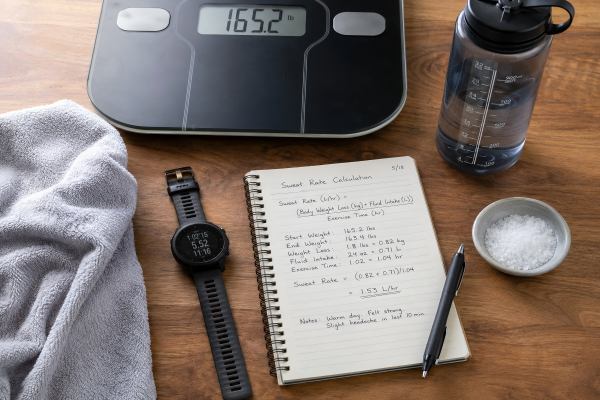
One of the simplest ways to estimate whole-body sweat loss during exercise is to compare body mass before and after a session while also accounting for anything consumed or eliminated during that period. Under practical field conditions, an acute body-mass decrease of approximately 1 kilogram is commonly treated as roughly 1 liter of water, although the calculation is an estimate rather than a perfect laboratory measurement.
A useful formula is:
Sweat loss ≈ pre-exercise body mass − post-exercise body mass + fluid consumed − urine produced
Suppose a runner weighs 0.7 kg less after a one-hour session but drank 0.5 L of water and did not urinate. Estimated sweat loss would be about 1.2 liters, producing an estimated sweat rate of 1.2 L/h.
Accuracy improves when the same process is repeated under realistic, comparable conditions. Clothing should be as dry as practical before the post-exercise weighing, fluid intake needs to be measured, and any bathroom breaks should be recorded. Testing a cool indoor treadmill session will not necessarily predict a long outdoor run in humid summer weather.
This calculation estimates water loss only. It does not determine sodium concentration. A person with a 1.2 L/h sweat rate may still have low, moderate, or relatively high sodium concentration.
Do You Need Electrolytes When Your Sweat Tastes Salty?
Not necessarily. Everyone loses some sodium and chloride through sweat, so saltiness alone does not establish a need for an electrolyte supplement. Water and normal food may be sufficient for many short or moderate activities. Electrolyte replacement becomes more relevant when sweating is prolonged, fluid losses are large, heat exposure is substantial, or normal meals cannot conveniently replace what is being lost.
When Is Water Usually Enough?
For many healthy adults completing a relatively short workout in ordinary conditions, water is a sensible starting point. Sports hydration guidance has traditionally distinguished activity lasting less than about an hour from longer endurance exercise because prolonged sessions create more opportunity for fluid and sodium losses to accumulate. That does not mean the 60-minute mark is a rigid biological cutoff, but it provides useful context.
Food also contributes significantly to sodium replacement. Someone completing a 40-minute strength session shortly before a regular meal may replace a meaningful amount of sodium through normal foods without needing a specialized electrolyte product. A four-hour cyclist in summer heat has a very different situation because substantial sweat loss can accumulate before a full meal is practical.
The better question is not simply “Did my sweat taste salty?” Instead, consider exercise duration, environmental heat, sweat rate, opportunities to eat, and how soon normal meals will resume. Those factors determine whether a specialized hydration product offers meaningful convenience.
This is particularly relevant in the supplement market, where products can range from modest-sodium daily hydration mixes to formulas delivering much larger sodium amounts per serving. The correct match depends on the situation rather than the most impressive number on the front of the package.
Which Situations Increase Electrolyte Needs?
Longer exercise, high sweat rates, hot environments, repeated training sessions, and extended outdoor work create stronger reasons to pay attention to electrolyte losses. The total amount lost can rise quickly when substantial sweating continues for several hours, especially in people whose sweat sodium concentration is above average.
Endurance events are an obvious example, but they are not the only one. Football practice in protective equipment, long-distance hiking, hot-weather construction work, cycling, tennis tournaments, warehouse labor, and repeated two-a-day training sessions can all produce more significant fluid and sodium losses than a short recreational workout.
Individualization still matters. Two people completing the same two-hour activity may differ dramatically in both sweat rate and sodium concentration. One could lose 0.6 L/h while another exceeds 1.5 L/h. A uniform product recommendation based only on workout duration would therefore miss an important part of the picture.
Overreplacement also deserves attention. Drinking fluid far in excess of actual losses is not automatically safer, even if the beverage contains electrolytes. During very prolonged events, excessive fluid intake can contribute to dangerously low blood sodium. The aim should be a reasonable strategy based on actual conditions, not a rule that more water and more sodium are always better.
How Should You Compare Sodium on Electrolyte Labels?
The first number to check is sodium per serving, but the comparison should not stop there. Serving definition, mixing volume, sugar, carbohydrate, potassium, magnesium, caffeine, sweetener type, and intended use all affect what a hydration formula is designed to do.
| Label Detail | Example | What It Tells You |
|---|---|---|
| Sodium per serving | 500 mg | Sodium consumed in one defined serving |
| Mixing volume | 500 mL | Water volume used for that serving |
| Sodium concentration | 1,000 mg/L | 500 mg sodium mixed into 0.5 L |
| Same serving in 1 L | 500 mg/L | Dilution cuts concentration in half |
| Sugar | 0 g, 5 g, 10 g | Relevant to preference and fueling context |
| Caffeine | 0 mg or disclosed amount | Shows whether stimulants are included |
A packet containing 500 mg sodium mixed into 500 mL produces roughly 1,000 mg/L. Mix the same packet into a full liter and the concentration drops to 500 mg/L. That is why “sodium per serving” and “sodium per liter” should never be treated as interchangeable specifications.
NutriReviewLab uses a label-first comparison approach for electrolyte products, focusing on current Supplement Facts, serving size, mixing instructions, sugar, sweeteners, other electrolytes, packaging format, and intended use rather than ranking formulas by sodium alone. For readers, this makes it easier to separate an endurance-oriented formula from a lighter daily hydration product.
For supplement brands, the same principle improves the quality of independent coverage. Current label images, precise serving information, flavor-specific differences, ingredient lists, and clear mixing directions give reviewers a much stronger factual basis than broad claims such as “maximum hydration.” Brands may submit verifiable product information for editorial consideration, but submission itself should not imply guaranteed coverage, ranking, or a positive conclusion.
Is Salty Sweat a Sign of Dehydration or a Health Problem?
Salty sweat alone does not prove dehydration or indicate a health disorder. Sodium and chloride are normal components of human sweat, and healthy people can differ substantially in sweat sodium concentration. Hydration status depends on overall fluid balance, while unusual sweating accompanied by concerning symptoms or specific medical circumstances should be evaluated by a qualified healthcare professional.
Does Salty Sweat Mean You Are Dehydrated?
Sweat taste is not a dependable hydration test. Dehydration refers to a deficit in body water, whereas sweat sodium concentration describes the amount of sodium present in the fluid being produced. The two are connected to exercise fluid balance but do not move together in a simple one-to-one relationship.
A useful illustration comes from controlled exercise research in which participants trained in hot conditions under hydrated and mildly dehydrated conditions. Even when body-mass loss approached roughly two percent in the dehydrated trial, local sweat electrolyte concentrations did not change enough to support the idea that people can judge hydration simply by noticing that sweat tastes saltier.
For routine exercise, several observations provide more useful information when considered together: body-mass change during repeatable workouts, thirst, how much fluid was consumed, exercise duration, environmental heat, and how frequently urination occurs before and after the session.
The opposite mistake also matters. Someone who sees salt on a shirt may assume that drinking as much water as possible is the safest response. During prolonged activity, however, excessive fluid consumption can dilute blood sodium. Hydration decisions should therefore aim to match realistic losses rather than treating either thirst or saltiness as a reason for unlimited drinking.
Is Salty Sweat Usually Normal?
Yes. Sodium chloride is a normal component of eccrine sweat, so a salty taste or visible dried residue after exercise is usually consistent with ordinary physiology. Controlled studies involving healthy people show several-fold differences in whole-body sodium concentration even when participants complete similar exercise under similar environmental conditions.
That range is important because it shows that there is no single “normal salty taste.” One person may rarely notice residue, while another consistently develops white streaks on a dark cap during long summer sessions. Neither observation, by itself, establishes a health problem.
The phrase salty sweater is commonly used in sports nutrition, but it is an informal description rather than a medical diagnosis. It may refer to someone with visibly salty sweat, a relatively high measured sodium concentration, a high total sodium loss, or simply a combination of heavy sweating and visible residue.
Context remains more important than comparison with another person. If salt marks appear predictably after long exercise or heat exposure and disappear once normal conditions return, the explanation is usually straightforward. A sudden, unexplained change in sweating together with other significant symptoms belongs in a different category and deserves professional attention.
When Should Unusual Sweating Be Discussed With a Professional?
Professional guidance is appropriate when sweating changes substantially without an obvious reason, occurs alongside significant symptoms, or needs to be interpreted in someone taking medication or managing a health condition that affects fluid or electrolyte balance. Pregnancy, kidney conditions, cardiovascular issues, and medically directed sodium restriction are examples where personalized guidance is more appropriate than following a general hydration article.
Cystic fibrosis is one reason medical discussions sometimes mention unusually salty sweat. The important distinction is that CF is not identified by tasting skin, examining a shirt, or using a consumer hydration test. Clinical evaluation relies on a standardized quantitative sweat chloride test performed under controlled conditions.
Current clinical guidance uses sweat chloride values to help interpret results. Values around 29 mmol/L or below are generally considered within the normal range, 30–59 mmol/L fall into an intermediate range requiring further evaluation, and 60 mmol/L or above are considered consistent with CF when interpreted within the appropriate clinical process. A positive or intermediate result is not something an online article should interpret for an individual.
For most healthy adults asking about salty sweat after exercise, the explanation remains normal sodium and chloride loss. The useful boundary is recognizing when an everyday hydration question has become a medical question.
Conclusion
Sweat tastes salty because sodium and chloride naturally move into sweat as part of the body’s cooling process. The amount lost is not determined by taste alone. A person’s sweat rate, sodium concentration, exercise duration, environmental heat, and acclimation all influence total sodium loss, which is why one athlete may lose a few hundred milligrams per hour while another can lose substantially more under demanding conditions.
For everyday hydration decisions, start with the actual situation rather than the supplement shelf. Consider how long the activity lasts, how much fluid is being lost, when normal food will be available, and what the current product label actually provides per serving and per liter. NutriReviewLab’s label-first comparison approach follows the same principle: sodium is most useful when interpreted alongside serving size, mixing volume, sugar, other electrolytes, and intended use rather than treated as a simple “more is better” number.
Why Is My Sweat So Salty?
Some people naturally produce sweat with a higher sodium concentration, while others simply produce a larger volume of sweat that leaves more visible salt behind after evaporation. Exercise intensity, heat, individual physiology, sweating rate, and acclimation can all influence the final result. A strong salty taste or repeated white marks may be useful clues, but they cannot show your exact sodium concentration. If you want practical information, estimating sweat rate during representative workouts is usually more useful than judging taste alone, while standardized sweat sodium testing may add detail for people with prolonged, high-volume training demands.
Does Salty Sweat Mean I Am Dehydrated?
Not necessarily. Salty sweat and dehydration describe different things. Sweat saltiness reflects the concentration of sodium and chloride in sweat, while dehydration reflects an overall body-water deficit. A person can begin exercise well hydrated and still produce relatively salty sweat. Another person may lose large amounts of water through less concentrated sweat. Hydration is better evaluated using several factors together, including fluid intake, exercise duration, environmental heat, thirst, body-mass changes, and recovery conditions. Salty taste alone is not a reliable test of hydration status and should not automatically trigger excessive water or sodium intake.
Does Eating Too Much Salt Make Sweat Saltier?
Dietary sodium can influence sodium balance, but a salty meal does not mean the next workout will automatically produce dramatically saltier sweat. Sweat sodium concentration is regulated by sweat-gland physiology and is also influenced by sweating rate, heat acclimation, hormones, and individual characteristics. Research shows substantial variation between people that cannot be explained simply by dietary intake. Normal meals are also an important source of sodium replacement after exercise, so dietary sodium should be considered as part of the overall day rather than separated completely from hydration products. People following medically directed sodium restrictions should use individualized professional guidance.
How Much Sodium Can You Lose Through Sweat?
The amount can vary from a few hundred milligrams per hour to several grams per hour under more extreme combinations of high sweat rate and high sweat sodium concentration. For example, someone sweating 0.5 L/h at 20 mmol/L sodium would lose approximately 230 mg per hour, while 1.5 L/h at 60 mmol/L would equal roughly 2,070 mg per hour. The second example represents a much heavier loss scenario and should not be treated as a typical requirement. Total sodium loss must be calculated from sweat volume, sodium concentration, and activity duration together.
Should I Drink Electrolytes If I Sweat a Lot?
Electrolytes may become more relevant when sweating is heavy, prolonged, repeated, or occurs in hot conditions, but heavy sweating does not automatically mean every session requires a high-sodium supplement. Shorter activities can often be supported with water and regular meals, while longer endurance sessions or extended hot-weather work may create larger cumulative losses. When choosing a product, compare sodium per serving, mixing volume, sugar, other electrolytes, caffeine, and intended use. The formula that fits a four-hour cycling session may not be the most appropriate option for a short gym workout or ordinary daily hydration.
What Causes White Salt Marks on Clothes After Sweating?
White marks form when sweat dries and water evaporates, leaving dissolved minerals behind. Sodium and chloride contribute strongly to the residue that appears on dark shirts, hats, backpack straps, or other athletic gear. Frequent visible staining can suggest that meaningful quantities of salt are reaching the skin, but it does not measure the sodium concentration or total sodium loss precisely. Someone who sweats a large volume of moderately concentrated sweat can leave more residue than a person whose sweat is saltier but less abundant. Fabric, humidity, airflow, and where sweat collects also change how noticeable the marks become.
Can Your Sweat Sodium Change After Heat Acclimation?
Yes. Repeated exposure to hot conditions can improve the body’s ability to conserve sodium in sweat, so sweat sodium concentration often decreases as heat acclimation develops. At the same time, an acclimated person may sweat earlier or produce a larger overall volume, which means total sodium loss does not necessarily fall in the same proportion. This is one reason a sweat estimate measured in cool weather may not perfectly describe summer training. People who regularly perform long workouts or physical work in the heat may find it more useful to reassess fluid loss under representative seasonal conditions rather than relying permanently on one old measurement.