

Electrolytes have moved far beyond marathon aid stations and football sidelines. Powder sticks now sit beside protein bars at grocery stores, hydration mixes fill gym shelves, and flavored electrolyte packets are marketed for workouts, travel, hot weather, mornings, long workdays, and ordinary afternoons. That visibility can make electrolyte supplementation seem like a missing step in everyone’s hydration routine. Human physiology is more nuanced. Sodium, potassium, chloride, magnesium, and calcium are essential nutrients, but an essential nutrient does not automatically need to come from a supplement.
For most healthy adults, electrolyte supplements are not routinely necessary. Normal meals and fluids generally replace ordinary mineral losses. Additional electrolyte replacement becomes more useful when losses rise substantially, such as during prolonged sweating, extended exercise, sustained work in hot conditions, or significant gastrointestinal fluid loss. The important question is not whether electrolytes matter, but whether your current losses justify deliberate replacement beyond normal food and water.
Consider two people leaving the same gym. One has spent 35 minutes lifting weights in an air-conditioned room and is heading home for dinner. The other has completed two hours of indoor cycling, has soaked through a shirt, and still has another training session later that day. Both exercised, but their hydration needs are unlikely to be identical. Once that distinction becomes clear, electrolyte products are much easier to evaluate without being distracted by front-label promises.
Medical note: This article provides general nutrition and supplement information rather than individualized medical advice. People who are pregnant or nursing, take prescription medications, have kidney, cardiovascular, or other health conditions, or have unusual or persistent symptoms should discuss electrolyte use with an appropriate healthcare professional.
Do Most People Need Electrolyte Supplements?
Most healthy adults do not need a dedicated electrolyte supplement every day. Sodium, potassium, chloride, magnesium, and calcium are essential, but normal losses through urine and modest sweating are generally replaced by food and beverages. Supplements become more relevant when sweating, exercise duration, environmental heat, or other sources of fluid loss substantially increase what needs to be replaced.
Essential Does Not Mean Supplement Required
One of the most common nutrition mistakes is assuming that because a nutrient is essential, a supplemental form must also be necessary. Electrolytes are essential because charged minerals participate in normal fluid regulation, nerve signaling, muscle contraction, cellular communication, and acid-base balance. Those functions are important every hour of the day, yet healthy bodies normally obtain and regulate electrolytes through ordinary food, beverages, kidney function, and normal physiological controls.
The NIH Office of Dietary Supplements has emphasized that healthy people generally replenish ordinary electrolyte losses through food and water. That distinction matters because a person does not become “electrolyte depleted” every time they sweat lightly, urinate, take a walk, or complete an ordinary gym session. Losses happen continuously, but replacement also happens continuously whenever people eat and drink.
A more useful way to think about electrolyte supplements is as a situational nutrition tool. They can be convenient when losses become large or prolonged, but they are not the baseline source of electrolytes for most adults. Someone eating regular meals and drinking according to normal hydration needs is already consuming sodium, potassium, magnesium, chloride, calcium, and other minerals without deliberately purchasing a hydration product.
Food Already Supplies Major Electrolytes
Electrolytes are widely distributed throughout the food supply. Sodium and chloride are common in table salt, breads, sauces, soups, cheese, prepared foods, and restaurant meals. Potassium occurs in potatoes, beans, dairy products, fruit, vegetables, meat, and fish. Magnesium is found in nuts, seeds, legumes, whole grains, and leafy green vegetables. Calcium is abundant in dairy products and many fortified foods.
The U.S. Food and Drug Administration uses Daily Values to give consumers a consistent reference point on Nutrition Facts and Supplement Facts labels. These numbers are not individualized intake prescriptions, but they make it easier to understand whether an electrolyte product supplies a minor amount or a substantial portion of a nutrient in one serving.
| Electrolyte | FDA Daily Value | Useful Label Context |
|---|---|---|
| Sodium | 2,300 mg | 500 mg is about 22% DV; 1,000 mg is about 43% DV |
| Potassium | 4,700 mg | Many hydration products supply only a small portion of the labeling DV |
| Magnesium | 420 mg | Helps reveal whether magnesium is a minor addition or substantial supplemental dose |
| Chloride | 2,300 mg | Often supplied with sodium salts but not always emphasized on front labels |
| Calcium | 1,300 mg | Usually a secondary electrolyte in hydration products rather than the main focus |
These reference values also demonstrate why context matters. A 1,000 mg sodium drink may make sense during sustained heavy sweating, while the same amount can be a large addition to an ordinary office day in which meals already contain substantial sodium. A label number is not inherently good or bad; its usefulness depends on what is being replaced.
Popularity Is Not the Same as Need
Modern electrolyte products solve several real convenience problems. A single powder packet is easier to carry during a bike ride than a full meal, tablets occupy little luggage space, flavored drinks can make water more appealing, and premeasured servings allow active users to track mineral intake more consistently. These advantages help explain why the category has expanded well beyond competitive sports.
The confusion begins when convenience becomes framed as universal necessity. A formula can contain useful minerals without being something every healthy person needs before breakfast. Likewise, adding vitamins, trace minerals, coconut water powder, amino acids, or wellness ingredients can create a broader formula without establishing that it is better for routine hydration.
A more experienced approach begins with the Supplement Facts panel rather than the front of the package. Check how much sodium one serving provides, whether potassium and magnesium amounts are disclosed, how much sugar or carbohydrate is present, which sweeteners are used, what amount of water the serving is intended for, and how many servings someone might realistically consume.
This label-first approach is also central to NutriReviewLab’s review process. Electrolyte products are most useful to compare by actual mineral profile, sugar and sweetener composition, serving size, ingredient transparency, use-case fit, and value rather than by vague phrases such as “maximum hydration” or “advanced electrolyte support.”
When the Answer Changes
The need for deliberate electrolyte replacement generally increases as fluid and mineral losses increase. Duration matters because sweat losses accumulate. Environmental temperature matters because the same activity can produce very different sweat volumes in a cool room and a humid outdoor setting. Exercise intensity, clothing, body size, acclimatization, individual sweat rate, and access to meals also influence the picture.
Someone completing a short indoor strength workout and eating afterward may have little reason to add a high-sodium drink. Someone cycling for several hours in summer heat, working outdoors throughout a shift, or participating in an endurance event may have a much clearer reason to think about sodium and fluid replacement together.
There is no single minute at which every person suddenly “needs electrolytes.” Guidance suggesting greater usefulness after roughly an hour of sustained activity is best treated as a starting point rather than a biological switch. A hard 50-minute outdoor workout in extreme heat may involve greater losses than a gentle 90-minute walk on a cool morning.
The practical dividing line is therefore simple: electrolyte supplements become more useful when they are replacing meaningful losses. For ordinary daily activity, normal meals and water remain the starting point. For prolonged sweating, endurance activity, repeated exercise, or substantial heat exposure, electrolyte replacement deserves more deliberate consideration.
What Do Electrolytes Actually Do?
Electrolytes are minerals that carry electrical charges in body fluids. They help regulate fluid distribution, nerve impulses, muscle contraction, cellular signaling, and acid-base balance. Sodium is especially important outside cells, potassium is concentrated primarily inside cells, and magnesium and calcium participate in many nerve, muscle, and enzyme processes. These essential functions do not mean supplementation is required for every healthy person.
Which Minerals Matter Most?
The word “electrolytes” describes a group of charged minerals rather than one specific nutrient. Sodium, potassium, chloride, magnesium, calcium, phosphate, and bicarbonate all participate in electrolyte balance. Commercial hydration products most commonly emphasize sodium, potassium, and magnesium, with chloride and calcium included in some formulas.
Each mineral has a different role, which is why counting the number of electrolytes on a front label tells consumers relatively little. Sodium is a major determinant of extracellular fluid balance, meaning the fluid outside cells. Potassium is the dominant positively charged ion inside cells and contributes to electrical gradients across cell membranes. Magnesium participates in hundreds of enzyme-dependent processes and contributes to normal nerve signaling and muscle function.
A product that lists six minerals is therefore not automatically superior to one containing three. One formula may include several minerals in very small quantities, while another may deliberately emphasize sodium because it is designed around substantial sweat replacement. Formulation intent matters more than the number of ingredient names.
Consumers should look at disclosed milligrams rather than marketing phrases. “Multi-mineral hydration” can sound impressive while providing little information about the actual nutritional load. A transparent label showing sodium, potassium, magnesium, serving size, and directions is far more useful for comparison.
How Electrolytes Manage Fluid
Body water is distributed across several compartments rather than existing as one uniform reservoir. A large portion is inside cells, while another portion occupies extracellular spaces including blood plasma and the fluid surrounding cells. Electrolytes contribute to the concentration gradients that help determine how water moves between these compartments.
Sodium is concentrated mainly in extracellular fluid, while potassium is concentrated primarily inside cells. Maintaining these differences is essential for normal electrical activity in nerves and muscles. Magnesium and calcium also participate in cellular transport, signaling, contraction, and enzyme activity.
This physiology sometimes gets simplified into the claim that plain water cannot hydrate effectively unless minerals are added. For ordinary healthy people, that is an overstatement. The kidneys continually regulate water and mineral excretion, while food supplies substantial quantities of electrolytes throughout the day. Normal hydration is therefore a combination of fluid intake, diet, kidney regulation, environmental conditions, and activity level.
Electrolyte beverages become more relevant when losses rise faster than ordinary eating and drinking can conveniently replace them. Long periods of sweating are the clearest example because water and sodium leave the body together. In those situations, replacing fluid without thinking about accumulated mineral losses may be less appropriate than during an ordinary day.
How Electrolytes Are Lost
Electrolytes leave the body every day through urine and sweat. These losses are normal, and their existence alone does not indicate a deficiency. The kidneys continuously adjust mineral excretion, while sweating becomes more important during exercise, heat exposure, and physically demanding work.
Sweat loss can vary widely between individuals and even within the same person on different days. Temperature, humidity, exercise intensity, duration, clothing, body size, fitness level, and acclimatization can all change how much fluid is lost. Sweat sodium concentration also varies, which is one reason experienced endurance athletes sometimes use sweat testing or individualized replacement plans rather than adopting one universal sodium target.
This variability is important for interpreting visible signs such as salt residue on clothing. White marks after long exercise can suggest substantial salt loss, but they are not a laboratory measurement and do not provide an exact replacement number. Likewise, vague symptoms such as headache, fatigue, or muscle discomfort are not reliable home tests for a specific electrolyte deficiency because many different factors can cause the same symptoms.
For most people, situational information is more useful than symptom guessing. Ask how long the activity lasted, how much sweating occurred, whether the environment was hot or humid, whether normal meals were eaten, and whether another exercise session or extended period of physical work is still ahead.
The Body Regulates More Than a Drink Does
Electrolyte products are often discussed as though the body passively accepts whatever amount is added to a bottle. In reality, healthy kidneys, hormones, thirst mechanisms, fluid intake, food intake, and mineral excretion operate together to maintain internal conditions within relatively narrow ranges.
This regulatory capacity is one reason more is not automatically better. Adding large amounts of sodium, potassium, or magnesium to an otherwise ordinary day does not force the body into a superior state of hydration. The additional minerals still have to be absorbed, distributed, used, and excreted.
That does not reduce the value of an appropriate electrolyte product. It simply puts the product in its proper role. During prolonged exercise or substantial heat exposure, convenient mineral replacement can help match increased losses. During normal daily activity, the same formula may provide nutrients the person would have obtained anyway through meals.
Understanding this difference protects consumers from two extremes: treating electrolyte supplements as unnecessary marketing in every situation, or assuming that everyone needs a mineral packet in every bottle of water.
How Can You Tell If You Need More Electrolytes?
The strongest clues are sustained sweating, activity duration, environmental heat, and the amount of fluid being lost rather than simply whether exercise occurred. Short activity with regular meals often requires little beyond water. Several hours of sweating, endurance exercise, repeated physical work in heat, or significant gastrointestinal fluid losses create a stronger reason to consider deliberate electrolyte replacement.
Exercise Duration and Sweat Loss
Duration changes electrolyte needs because sweat losses accumulate over time. A 30-minute walk in cool weather and a four-hour bike ride cannot reasonably use the same hydration strategy, even though both qualify as exercise. Intensity and heat modify the picture further, so time should be considered alongside how much someone is actually sweating.
As activity moves beyond roughly an hour, particularly when sweating is substantial, electrolyte replacement becomes increasingly relevant. This does not mean everyone needs a sports drink at minute 61. A low-intensity activity in a cool environment can produce less sweat than a shorter, high-intensity session in summer heat.
Long events also introduce a second hydration problem that receives less public attention: consuming too much fluid. Exercise-associated hyponatremia can occur when blood sodium becomes excessively diluted during prolonged activity. Drinking far beyond actual fluid losses is a recognized contributor, which is why modern endurance hydration guidance does not encourage athletes to force unlimited quantities of water.
The most sensible approach is therefore neither “electrolytes after every workout” nor “plain water no matter what.” The goal is to approximately match the demands created by the activity. Short, lightly sweaty sessions usually require less intervention, while prolonged or repeated sweat exposure makes fluid and electrolyte planning more important.
Heat and Outdoor Work
Heat can transform an otherwise ordinary activity into a much larger hydration challenge. People working construction, landscaping, warehouses without full climate control, agriculture, road crews, outdoor events, or other physically demanding jobs may continue sweating for several hours rather than completing a single exercise session and heading home.
NIOSH workplace heat guidance provides useful real-world context. For moderate work in heat lasting less than two hours, it recommends approximately 8 ounces of water every 15–20 minutes. When sweating continues for several hours, balanced electrolyte beverages become more relevant. The same guidance also cautions against excessive fluid intake rather than encouraging workers to drink unlimited amounts.
| Situation | Practical Starting Point | What Changes the Decision |
|---|---|---|
| Normal daily activity | Water and regular meals | Additional electrolytes are usually unnecessary |
| Short moderate workout | Water is often sufficient | Heat and unusually heavy sweating may increase losses |
| Moderate work in heat under 2 hours | NIOSH emphasizes frequent water intake | Clothing, workload and humidity affect sweat rate |
| Several hours of sustained sweating | Electrolyte replacement becomes more relevant | Sodium amount should match use case rather than marketing claims |
| Long endurance event | Individualized fluid and sodium planning may be useful | Sweat rate, food intake and event conditions vary widely |
These are starting points rather than universal dosing instructions. A runner, warehouse worker, cyclist, construction worker, and recreational hiker may all have different needs even if they spend the same number of hours in warm conditions.
What matters is accumulated loss. Electrolytes make increasing sense when sweating continues long enough that replacing fluid and minerals together becomes more convenient than relying only on water followed by a later meal.
Vomiting and Diarrhea Are Different
Significant gastrointestinal fluid loss should not be treated as an ordinary sports hydration situation. Repeated vomiting or diarrhea can remove both fluid and electrolytes, sometimes much more rapidly than a normal workout. In these situations, formulation matters because not every product labeled “electrolytes” is equivalent to a properly formulated oral rehydration solution.
Oral rehydration solutions are designed around specific combinations of glucose and electrolytes to support fluid replacement during gastrointestinal losses. A recreational hydration powder may contain different quantities of sodium, sugar, potassium, flavor ingredients, vitamins, or sweeteners and may have been created for an entirely different use case.
The shared word “electrolytes” can therefore be misleading. A sports drink, low-calorie wellness powder, high-sodium endurance formula, and oral rehydration solution may all contain sodium and potassium but still be nutritionally and functionally different products.
Persistent vomiting, severe diarrhea, signs of substantial dehydration, altered mental status, or concerns involving young children, older adults, kidney disease, medication use, or other medical conditions should not be turned into a supplement-shopping decision. Those circumstances can require professional evaluation rather than simply increasing servings of a consumer hydration powder.
Symptoms Are Not an Electrolyte Test
Consumers frequently associate cramps, headaches, fatigue, thirst, dizziness, or poor workout performance with a need for electrolytes. The problem is that these symptoms are nonspecific. Lack of sleep, inadequate food intake, heat exposure, overexertion, illness, fluid deficit, excess fluid intake, medication effects, and many other factors can produce overlapping sensations.
Even during endurance sports, symptoms alone cannot reliably identify a specific sodium problem. Exercise-associated hyponatremia, for example, can produce headache, nausea, vomiting, bloating, confusion, or other symptoms, yet diagnosis depends on actual blood sodium measurement rather than guesswork.
For routine decisions, use observable circumstances rather than attempting to diagnose a mineral shortage from how you feel. Consider the duration and intensity of activity, the amount of visible sweating, the temperature, what you have eaten, how much fluid you have consumed, and whether fluid loss is continuing.
If a symptom is severe, persistent, unusual, or associated with confusion, collapse, significant illness, or other concerning changes, taking another electrolyte packet is not an appropriate substitute for medical attention.

Is Water Enough for Daily Hydration?
For most healthy adults during ordinary daily activity, water is an appropriate primary hydration beverage. Food supplies electrolytes while the kidneys help regulate fluid and mineral balance. Electrolyte drinks become more useful when losses rise through prolonged exercise, hours of sweating, sustained heat exposure, or other significant fluid loss rather than because plain water is inherently incomplete.
Water Works for Ordinary Days
Most daily routines do not resemble an endurance event. Office work, household activity, commuting, casual walking, errands, and many shorter gym sessions create modest fluid losses compared with several hours of continuous exercise in heat. For these ordinary situations, water combined with regular meals is usually a sensible starting point.
The food component is important. Someone who drinks water after a workout and later eats rice, vegetables, meat, dairy, fruit, bread, beans, soup, or another normal meal is replacing electrolytes from multiple dietary sources. The drink bottle does not need to carry every nutrient the body will receive over the next several hours.
This is why the statement “water contains no electrolytes” can be technically true while still being misleading. Humans hydrate within the context of an entire diet. Plain water supplies fluid, while meals supply minerals. Healthy kidneys then help regulate how much water and electrolyte remain in circulation or are excreted.
An electrolyte drink can still be a reasonable preference. Some people drink more consistently when water has flavor, while others appreciate preportioned packets during travel or busy workdays. Those are valid convenience reasons, but they are different from saying plain water would have been physiologically inadequate.
Water and Electrolyte Drinks Serve Different Jobs
The question “Is an electrolyte drink better than water?” usually has no useful answer until the situation is defined. Water performs extremely well as an inexpensive, calorie-free, widely available source of fluid during normal daily life. Electrolyte products add value when replacing minerals at the same time becomes useful.
Different beverage categories also serve different purposes, despite being grouped together by consumers as “hydration drinks.”
| Beverage Type | Typical Use | Main Label Features to Check |
|---|---|---|
| Plain water | Everyday hydration and many shorter activities | Overall fluid intake and normal diet |
| Electrolyte powder or tablet | Convenient mineral replacement | Sodium, potassium, magnesium, sweetener and serving size |
| Carbohydrate sports drink | Longer exercise requiring hydration plus fuel | Carbohydrate, sugar, calories and sodium |
| High-sodium electrolyte formula | Heavy or prolonged sweating | Sodium per serving and number of servings |
| Oral rehydration solution | Structured replacement during gastrointestinal fluid loss | Glucose-electrolyte formulation and appropriate use directions |
The table also illustrates why one category should not automatically be ranked above another. A sugar-containing sports drink can be less appropriate for someone sitting at a desk but more useful during prolonged endurance activity when carbohydrate intake is part of the fueling strategy.
Similarly, a high-sodium electrolyte packet may offer a useful profile during several hours of heavy sweating but be excessive for someone who simply wants flavored water with lunch.
Food Can Do More Than a Packet
The supplement market makes electrolytes look like ingredients that live mainly inside powder sticks, but ordinary foods can provide substantial amounts. Magnesium is an easy example. Nuts, seeds, beans, spinach, and whole grains can contribute meaningful quantities throughout the day. Potassium appears in potatoes, beans, fruits, dairy foods, vegetables, meat, and fish.
Sodium is often even easier to obtain because salt is widespread in modern food. For many U.S. adults, the nutritional concern is not finding enough everyday sodium but understanding total intake from meals, packaged foods, restaurant foods, sauces, snacks, and beverages.
This does not mean an electrolyte product has no place in a well-designed routine. Food is not always convenient during exercise. A cyclist cannot easily eat a bowl of beans halfway through a ride, and an outdoor worker may need a practical hydration option during a long hot shift. Portability and timing are legitimate reasons to use a formulated drink.
The experienced way to evaluate the category is to separate nutrition need, practical convenience, and personal preference. A product may succeed on one or two of those dimensions without being required on all three.
More Water Is Not Always Better
Hydration messaging often focuses on the dangers of drinking too little, but forcing excessive amounts of fluid can also create problems during prolonged exercise. The goal is not to consume the largest possible quantity of water. It is to replace fluid in a way that reasonably matches losses and conditions.
Exercise-associated hyponatremia is one example of what can happen when fluid intake greatly exceeds fluid losses during extended physical activity. Blood sodium becomes diluted, and serious cases can become dangerous. This is why modern endurance guidance has moved away from older ideas that athletes should drink continuously regardless of thirst or individual sweat rate.
For everyday readers, the lesson is straightforward. Drinking more is not automatically better, just as consuming more electrolytes is not automatically better. Normal hydration depends on matching intake with what the body is actually losing.
On an ordinary day, water and meals usually work well together. During sustained sweating, a properly selected electrolyte beverage may become useful. During very long endurance events or unusually demanding work conditions, individualized fluid and sodium planning can become more appropriate than following a generic instruction printed on a packet.
Which Electrolyte Supplement Fits Different Needs?
There is no single electrolyte formula that is best for every situation. Sodium deserves particular attention when sweat losses are substantial, carbohydrates can be useful when longer exercise also requires fuel, and lower-sugar formulas may better fit routine use. Compare milligrams per serving, serving frequency, sugar, calories, sweeteners, preparation format, and actual use case rather than assuming more electrolytes means a better product.
Start With Sodium
Sodium is often the most important number in a product designed for substantial sweat replacement, yet it is frequently hidden behind front-panel language about hydration blends or total electrolyte counts. When comparing products, the first useful question is how many milligrams of sodium one realistic serving provides.
FDA’s Daily Value for sodium is 2,300 mg. That makes the scale of different formulas easier to understand. A 200 mg serving represents roughly 9% of that Daily Value, 500 mg is about 22%, and 1,000 mg is about 43%. These percentages are not sports nutrition prescriptions, but they reveal that seemingly similar electrolyte powders can deliver dramatically different sodium loads.
A high-sodium formula may be deliberately designed for endurance activity, prolonged heat exposure, or people with substantial sweat losses. A lower-sodium product may fit lighter exercise or people who mainly want flavored water with modest mineral content. Calling one “stronger” and therefore better ignores the purpose of each formula.
Consumers should also calculate the real daily total. A product may appear reasonable when viewed as one serving, but someone using three packets during an event is consuming three times the listed amount. Serving frequency is therefore just as important as the number printed on one packet.
Sugar Depends on the Use Case
Sugar is another area where simplistic rankings can mislead. A product containing sugar is not automatically inferior, and a zero-sugar product is not automatically more advanced. Carbohydrate can play a deliberate role in prolonged exercise, when an athlete is trying to consume both fluid and energy during the same period.
The same carbohydrate can be unnecessary for someone drinking an electrolyte mix at an office desk, with breakfast, or during a brief low-intensity workout. That is why product comparisons should distinguish sports fueling from general daily hydration rather than using one sugar standard for both.
Sugar-free formulas also require closer label reading. They may use stevia, sucralose, monk fruit, erythritol, allulose, or another sweetening system. Some users prefer these options, while others dislike the aftertaste or experience gastrointestinal discomfort with particular sweeteners.
The meaningful questions are therefore broader than “Does it contain sugar?” Check total carbohydrate, total sugar, added sugar, calories, sweetener type, and intended serving frequency. A person consuming one packet per day has a different nutritional exposure from someone using four servings during an endurance event.
Potassium and Magnesium Need Context
Potassium and magnesium add useful information to an electrolyte formula, but large numbers do not automatically make a product more appropriate. FDA’s Daily Value for potassium is 4,700 mg and for magnesium is 420 mg, which provides perspective when evaluating the quantities disclosed on a supplement label.
A drink containing 50 mg magnesium contributes a relatively modest amount compared with the labeling Daily Value, while 200 mg represents a much more substantial supplemental dose. The total also matters if the user already takes a magnesium capsule, multivitamin, sleep formula, antacid, or another product containing magnesium.
Potassium requires similar interpretation. A formula may highlight potassium prominently on the front of the package while supplying only a relatively small percentage of the labeling Daily Value. That does not make the product weak if its main purpose is replacing sweat sodium rather than acting as a major source of dietary potassium.
The strongest comparisons therefore avoid using a single mineral as a universal quality score. NutriReviewLab evaluates whether the electrolyte profile fits the stated use case, while also looking at ingredient transparency, sugar and sweeteners, serving size, format, and value. For brands seeking editorial consideration, providing a current Supplement Facts panel and clearly identified U.S. SKU also makes accurate comparison significantly easier.
Format Matters More Than It Seems
Powders, stick packs, tablets, capsules, concentrates, and ready-to-drink beverages can supply similar minerals while creating very different real-world experiences. A large powder tub may offer a lower cost per serving and less packaging waste, but it is less convenient for a traveler or runner. Single-serving packets cost more to package but are easy to carry, portion, and mix away from home.
Tablets are compact and convenient for luggage, although they require dissolution time. Ready-to-drink bottles eliminate preparation entirely but are heavier to store and transport. Liquid concentrates offer flexible dosing but require the user to measure accurately.
Water volume also matters. Two products may each contain 500 mg sodium, but one may be designed for 16 ounces of water and another for 32 ounces. The sodium dose is identical while the concentration and taste experience can be quite different.
| Primary Need | Fields to Check First | Common Trade-Off |
|---|---|---|
| Heavy sweating | Sodium, serving frequency, water volume | High sodium may be unnecessary for light daily use |
| Everyday flavored hydration | Calories, sugar, sweetener, moderate mineral profile | May provide less sodium for prolonged sweating |
| Long endurance exercise | Sodium, carbohydrate, calories, serving timing | Higher carbohydrate may not suit routine drinking |
| Sugar-free preference | Sugar, added sugar, sweetener system | Taste and sweetener tolerance vary |
| Added magnesium | Elemental magnesium and combined supplement intake | Higher supplemental intake can affect GI tolerance |
| Travel | Stick/tablet size, package weight, mixing convenience | Portable formats can cost more per serving |
A credible electrolyte comparison should therefore lock the exact product version being evaluated. Different flavors, package sizes, regional versions, and reformulations can have different Supplement Facts panels. Mixing data from several variants creates a comparison that looks precise while being fundamentally unreliable.
Are Electrolyte Supplements Safe for Daily Use?
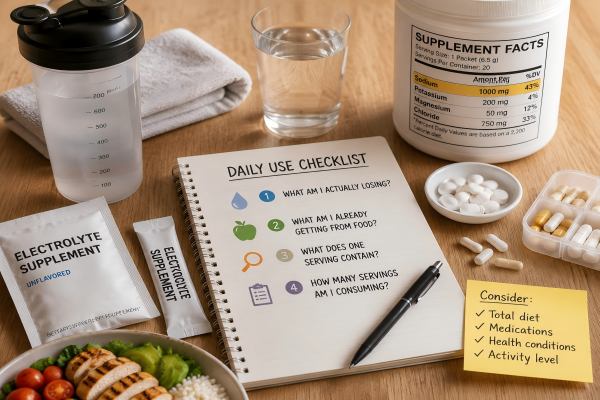
Electrolyte supplements can fit some daily routines, but daily use should be judged against total diet, mineral amounts, serving frequency, activity level, medications, and health conditions. Higher electrolyte doses are not automatically better. Sodium can accumulate quickly across food and drinks, supplemental magnesium has a separate adult upper limit, and potassium deserves additional caution when kidney function or certain medications are involved.
Sodium Can Add Up Quickly
One of the most important reasons to read an electrolyte label before making it a daily habit is that sodium amounts can vary enormously between products. Some formulas provide only modest amounts, while high-sodium products can deliver a substantial share of the FDA Daily Value in one serving.
A 1,000 mg sodium serving represents about 43% of the 2,300 mg Daily Value. Two servings provide 2,000 mg before accounting for sodium from bread, cheese, soups, sauces, snacks, restaurant meals, packaged foods, or other drinks. That total may be entirely different in meaning during a four-hour endurance event with major sweat losses than during a quiet office day.
This is why daily frequency alone does not answer the safety question. A low-sodium flavored electrolyte mix and a high-sodium endurance formula can both be consumed “once per day” while creating very different nutrient exposures.
People intentionally monitoring sodium intake should review actual milligrams rather than assuming every hydration product is nutritionally light. The word “electrolytes” does not mean a beverage can be added to an existing diet without considering the rest of the day’s mineral intake.
Magnesium Has a Supplemental Upper Limit
Magnesium illustrates the difference between obtaining a nutrient from food and consuming it in supplemental form. Adult magnesium requirements are generally in the range of roughly 310–420 mg per day depending on age and sex, but the tolerable upper intake level for magnesium specifically from supplements and medications is 350 mg per day for adults.
That 350 mg limit does not include magnesium naturally present in food. The distinction matters because consumers can easily combine several supplemental sources without realizing it. An electrolyte powder may be used alongside a magnesium capsule, multivitamin, sleep product, antacid, laxative, or another supplement containing magnesium.
Higher amounts of supplemental magnesium can cause gastrointestinal effects such as diarrhea, nausea, and abdominal cramping. People with impaired kidney function require additional caution because the kidneys play an important role in magnesium clearance.
A product containing 50 mg magnesium and one containing 200 mg therefore should not be described simply as “low” and “high” quality versions of the same thing. The appropriate amount depends on what else the person consumes and why the mineral is included in the formula.
Potassium and Medications Need Extra Care
Potassium is essential to normal cellular and electrical function, but potassium-containing supplements deserve additional care when kidney function or certain medications affect the body’s ability to regulate the mineral.
Some blood-pressure medications, including ACE inhibitors and angiotensin receptor blockers, can reduce urinary potassium loss. Potassium-sparing diuretics can also increase potassium retention. Other medications can affect sodium, magnesium, fluid balance, or kidney handling in different ways.
This is one reason a general supplement article should not assign personalized electrolyte targets to people managing medical conditions. Someone taking prescription medication, following a clinician-directed sodium or potassium plan, managing kidney disease, or dealing with another condition that affects mineral balance should obtain individualized advice rather than copying a sports influencer’s routine or a friend’s supplement schedule.
The same principle applies to pregnancy and nursing. The presence of familiar dietary minerals does not make every electrolyte formula automatically appropriate for every life stage because products can contain additional vitamins, herbal ingredients, caffeine, sweeteners, or other components beyond the electrolytes themselves.
Daily Use Should Have a Reason
For healthy adults with ordinary activity and a reasonably varied diet, there is little reason to assume an electrolyte supplement must be consumed every day. Normal food and water generally replace routine electrolyte losses. A more persuasive reason for regular use exists when someone’s routine repeatedly produces substantial sweat losses or when the product solves a genuine convenience problem.
Some people simply prefer flavored electrolyte water and find that it encourages them to drink more consistently. That can be a perfectly reasonable personal preference. It does not prove that plain water would have failed to hydrate them. Others may work long outdoor shifts, train for endurance events, or exercise repeatedly in hot conditions, making a structured replacement routine more relevant.
Before turning an electrolyte drink into a daily habit, ask four questions: What am I actually losing? What am I already getting from food? What does one serving contain? How many servings am I realistically consuming?
Those questions are more useful than asking whether electrolytes are “good” in the abstract. They also provide a better framework for comparing products, because a formula can be excellent for one situation and unnecessarily aggressive for another.
Conclusion
Electrolytes are essential nutrients, but electrolyte supplements are better understood as situational tools rather than universal daily requirements. Most healthy adults can replace routine losses through food and water, while deliberate supplementation becomes more useful when exercise, heat, prolonged sweating, repeated physical activity, or other substantial fluid losses change the equation. Looking at duration, sweat exposure, normal meals, and total daily mineral intake gives a much clearer answer than assuming every workout or every bottle of water needs added electrolytes.
When a supplement does make sense, the label should drive the decision. Compare sodium, potassium, magnesium, sugar, calories, sweeteners, serving size, preparation format, and expected number of servings against the actual use case. A high-sodium endurance formula, a lightly dosed daily hydration mix, and a carbohydrate sports drink can all be well designed while serving completely different people. The most useful product is therefore not the one with the biggest electrolyte number, but the one whose composition matches the reason you are using it.
Frequently Asked Questions
Do You Need Electrolytes Every Day?
Most healthy adults do not need a dedicated electrolyte supplement every day when they eat regular meals, drink adequate fluids, and are not experiencing substantial sweat or fluid losses. Sodium, potassium, magnesium, chloride, and calcium are already present in common foods. Daily supplementation becomes more relevant when someone’s routine repeatedly includes prolonged exercise, heavy sweating, hot working conditions, or other situations that create greater-than-normal replacement needs.
Is Water Better Than Electrolyte Drinks?
Neither option is universally better. Plain water is usually the more straightforward choice for ordinary daily hydration, short workouts, and situations in which normal meals provide sufficient minerals. Electrolyte drinks become more useful when water and minerals are being lost together for extended periods. The best choice depends on activity duration, heat exposure, sweat losses, diet, sugar preferences, and the sodium concentration of the specific product being considered.
How Long Do You Need to Exercise Before Electrolytes Become Useful?
Electrolytes become more relevant as exercise extends beyond roughly an hour, especially when activity is intense, the environment is hot or humid, or sweating is substantial. The clock alone does not determine the answer. A hard 50-minute outdoor workout in extreme heat can produce larger losses than a 90-minute gentle walk in cool weather, so duration should always be considered alongside actual sweat exposure and environmental conditions.
Can You Drink Electrolytes Without Working Out?
Yes. There is nothing about an electrolyte drink that requires exercise at the same time, and some people use these products because they enjoy the flavor or convenience. The more important question is whether the mineral profile fits the situation. A lightly dosed formula may fit ordinary use more naturally than a high-sodium endurance product, especially when the rest of the day’s diet already contains substantial sodium and other minerals.
What Happens If You Drink Too Many Electrolytes?
The effect depends on which minerals are consumed, how much is taken, and the person’s health status. Large amounts of sodium can substantially increase total daily sodium intake, while high supplemental magnesium may cause diarrhea, nausea, or abdominal discomfort. Potassium deserves additional caution in people with impaired kidney function or certain medication regimens. More electrolyte intake does not automatically produce better hydration, so total daily exposure should be considered.
Do Electrolyte Drinks Help in Hot Weather?
They can become useful when hot weather leads to prolonged or heavy sweating, particularly during extended outdoor work, endurance exercise, or repeated physical activity. For shorter periods of moderate activity, water and normal meals may still be sufficient. Heat increases fluid loss, but individual needs vary with workload, humidity, clothing, acclimatization, body size, and sweat rate, so hot weather alone does not automatically require a high-sodium product.
Which Electrolyte Is Most Important for Heavy Sweating?
Sodium usually deserves the closest attention when the goal is replacing minerals lost through substantial sweating because it is a major electrolyte present in sweat. That does not mean the product with the highest sodium amount is always the best choice. Potassium, magnesium, carbohydrates, water volume, serving frequency, and total dietary intake still matter, and the appropriate sodium amount for a long endurance session can be very different from what fits routine daily hydration.