

Two people can finish the same summer run with soaked shirts and still have very different hydration needs. One may lose a large amount of fluid every hour but have relatively dilute sweat. The other may sweat less yet leave obvious white salt marks on dark clothing because each liter contains considerably more sodium. Looking only at how wet someone appears can therefore hide the most important part of the story: sweat volume and sweat composition are separate measurements, and each can vary substantially from person to person.
A heavy sweater produces a relatively large volume of sweat, while a salty sweater has a relatively high sodium concentration in that sweat. These traits can occur separately or together. Total sodium loss depends on both variables: sweat rate in liters per hour multiplied by sweat sodium concentration in milligrams per liter, with exercise duration determining how large the cumulative loss becomes. Research reviews describe broad interindividual variation in both measurements.
That distinction becomes easier to appreciate during a long ride or run. Imagine two cyclists arriving at a rest stop after two hours in the heat. Both look equally drenched, yet one has lost far more fluid while the other has lost more sodium per liter. A useful hydration plan begins by separating those questions instead of placing everyone who sweats noticeably into the same category. Once that difference is clear, electrolyte labels, sweat tests, and personal hydration records become much easier to interpret.
What Is a Heavy Sweater?
A heavy sweater is someone who produces a comparatively large amount of sweat during a given activity and set of environmental conditions. The useful measurement is sweat rate, normally expressed in liters per hour. Heavy sweating describes fluid volume rather than sodium concentration, so someone can have a high sweat rate while producing sweat that is relatively low, moderate, or high in sodium.
What Is Sweat Rate?
Sweat rate describes how much fluid leaves the body through sweating over a defined period. In sports settings, it is commonly estimated from changes in body mass before and after exercise while accounting for fluid consumed and urine produced. A kilogram of acute body-mass change is often treated as approximately one liter of water for practical field estimation, although wet clothing, unrecorded drinks, and measurement conditions can introduce error. The number is most useful when it is attached to a specific workout rather than treated as a permanent personal characteristic.
One large athlete dataset helps show how wide the range can be. Baker and colleagues compiled data from 506 athletes and reported an average whole-body sweating rate of about 1.21 L/h, with a broad observed range from approximately 0.26 to 5.73 L/h. The study included athletes exercising in markedly different conditions, so the extreme values should not be turned into universal thresholds for classifying every active person. They do, however, demonstrate why a single generic hydration rule cannot accurately represent everyone.
| Sweat Measure | Research Context | What It Tells the Reader |
|---|---|---|
| Athletes in dataset | 506 | Large real-world athlete sample |
| Mean whole-body sweat rate | ~1.21 L/h | Useful population context, not a personal target |
| Observed sweat-rate range | ~0.26–5.73 L/h | Shows substantial person-to-person variation |
| Common review range | ~0.5–2.0 L/h | Frequently observed during exercise |
| Sweat sodium review range | ~10–90 mmol/L | Composition varies separately from fluid volume |
The figures above provide context rather than diagnostic cutoffs. A person sweating 1.3 L/h during a hard August run may be experiencing a very different physiological and environmental situation from someone recording the same rate during indoor cycling, football practice, or physically demanding outdoor work.
Which Factors Affect How Much You Sweat?
Sweat rate can change considerably with workload and environment. Harder exercise creates more metabolic heat, while air temperature, radiant heat, humidity, airflow, clothing, protective equipment, body size, and acclimatization influence how the body manages that heat. This is one reason an athlete may record a moderate sweat rate during a cool recovery session and a much higher number during a long race in humid summer conditions. Comparing sweat measurements without recording the surrounding conditions removes information that is essential to interpreting the number correctly.
Heat acclimatization also demonstrates that sweat volume and sweat composition can move in different directions. In a study involving 19 semiprofessional football players, six days of acclimatization in dry heat increased sweat rate by 34% during a standardized heat-exposure test while reducing sweat sodium concentration by 18%. The result does not mean every athlete will adapt by exactly those percentages, but it clearly shows that becoming a heavier sweater after heat adaptation does not necessarily mean each liter of sweat becomes saltier.
For personal tracking, the number becomes more useful when a few simple details are recorded beside it: workout duration, intensity, temperature, humidity, clothing, and whether the athlete is accustomed to the heat. Over time, several measurements can reveal a realistic range for cool sessions, hot sessions, long workouts, and race-like efforts. That kind of record usually provides more decision value than attaching a permanent label such as “I always sweat 1.5 liters per hour.”
Is Heavy Sweating the Same as Salty Sweating?
Heavy sweating and salty sweating are not the same thing because they describe different variables. Consider a hypothetical athlete who sweats at 1.5 L/h with 500 mg sodium/L. Estimated sodium loss is 750 mg/h. Another athlete sweats only 0.8 L/h but has 1,200 mg sodium/L, producing an estimated sodium loss of 960 mg/h. The first athlete loses more fluid, but the second loses more sodium each hour despite sweating almost half as much.
This distinction is especially important when comparing electrolyte supplements. A soaked shirt does not automatically justify choosing the highest-sodium formula available. Sodium per serving is a characteristic of a product; sweat sodium loss is a characteristic of the person and activity. A responsible product comparison therefore considers sodium alongside serving size, mixing volume, sugar, sweeteners, other electrolytes, duration of activity, and intended use rather than awarding the largest mineral number an automatic advantage.
NutriReviewLab’s documented electrolyte-review framework follows a similar principle by separating electrolyte profile from sugar and sweetener profile, ingredient transparency, use-case fit, price per serving, and other decision factors. The purpose is to make label comparisons useful without turning a single nutrient number into a universal quality score.
What Is a Salty Sweater?
A salty sweater has a comparatively high concentration of sodium in sweat. Sweat sodium concentration is generally expressed in millimoles per liter or milligrams per liter and is separate from the amount of sweat produced. There is no single universally accepted consumer threshold that defines every “salty sweater,” so the measured value and resulting total sodium loss are more informative than the nickname alone.
What Is Sweat Sodium Concentration?
Sweat sodium concentration tells you how much sodium is present in a specific volume of sweat. Converting units can help make research numbers easier to understand because 1 mmol of sodium is approximately 23 mg. A sweat sodium concentration of 20 mmol/L is therefore about 460 mg/L, while 60 mmol/L is roughly 1,380 mg/L. Sports-science reviews describe substantial variation between athletes, with values commonly discussed across a broad range rather than around one universal “normal” concentration.
Research using larger datasets supports that variability. A 2022 analysis included 1,944 sweat tests from 1,304 individuals and found that the statistical models examined explained only 17%–23% of the variation in whole-body sweat sodium concentration. Energy expenditure and season were among the more influential factors, while many characteristics that might seem intuitively predictive contributed little or nothing in the models. The result is a useful reminder that body size, age, workout type, or appearance cannot accurately predict an individual sweat sodium value on their own.
Some studies create categories for a particular research purpose. In one marathon study, runners were categorized as below 30 mmol/L, between 30 and under 60 mmol/L, or at least 60 mmol/L of sweat sodium. Those thresholds help interpret that specific research sample but should not be treated as universal clinical categories or automatic supplement-dosing rules for every athlete.
What Are Common Signs of Salty Sweat?
White residue on dark clothing, visible salt crystals on the skin, gritty-feeling dried sweat, or noticeable salt accumulation around a hat band can suggest that meaningful sodium has been left behind after sweat water evaporates. These observations can be useful because they draw attention to a person’s repeated sweat pattern, but they cannot reveal the exact concentration. A shirt cannot tell the difference between 500 mg and 1,200 mg sodium per liter with any reliable precision.
The reason becomes clear when total volume is considered. A person producing two liters of moderately salty sweat can leave more total sodium on clothing than someone producing half a liter of highly concentrated sweat. Fabric, evaporation, workout duration, airflow, and repeated wetting of the same area also affect how much residue becomes visible after exercise. Salt marks are therefore best treated as a clue that supports further observation rather than as a substitute for quantitative testing.
The same caution applies to sensations such as sweat stinging the eyes or tasting especially salty. Those experiences confirm that sweat contains dissolved electrolytes but cannot translate the sensation into an exact mg/L value. For consumers choosing among electrolyte powders, such signs may justify paying closer attention to sodium levels and activity duration, but they do not establish a precise personal requirement.
Are All Salty Sweaters Heavy Sweaters?
No. A person can produce relatively little sweat that happens to contain a high sodium concentration, while another person can produce a large amount of comparatively dilute sweat. Large athlete datasets specifically measure whole-body sweating rate and sweat sodium concentration as separate variables because one cannot be reliably substituted for the other. Data from 1,303 athletes have been used to establish sport-specific reference information for sweating rate, sweat sodium concentration, and the resulting rate of sodium loss.
This creates four useful combinations: lower sweat volume with lower sodium concentration, high sweat volume with lower concentration, lower sweat volume with higher concentration, and high volume combined with higher concentration. The fourth profile can produce especially large hourly sodium losses because both parts of the equation are elevated, but even this description remains dependent on exercise duration and conditions.
The distinction also protects consumers from oversimplified product messaging. “For salty sweaters” can be a useful positioning phrase, but the useful comparison starts with the actual Supplement Facts panel and a realistic picture of the person’s losses. A formula containing 1,000 mg sodium is not automatically more appropriate than one containing 300 or 500 mg unless the higher amount matches the intended activity, dietary context, and individual circumstances.
How Are Heavy and Salty Sweaters Different?
Heavy and salty sweaters differ in the measurement being described: heavy refers to the volume of sweat produced, while salty refers to the sodium concentration within that sweat. Neither value alone determines total sodium loss. Multiplying sweat rate by sweat sodium concentration provides a more useful estimate of hourly sodium loss and explains why the wettest athlete is not always the largest sodium loser.
Which Matters More: Sweat Volume or Sweat Sodium?
The answer depends on what you are trying to understand. Sweat volume matters directly when estimating fluid loss. Sodium concentration matters when estimating how much sodium exists within each liter. If the goal is to understand total sodium loss per hour, both measurements are necessary. A person sweating 1.5 L/h at 500 mg/L loses an estimated 750 mg sodium per hour, while someone at 0.6 L/h and the same concentration loses only 300 mg per hour.
Holding sweat volume constant produces the opposite lesson. At 1.0 L/h, someone with sweat sodium of 400 mg/L loses about 400 mg sodium per hour, whereas someone at 1,200 mg/L loses approximately three times that amount. These examples are mathematical illustrations rather than replacement recommendations, but they show why neither fluid volume nor sodium concentration should be treated as the complete story.
This distinction becomes particularly useful at the supplement shelf. A product providing 1,000 mg sodium per serving contains four times as much sodium as a 250 mg formula, but the larger number does not automatically mean higher product quality. It may simply indicate a different intended use. Product comparisons become more useful when nutrient amounts are interpreted alongside mixing instructions, carbohydrate content, serving frequency, activity duration, and the user’s likely losses.
Can You Be Both a Heavy and Salty Sweater?
Yes. Someone can have both a high sweat rate and high sweat sodium concentration, which can produce substantial hourly sodium losses during prolonged exercise. Research involving more than a thousand athletes shows wide interindividual variation across both sweating rate and sweat sodium concentration, reinforcing the usefulness of measuring the two separately rather than assuming one from the other.
The table below uses hypothetical values for illustration. They are not recommended intake targets, but the arithmetic makes the interaction easy to see.
| Example Sweat Profile | Sweat Rate | Sweat Sodium | Estimated Sodium Loss |
|---|---|---|---|
| Lower volume + lower sodium | 0.6 L/h | 400 mg/L | 240 mg/h |
| Heavy + lower sodium | 1.5 L/h | 500 mg/L | 750 mg/h |
| Lower volume + salty | 0.7 L/h | 1,400 mg/L | 980 mg/h |
| Heavy + salty | 1.5 L/h | 1,400 mg/L | 2,100 mg/h |
The comparison highlights two common mistakes. First, the third example loses more sodium per hour than the second despite producing less than half as much sweat. Second, the fourth example has exactly the same sweat volume as the second but almost three times the sodium loss because concentration is much higher. Descriptive labels become much more useful once they are translated into measurable variables.
Which Type Can Lose More Sodium?
Either type can lose more sodium depending on the numbers. The useful equation is sweat rate in liters per hour × sodium concentration in milligrams per liter = estimated sodium loss in milligrams per hour. Exercise duration then determines how long that loss accumulates. Someone losing an estimated 900 mg/h over 30 minutes would lose about 450 mg during the session, while the same hourly rate continued for four hours would produce a calculated total of approximately 3,600 mg.
Those calculations describe loss rather than a direct instruction to replace every milligram during exercise. Sodium consumed through meals, fluid consumed before and during activity, the duration of the session, and individual health considerations all influence how a loss estimate should be interpreted. Sports-nutrition reviews emphasize that sweat testing can help guide individualized fluid and electrolyte planning when collection and interpretation are performed appropriately.
For readers comparing products, this is the point where “high sodium” becomes a meaningful specification instead of a marketing adjective. The better question is not whether a formula contains a large amount of sodium, but whether that amount makes sense for the person, the session, and the likely scale of losses.
How Can You Tell Which Type of Sweater You Are?
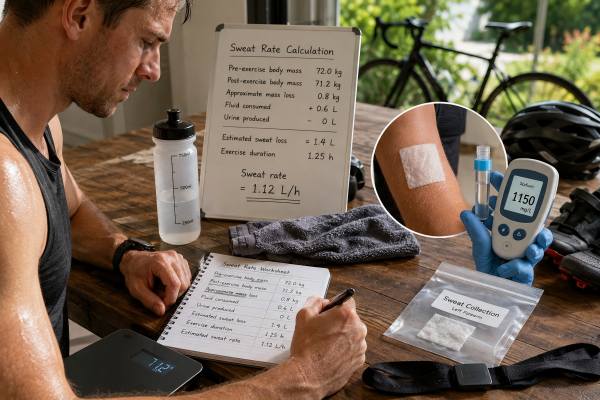
Start by estimating sweat rate during a representative workout using pre- and post-exercise body weight together with recorded fluid intake and urine output. Sweat sodium concentration requires a separate collection and analysis method if you want a quantitative value. Visible salt marks can provide clues but cannot accurately measure concentration. Repeating sweat-rate measurements under different conditions gives a more useful personal picture than relying on one workout.
How Do You Measure Your Sweat Rate?
A practical field estimate begins with body mass before exercise, body mass after exercise, drinks consumed, urine produced, and session duration. The goal is to account for fluid that left the body while separating it from fluid that entered during the workout. Sports-science reviews recognize body-mass change as a practical approach to estimating sweating rate when measurements are collected carefully and interpreted within the conditions in which they were taken.
Consider an athlete who weighs 72.0 kg before a 75-minute run and 71.2 kg afterward. During the session, the runner consumes 600 mL of fluid and does not urinate. Approximate body-mass loss is 0.8 kg, treated for field calculation as roughly 0.8 L of fluid. Adding the 0.6 L consumed produces an estimated sweat loss of 1.4 L over 1.25 hours, or approximately 1.12 L/h.
| Sweat-Rate Worksheet | Example Value |
|---|---|
| Pre-exercise body mass | 72.0 kg |
| Post-exercise body mass | 71.2 kg |
| Approximate mass loss | 0.8 kg |
| Fluid consumed | 0.6 L |
| Urine produced | 0 L |
| Estimated sweat loss | 1.4 L |
| Exercise duration | 1.25 h |
| Estimated sweat rate | 1.12 L/h |
Accuracy improves when the same scale is used, drinks are measured instead of guessed, wet clothing is minimized during the post-exercise weighing, and weather and workout intensity are recorded. The result should be viewed as a session-specific estimate rather than a permanent number that applies to every workout.
How Is Sweat Sodium Measured?
Sweat sodium testing requires a sample of sweat and an analytical method capable of measuring sodium concentration. Research approaches include whole-body washdown techniques and regional collection using absorbent patches. Regional testing is much more convenient in the field, but measurements taken from a forearm, upper arm, chest, or back may not be identical to the whole-body average. This is one reason testing method and sampling location matter when interpreting a seemingly precise sodium result.
Large athlete studies have often used standardized regional sweat collection and prediction methods to estimate whole-body values. The 1,303-athlete normative dataset, for example, used standardized absorbent patch techniques and normalized local sweat sodium measurements to whole-body estimates. Those methods are useful for research and applied sports settings, but consumers should be cautious about assuming every wearable sensor or commercial test uses an equivalent validation process.
A result displayed as “1,150 mg/L” may look highly precise, yet the useful question is how the sample was collected, whether contamination and evaporation were controlled, where on the body the sample came from, and how the system was validated. Precision in the displayed number is not automatically the same as accuracy in the underlying measurement.
Are Salt Stains Enough to Identify a Salty Sweater?
Salt stains are useful observations but insufficient for identifying an exact sweat sodium concentration. Suppose Runner A produces 2.0 L of sweat containing 600 mg sodium per liter, while Runner B produces 0.7 L containing 1,200 mg/L. Runner A deposits about 1,200 mg of sodium across the total sweat, while Runner B deposits about 840 mg. The first athlete could leave more visible residue even though the second person’s sweat is twice as concentrated.
Workout duration, fabric type, evaporation, repeated wetting, humidity, and the areas where sweat collects can all influence what is visible after exercise. This is why a white collar, salty cap, or gritty forehead is better interpreted as evidence that sodium is being lost rather than proof that the individual falls into a precise numerical category.
A repeated pattern still has value. Someone who consistently leaves significant salt residue after long sessions may reasonably decide that sodium deserves closer attention when reviewing hydration products or discussing a plan with a qualified sports professional. The mistake is jumping directly from “I see salt marks” to an exact personal sodium prescription.
Should You Test More Than Once?
Repeated testing is particularly valuable for sweat rate because conditions can change the number considerably. A cool 45-minute run, indoor spin class, humid summer race, and long outdoor work shift do not create the same thermal load. The 2012 heat-acclimatization study is a useful example: after six days in dry heat, the athletes’ standardized sweat rate rose 34%, while their sweat sodium concentration decreased 18%. One measurement taken before adaptation would not have described the later response accurately.
A personal record becomes more useful when it contains several representative conditions. Rather than chasing one “perfect” value, look for patterns such as 0.8–1.0 L/h during cool easy workouts and 1.3–1.6 L/h during hot, demanding sessions. Those ranges can provide a more realistic starting point for planning fluids and comparing electrolyte products.
Sweating that appears unexpectedly excessive at rest, changes abruptly without a clear heat or exercise trigger, or occurs alongside concerning symptoms falls outside the normal sports-hydration discussion. In those situations, a qualified healthcare professional is more appropriate than trying to solve the issue by simply adding more electrolyte supplements.
How Do Sweat Rate and Sodium Concentration Affect Sodium Loss?
Sweat rate determines how much fluid is lost, while sweat sodium concentration determines how much sodium each liter contains. Multiplying those values estimates sodium loss per hour, and multiplying again by exercise duration estimates cumulative loss. Heat, workload, and acclimatization can change the underlying measurements, so sodium-loss estimates are most useful when tied to a specific type of activity and environment.
How Is Sweat Sodium Loss Calculated?
The calculation becomes straightforward once both measurements are available. A cyclist sweating 1.2 L/h with a sweat sodium concentration of 900 mg/L has an estimated sodium loss of 1,080 mg/h. If similar conditions continued for three hours, the arithmetic total would reach approximately 3,240 mg. The calculation is useful because it converts separate fluid and concentration measurements into a number that can be compared across different sessions.
That number should still be interpreted as an estimate of what left the body rather than a command to consume an identical amount immediately. Exercise begins with sodium and water already distributed throughout body-fluid compartments, and sodium also comes from food and drinks consumed before, during, and after activity. How much of an estimated loss should be replaced during a particular session depends on duration, intensity, fluid strategy, food intake, individual tolerance, and health circumstances.
The calculation is most helpful as a scale indicator. Someone estimated to lose 300 mg/h is facing a different situation from someone near 1,500 mg/h during a four-hour event. Understanding the difference allows an athlete to read electrolyte labels with context rather than treating every formula as interchangeable.
Which Sweat Profile Produces the Highest Loss?
The largest calculated sodium losses generally occur when high sweat rate and high sodium concentration occur together over a long duration. For example, 1.6 L/h × 1,300 mg/L equals an estimated 2,080 mg sodium per hour. If that rate were maintained for three hours, the mathematical total would be roughly 6,240 mg. By contrast, 0.7 L/h at 500 mg/L produces about 350 mg/h, or 1,050 mg over the same period.
These examples demonstrate the multiplication effect but should not be mistaken for target intakes. Real sweat rates can change as exercise intensity, temperature, clothing, and acclimatization change. Research involving 1,303 athletes found substantial sport-specific and individual variation in sweating rate, sodium concentration, and sodium-loss rate, which helps explain why fixed one-size-fits-all numbers perform poorly when applied across different sports and environments.
For endurance athletes, outdoor workers, or people training in prolonged heat, duration often turns a moderate hourly loss into a much larger cumulative number. That is where a seemingly small difference between two electrolyte formulas can become more relevant, especially when repeated servings are used over several hours.
How Do Heat and Exercise Duration Change Losses?
Duration is the simplest multiplier. An hourly loss continued for three hours creates approximately three times the cumulative loss of one hour if sweat rate and sodium concentration remain similar. Real exercise is less tidy because intensity, airflow, temperature, hydration status, and pacing can change during the session, but the principle explains why electrolyte planning becomes more relevant during long events than during a short routine workout.
Heat can increase the demand for evaporative cooling and often raises sweat production, yet heat exposure does not mean sodium concentration must rise. Heat acclimatization may increase sweat rate while improving sodium conservation. The football study showing a 34% increase in sweat rate and an 18% decrease in sodium concentration after six days is a useful illustration of how the two variables can move in opposite directions.
The 2022 analysis of 1,944 sweat tests adds another layer. Warmer months, used as a proxy for heat acclimatization, were associated with lower whole-body sweat sodium concentration, while energy expenditure was among the more important predictors in the study models. Even so, the models explained only 17%–23% of overall variation, reinforcing how difficult it is to predict an individual value from environment and demographics alone.
Is More Sodium Always Better?
More sodium is not automatically better because sodium quantity is a specification, not a universal quality score. A formula providing 1,000 mg per serving contains four times as much sodium as one providing 250 mg, but the two may be designed for very different situations. A long, hot endurance session and a light everyday hydration routine do not create the same fluid or electrolyte context.
This matters when reading product reviews. A useful comparison should consider sodium amount together with water-mixing instructions, serving size, potassium, magnesium, sugar, carbohydrate, sweetener type, price, flavor, and intended use. A product can be well formulated for one group and unnecessarily sodium-heavy for another. NutriReviewLab’s documented review methodology likewise emphasizes consistent fields and use-case fit rather than assuming that the largest dose is always the strongest option.
People who have been advised to monitor sodium intake, are pregnant or nursing, take medication that may affect fluid or electrolyte balance, or manage a medical condition should seek individualized guidance from a qualified healthcare professional before adopting a high-sodium supplement routine. This educational framework is intended to help readers understand labels and exercise losses, not provide individualized medical advice.
How Should Heavy and Salty Sweaters Approach Hydration?
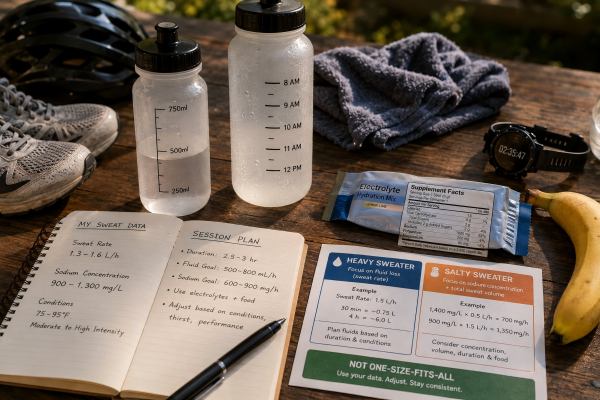
Heavy sweaters should first understand their fluid-loss range, while salty sweaters should consider sodium concentration together with total sweat volume. During prolonged or hot activity, both variables become more important. A useful hydration approach does not reduce the problem to “drink more water” or “take more salt”; it compares personal losses, session duration, food intake, and the actual composition of the electrolyte product being considered.
Do Heavy Sweaters Need More Fluid?
Someone sweating at 1.5 L/h loses fluid more rapidly than someone at 0.5 L/h, so fluid planning generally becomes more important as sweat rate and exercise duration rise. What does not follow is that the heavier sweater must consume exactly the same volume every hour regardless of temperature, stomach comfort, food, pacing, and access to drinks. Sweat-rate measurements work better as a realistic reference range than as a rigid drinking command.
Duration changes the practical meaning of the same number. A sweat rate of 1.2 L/h maintained for 30 minutes represents roughly 0.6 L of estimated sweat, whereas four hours at the same rate would reach about 4.8 L. This helps explain why a short gym session and a long summer ride should not be treated as equivalent hydration problems simply because the same person is involved.
Overdrinking is also not a desirable goal. Sports-hydration guidance has long emphasized matching fluid intake to realistic needs rather than assuming more is always better, particularly during prolonged events. The useful approach is to learn a personal range under representative conditions, monitor how the plan works in practice, and avoid turning an estimate into a rule that overrides thirst, comfort, and changing environmental conditions.
Do Salty Sweaters Need More Sodium?
Higher sweat sodium concentration increases the amount of sodium lost in every liter, but the total still depends on sweat volume. A person at 1,400 mg/L who sweats 0.5 L/h loses an estimated 700 mg/h. Another person at only 900 mg/L who sweats 1.5 L/h loses approximately 1,350 mg/h. The first person has saltier sweat, yet the second loses nearly twice as much sodium per hour because substantially more fluid is being produced.
For short sessions in mild conditions, normal meals and fluids may cover much of what was lost without an elaborate sodium strategy. As activity extends for several hours, particularly in the heat, measured or estimated sodium-loss patterns become more relevant when choosing among products containing very different sodium amounts. The key comparison is not simply “high sodium versus low sodium,” but how a serving fits the size and duration of the expected losses.
A salty-sweater label is therefore most helpful when it leads to better questions: How salty? How much sweat per hour? How long is the session? What other sodium will be consumed? Those questions create a much stronger basis for deciding whether a concentrated electrolyte product is appropriate.
Do All Heavy Sweaters Need High-Sodium Electrolytes?
No. High sweat rate confirms that a person loses a large amount of fluid, but it does not reveal how much sodium is contained in each liter. Research datasets consistently show broad variation in both measurements, which makes it unreliable to assume that someone with a completely soaked shirt automatically belongs at the high end of the sodium spectrum.
A heavy sweater whose sodium concentration is relatively low can lose less sodium per hour than a moderate sweater whose sweat is much more concentrated. Conversely, a person who does not appear dramatically sweaty can still have relatively salty sweat. This is why sweat rate should inform fluid planning first, while sodium concentration—when known—adds another layer for electrolyte planning.
When sodium concentration has not been measured, conservative and context-based interpretation is preferable to pretending an exact requirement has been established. Product labels can still be compared by sodium amount, but the number should be treated as part of a range of options rather than a personalized prescription.
Which Electrolyte Label Details Matter Most?
Electrolyte packaging often emphasizes a single headline such as zero sugar, hydration, or a large sodium number, but the Supplement Facts panel and mixing instructions contain the details needed for a meaningful comparison. Readers evaluating products for heavy or salty sweating should pay particular attention to sodium per serving and finished-drink volume, then consider the remaining formula in relation to the intended activity.
| Label Detail | What to Check | How It Helps |
|---|---|---|
| Sodium | mg per serving | Allows comparison with likely sweat sodium losses |
| Mixing volume | mL or fl oz | Shows how concentrated the finished drink will be |
| Serving size | Packet, scoop, tablet | Prevents unequal serving comparisons |
| Potassium | mg per serving | Adds context to the electrolyte profile |
| Magnesium | mg per serving | Useful secondary mineral field |
| Sugar / added sugar | g per serving | Distinguishes hydration from carbohydrate-fueling needs |
| Total carbohydrate | g per serving | Relevant for long endurance sessions |
| Sweetener type | Sugar, stevia, sucralose, etc. | Can affect taste and repeat use |
| Servings per container | Number of servings | Needed for cost-per-serving calculations |
| Directions | Water volume and use instructions | Shows how the labeled dose is intended to be consumed |
A robust supplement comparison also checks whether the label belongs to the current U.S. SKU, whether ingredient amounts are clearly disclosed, and whether pricing and product information have a stated collection date. NutriReviewLab’s editorial rules require verifiable product information, clear limitations, consistent comparison fields, and separation between editorial evaluation and commercial relationships. Those safeguards matter because electrolyte products can differ substantially in sodium, sugar, packaging, intended use, and price even when every option is marketed under the same broad “hydration” category.
Conclusion
A heavy sweater and a salty sweater are not two names for the same thing. Heavy sweating describes how much fluid is produced, while salty sweating describes how much sodium is present in each liter. Someone can fall high on one measurement and low on the other, or high on both. The most informative estimate of sodium loss therefore combines sweat rate, sweat sodium concentration, and exercise duration instead of relying on wet clothing or visible salt residue alone.
For most active adults, the goal is not to chase the highest sodium number on an electrolyte label. It is to understand the conditions in which losses become meaningful and compare products accordingly. A measured or reasonably estimated sweat rate, a careful reading of sodium per serving, and realistic consideration of workout duration can turn a vague “heavy versus salty” label into a much more useful hydration framework.
Frequently Asked Questions
How Do I Know If I Am a Heavy Sweater?
The most useful way to determine whether you sweat heavily is to estimate your sweat rate during representative workouts. Weigh yourself before and after exercise, record how much you drink, account for urine if applicable, and divide the estimated sweat loss by exercise duration. Repeating the calculation in cool, hot, easy, and demanding conditions is more informative than judging sweat rate from a wet shirt alone because evaporation, humidity, clothing, and workout intensity all affect how sweaty someone appears.
How Do I Know If I Am a Salty Sweater?
Visible white salt marks, gritty skin, or repeated salt residue after long workouts can suggest that meaningful sodium is being lost, but those clues cannot determine an exact sodium concentration. A quantitative answer requires sweat collection and sodium analysis using an appropriate method. Regional patch tests can be useful when properly validated and interpreted, although measurements from one body site are not automatically identical to whole-body sweat composition. The practical focus should remain on concentration together with total sweat volume.
Can You Be a Heavy Sweater Without Being a Salty Sweater?
Yes. Sweat rate and sweat sodium concentration are separate measurements, so a person can produce a large volume of relatively dilute sweat. Heat acclimatization provides a useful real-world example of how those variables can move independently: in one football study, six days of heat acclimatization increased sweat rate by 34% while reducing sweat sodium concentration by 18%. A person can therefore become a heavier sweater under certain conditions without becoming saltier per liter of sweat.
How Much Sodium Is Usually Found in Sweat?
Sweat sodium concentration varies widely among individuals, and there is no single number that accurately represents everyone. A major sports-science review discusses values commonly spanning roughly 10–90 mmol/L, which converts to approximately 230–2,070 mg sodium per liter. Individual measurements can vary with physiology, workload, environment, acclimatization, and testing method. Population ranges are useful for context, but they should not be converted directly into a personal supplementation target without considering sweat volume and exercise duration.
Do Heavy Sweaters Need Electrolytes Every Time They Exercise?
Not necessarily. A high sweat rate makes fluid and electrolyte losses more relevant, but duration and conditions determine how much those losses accumulate. A short, cool workout can produce a very different total loss from a three-hour session in summer heat. Food and normal fluids also contribute sodium and other electrolytes. Rather than assuming every sweaty workout requires a high-sodium product, compare the session length, personal sweat pattern, diet, and actual product label before deciding what fits the situation.
Is a High-Sodium Electrolyte Powder Better for Salty Sweaters?
A higher-sodium formula may be worth considering when someone has substantial sodium losses during prolonged activity, but “more sodium” is not automatically better. A 1,000 mg serving and a 300 mg serving are designed around very different quantities, and suitability depends on sweat volume, sodium concentration, session duration, other food and fluid intake, and individual health considerations. Product quality should also be judged by serving instructions, label transparency, sugar, other electrolytes, taste, and overall use-case fit rather than sodium alone.
Can Sweat Rate Change From Season to Season?
Yes. Sweat responses can change as temperature, workload, clothing, fitness, and heat acclimatization change. Research examining 1,944 sweat tests found that season was associated with whole-body sweat sodium concentration, while a separate heat-acclimatization study showed that repeated heat exposure could increase sweat rate and reduce sodium concentration. For practical planning, it makes sense to repeat sweat-rate measurements when moving from cool-season training into hot summer conditions rather than assuming a number recorded months earlier will remain unchanged.