
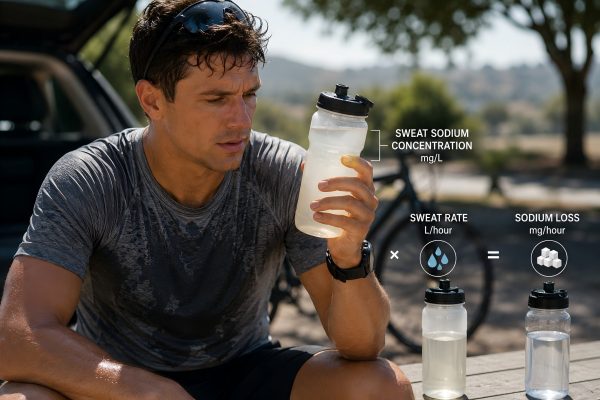
A white crust on a running shirt can make sweat sodium seem easy to understand: the more salt you can see, the more sodium you must be losing. Human sweating is not quite that simple. Two people can complete the same workout, finish with equally soaked clothing, and still lose very different amounts of sodium because sweat concentration and total sweat volume are separate variables. Published sports-science research consistently shows large differences in both sweat rate and sweat sodium concentration between athletes, making a single universal number a poor description of everyone’s needs.
Sweat sodium concentration is the amount of sodium contained in a given volume of sweat, usually expressed in milligrams per liter (mg/L) or millimoles per liter (mmol/L). It describes how sodium-rich the sweat is, but it does not show total sodium loss by itself. Total loss also depends on how much a person sweats and how long the sweating continues.
That distinction becomes surprisingly useful once real numbers enter the conversation. Someone whose sweat contains 600 mg/L of sodium but who sweats 2.0 L per hour can lose more sodium each hour than someone testing at 1,000 mg/L who produces only 0.7 L of sweat. Understanding concentration, sweat rate, and sodium loss as three separate measurements turns an isolated test result into something that can actually be interpreted—and prevents a product label from being mistaken for a personalized hydration prescription.
What Is Sweat Sodium Concentration?
Sweat sodium concentration describes how much sodium is present in a specific volume of sweat. It is commonly reported in mg/L or mmol/L. Athlete research has reported regional values spanning roughly 10–90 mmol/L, showing that sweat chemistry varies substantially between individuals. Concentration describes the composition of sweat, not the total amount of sodium lost during an exercise session.
What Does mg/L Mean?
The abbreviation mg/L means milligrams per liter. If a sweat analysis reports 800 mg/L of sodium, the result means that one liter of sweat with the same average composition contains approximately 800 milligrams of sodium. It does not mean the person loses 800 mg every hour, because hourly sodium loss also depends on whether that person produces 0.4, 1.0, 1.5, or more liters of sweat during that hour. The unit therefore describes concentration rather than time-based loss.
Scientific papers frequently report the same measurement in mmol/L. Because sodium has a molar mass of approximately 22.99 grams per mole, 1 mmol/L of sodium is approximately 23 mg/L. A value of 40 mmol/L is therefore roughly 920 mg/L, while 60 mmol/L is approximately 1,380 mg/L. These numbers describe the same underlying measurement in different units, which is important when comparing a research paper with a commercial sweat report or consumer hydration guide.
| Sweat Sodium | Approx. mg/L | What the Number Represents |
|---|---|---|
| 20 mmol/L | 460 mg/L | About 460 mg sodium per liter of sweat |
| 40 mmol/L | 920 mg/L | About 920 mg sodium per liter of sweat |
| 60 mmol/L | 1,380 mg/L | About 1,380 mg sodium per liter of sweat |
| 80 mmol/L | 1,840 mg/L | About 1,840 mg sodium per liter of sweat |
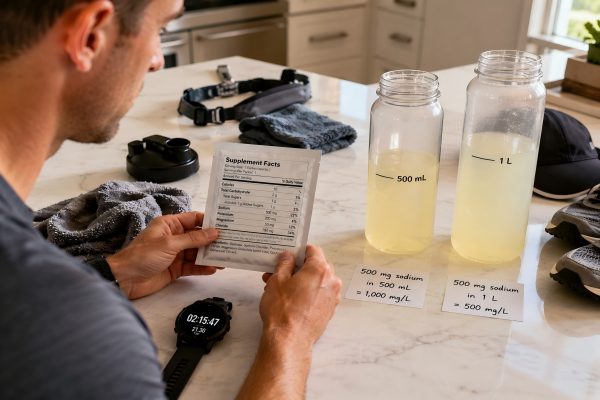
The unit difference matters when electrolyte supplements enter the discussion. U.S. Nutrition Facts and Supplement Facts panels normally present sodium as milligrams per serving, whereas a sweat report commonly presents sodium as milligrams per liter. Those two figures should not be compared as though they were identical. A serving tells you how much sodium the product supplies; a sweat concentration tells you how much sodium is contained in a measured volume of sweat.
Is Sweat Sodium the Same as Salt?
Sodium and salt are closely related, but they are not interchangeable measurements. Table salt is sodium chloride, or NaCl, and sodium represents about 39% of sodium chloride by mass. Chemically, 1,000 mg of sodium corresponds to approximately 2,540 mg of sodium chloride. Sweat, however, is not simply table salt dissolved in water, because it contains several ions and other dissolved substances rather than pure sodium chloride alone.
This distinction prevents a common reading error. A study may report sodium concentration, another source may discuss chloride, and a consumer article may casually describe “salt loss.” Those values cannot be compared until the units and substances are clarified. For supplement shoppers, the most reliable figure is usually the actual sodium per serving shown on the label, while “salt” language should be treated as a broader description unless a precise conversion is provided.
Which Electrolytes Are Lost in Sweat?
Sodium and chloride are the major electrolytes emphasized in exercise-sweat research, while potassium is also present and magnesium and calcium generally occur in lower concentrations. Sweat composition is not fixed, and concentration can vary with the individual, body site, sweat rate, environmental conditions, heat adaptation, and collection method. That variability is one reason sports-science reviews caution against assuming that one universal sweat composition represents every person.
From a supplement perspective, the presence of four or five named electrolytes on the front of a package does not automatically make the formula better suited to sweat replacement. The actual quantities matter much more. A few milligrams of one mineral and several hundred milligrams of another are not nutritionally equivalent simply because both appear in an “electrolyte complex.” NutriReviewLab’s editorial framework therefore emphasizes transparent label amounts and consistent comparison fields rather than rewarding a longer ingredient list on its own.
What Is a Normal Sweat Sodium Concentration?
There is no single sweat sodium concentration that is normal for everyone. Regional measurements in athlete research commonly fall within a broad range of roughly 10–90 mmol/L, or about 230–2,070 mg/L. Large studies also show substantial differences between athletes, so an individual value is better interpreted within a distribution than against one universal “ideal” sweat sodium number.
What Range Is Common in Athletes?
A useful example comes from research involving 696 professional male team-sport athletes. Regional sweat sodium concentrations ranged from 17 to 92 mmol/L, with a group mean of 46.4 ± 13.6 mmol/L. Converted to mass units, the average is approximately 1,067 mg/L, while the reported range extends from roughly 390 mg/L to more than 2,100 mg/L. The spread is more informative than the average because it shows how different athletes can be under real testing conditions.
Other athlete datasets tell a similar story. Research involving tropical runners reported predicted whole-body sweat sodium values between 11 and 80 mmol/L, while the 2017 methodology review summarized regional values of approximately 10–90 mmol/L. These numbers are useful reference ranges, but they are not diagnostic categories and do not identify an ideal concentration that every athlete should try to achieve.
| Sweat Sodium Example | Approx. mmol/L | Useful Context |
|---|---|---|
| 400 mg/L | 17 mmol/L | Lower end of some published athlete datasets |
| 800 mg/L | 35 mmol/L | Within commonly observed athlete values |
| 1,000 mg/L | 43.5 mmol/L | Near the middle of several published distributions |
| 1,500 mg/L | 65 mmol/L | Higher, but still within documented athlete ranges |
| 2,000 mg/L | 87 mmol/L | Near the upper end of many regional datasets |
These figures are reference points rather than medical cutoffs or automatic electrolyte-intake targets. A value at the upper end of an athlete dataset does not by itself indicate a health problem, just as a lower concentration does not prove that a person needs less attention to hydration. The practical meaning changes once sweat volume, exercise duration, weather, food, fluid intake, and testing method are added to the picture.
Is 1,000 mg/L High?
A sweat sodium concentration of 1,000 mg/L is approximately 43.5 mmol/L. That value sits comfortably within ranges reported in athlete research and is close to the average reported in the study of 696 professional team-sport athletes. Calling 1,000 mg/L simply “high” would therefore remove useful context, particularly because regional testing methods and athletic populations differ.
The more important calculation begins with sweat rate. At a concentration of 1,000 mg/L, someone sweating 0.6 L/h would have an estimated sodium loss of approximately 600 mg/h, while someone sweating 1.5 L/h would lose approximately 1,500 mg/h. The concentration is identical, but the second person loses two and a half times as much sodium each hour. This is the clearest reason not to convert a sweat-test concentration directly into an hourly supplement dose.
What Is a Salty Sweater?
“Salty sweater” is a useful everyday phrase rather than a universally standardized scientific classification. In one study of amateur marathon runners, approximately 80% had sweat sodium concentrations below 60 mmol/L, while about 20% were categorized by the researchers as salty sweaters and had greater salt losses. That threshold belongs to the study design and should not be turned into a universal definition for every athlete, environment, or testing protocol.
White residue on dark clothing, visible crystals on the skin, or noticeably salty sweat can indicate that minerals remain after water evaporates, but these signs cannot quantify concentration. A high-volume sweater with a moderate concentration may leave more visible residue than a low-volume sweater with a higher concentration. Clothing material, evaporation, repeated sweating, humidity, and how much sweat reaches the fabric all affect what a person sees after exercise.
Is Higher Sweat Sodium Better or Worse?
Higher sweat sodium concentration is not a quality score. It does not automatically mean someone is better trained, poorly hydrated, healthier, or in greater need of a high-sodium product. It simply means that more sodium is present in each liter of measured sweat under the testing conditions. Reviews of athlete data show that substantial between-person variation is expected and can be influenced by multiple physiological and environmental factors.
The same logic should be applied when comparing electrolyte supplements. A serving containing 1,000 mg of sodium is not automatically superior to one containing 300 or 500 mg. The appropriate amount depends on the intended setting, total diet, exercise duration, sweat volume, dilution, and individual circumstances. NRL’s comparison standards explicitly treat electrolyte profiles as a use-case consideration rather than assuming that the highest mineral amount deserves the highest score.
Why Does Sweat Sodium Concentration Vary?
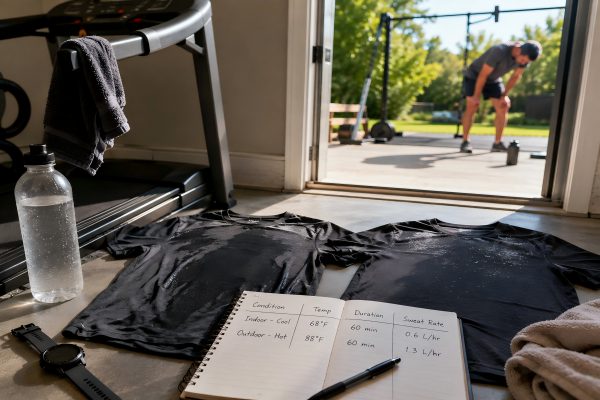
Sweat sodium concentration varies because sweat glands actively reabsorb some sodium before sweat reaches the skin. The final concentration can be influenced by individual physiology, sweat rate, heat acclimation, exercise intensity, environmental conditions, diet, and testing method. Even the same person can produce somewhat different results when the exercise setting or adaptation status changes.
Do Genetics Affect Sweat Sodium?
Individual physiology contributes to sweat composition, but reducing the explanation to genetics alone is misleading. Eccrine sweat glands produce a precursor fluid, and some sodium and chloride are reabsorbed as that fluid travels through the gland duct toward the skin. Differences in secretion rate, reabsorption, hormonal regulation, heat exposure, and other physiological factors can influence the sodium concentration that eventually appears on the skin.
The consistent differences observed between people suggest that individual tendencies are real, yet an individual number is not necessarily permanent. Heat acclimation, sweat rate, workload, and environmental conditions can alter results over time. That distinction matters whenever “personalized hydration” is discussed. Asking whether someone “sweats a lot” only addresses volume; it does not identify the sodium concentration of that sweat. Heavy sweating and salty sweating are related concepts, but they are not synonyms.
Does Sweat Rate Affect Concentration?
Sweat rate and sodium concentration are separate measurements, yet research indicates that sweat secretion rate can influence the concentration measured at the skin. When sweat moves through the gland more quickly, there may be less opportunity for sodium to be reabsorbed before the fluid reaches the surface. The relationship varies by individual and body site, so sweat rate cannot be used as a reliable shortcut to predict a person’s exact sodium concentration.
This interaction helps explain why harder or hotter sessions can produce much larger sodium losses. More sweat may be leaving the body each hour, and the sodium concentration of that sweat can also shift. In one controlled investigation, increasing exercise intensity produced an approximately 150% increase in total sweat sodium and chloride losses under the study conditions. That finding should not be generalized into a fixed percentage for every workout, but it demonstrates how strongly workload can change total electrolyte loss.
Do Heat and Acclimation Matter?
Repeated heat exposure can change sweat physiology. A seven-day heat-acclimation study in a very hot environment found a progressive decline in sweat sodium concentration, illustrating the body’s ability to improve sodium conservation during adaptation. Broader seasonal research has also reported reductions in sweat sodium concentration after summer acclimatization in several studies, although the magnitude varies considerably between protocols and populations.
This has an important practical consequence: a sweat test has a date and a context. A measurement collected during early-season indoor training may not perfectly represent an athlete later in a summer heat block. The number remains useful, but it becomes more useful when temperature, humidity, recent heat exposure, exercise duration, and estimated sweat rate are recorded alongside it. A concentration without those details can appear more permanent and precise than the physiology actually is.
| Factor | What It Can Influence | Interpretation Issue |
|---|---|---|
| Sweat rate | Sweat volume and measured concentration | Higher output can substantially increase hourly sodium loss |
| Exercise intensity | Sweat production and electrolyte loss | Harder sessions may not resemble easy-training results |
| Heat acclimation | Sodium conservation in sweat | Concentration can change after repeated heat exposure |
| Temperature and humidity | Cooling demand and sweat production | Different environments can produce different losses |
| Sampling site | Regional sodium result | Local sweat is not identical to whole-body sweat |
| Collection protocol | Result comparability | Different methods should not be assumed equivalent |
Does Exercise Intensity Change It?
Exercise intensity affects metabolic heat production and typically changes the demand for sweating. As intensity increases, total sweat volume often rises, and experimental research has shown that total sodium losses can increase substantially under harder exercise conditions. The effect on concentration itself varies by site and individual, which is why a hard 90-minute workout should not automatically be compared with a moderate 45-minute test as though conditions were identical.
When repeated measurements are being used for training or product-selection decisions, recording basic context adds considerable value. Workout duration, approximate intensity, ambient temperature, humidity, body mass before and after exercise, fluid consumed, sampling site, and heat-acclimation status can help explain why two test results differ. A sweat sodium number is much easier to interpret when it is attached to the workout that produced it rather than stored as an isolated permanent trait.
How Is Sweat Sodium Concentration Measured?
Sweat sodium concentration is measured by collecting sweat and analyzing the sample for sodium. Exercise-based methods commonly use regional absorbent patches, while research may also use whole-body washdown or other controlled techniques. Results depend on skin preparation, sampling location, sweat flow, collection time, contamination control, and the method used to translate a regional measurement into whole-body estimates.
How Does a Sweat Test Work?
In an exercise-based test, the skin is typically cleaned and dried before a collection device is attached to a defined body site. The athlete then exercises long enough to produce an adequate sample. After collection, the sweat is analyzed for sodium concentration. Regional patches are widely used because they are practical in the field, while more complex research methods can estimate or directly measure whole-body electrolyte losses.
Collection quality matters as much as the analyzer. Sodium already present on the skin, excessive patch saturation, long collection periods, evaporation, contamination, or poor handling can alter the sample. A useful test report should therefore provide more than one isolated number. Collection location, exercise conditions, method, and whether the final value is regional or an estimated whole-body concentration all help a reader judge what the number actually represents.
How Do Sweat Patches Work?
Regional absorbent patches collect sweat from one area of the body, such as the forearm, during exercise. Researchers can then analyze the sample and, where appropriate, use validated relationships to estimate whole-body sodium concentration. The method is far easier to use during normal training than whole-body washdown, which helps explain why patches appear frequently in athlete research and commercial field testing.
Their convenience comes with an important limitation: regional sweat is not identical to whole-body sweat. Sodium concentration varies among body sites, so a forearm reading cannot simply be treated as if every drop of sweat from the entire body had been collected. Research has therefore examined prediction equations connecting regional samples with whole-body values. When comparing consumer testing services, it is reasonable to ask whether the displayed result is a direct regional value or a converted estimate.
A number displayed as 1,127 mg/L can look exceptionally precise, but biological and sampling uncertainty remain. Collection location, device handling, analytical calibration, sweat rate, and conversion methods all influence the final estimate. For practical planning, a defensible range and repeated measurements under representative conditions may offer more value than assuming one highly precise number is a permanent property of the athlete.
Are At-Rest Tests Different?
Yes. Sweat collected during exercise and sweat produced through localized stimulation do not necessarily arise under identical physiological conditions. Sweat rate, skin temperature, gland activity, workload, and environmental exposure can differ, so results from different protocols should not automatically be placed side by side as interchangeable measurements. The broader sweat-testing literature repeatedly emphasizes methodology because technique contributes meaningfully to the final number.
The word “sweat test” also has a separate clinical meaning that should not be confused with sports hydration testing. Clinical evaluation for cystic fibrosis uses established diagnostic sweat-testing procedures focused primarily on sweat chloride. A sports-oriented sodium assessment is intended to characterize exercise-related electrolyte losses, not diagnose a medical condition. Maintaining that distinction protects readers from giving a consumer hydration result medical significance it was never designed to carry.
Can You Estimate It Without Testing?
Body-mass measurements can help estimate sweat rate, but they cannot reveal sweat sodium concentration. The American College of Sports Medicine has long noted that individual sweat rates can be estimated from body weight before and after exercise, with fluid intake and other losses taken into account. That approach estimates how much fluid was lost; it does not analyze what was dissolved in that fluid.
Suppose an athlete loses 0.8 kg during a one-hour workout, consumes 0.5 L of fluid, and does not urinate. A simplified calculation suggests approximately 1.3 L of fluid loss during that hour. The calculation provides useful information about sweat volume, but nothing in the body-mass change reveals whether the sodium concentration was 400, 900, or 1,500 mg/L.
White salt marks, salty skin, eye stinging, or a questionnaire about sweating habits can offer clues but cannot produce a defensible concentration measurement. A calculator can estimate sweat volume from body mass, yet a precise mg/L result requires information about sweat composition. This is one area where apparent numerical precision can easily outrun the quality of the underlying evidence.
How Is Sweat Sodium Different From Sweat Rate?
Sweat sodium concentration tells you how much sodium is in each liter of sweat, while sweat rate tells you how much sweat is produced over time. Concentration is normally expressed in mg/L or mmol/L, whereas sweat rate is typically expressed in L/h. Multiplying the two gives an estimate of sodium loss per hour, a third measurement with a different meaning.
What Is Sweat Rate?
Sweat rate describes how much fluid a person loses through sweating over a period of time. In practical field settings, it is commonly estimated using pre- and post-exercise body mass while accounting for fluid consumed and urine produced. The ACSM position stand specifically notes that individual sweat rates can be estimated through body-weight changes around exercise, reflecting the large variability in sweating between people.
A simplified example makes the distinction easier to see. Someone weighs 70.0 kg before a one-hour run and 69.2 kg afterward, drinks 500 mL during the workout, and produces no urine. A practical estimate is approximately 1.3 L of sweat over the hour. That gives a sweat rate near 1.3 L/h. The calculation tells us nothing about sodium concentration; a separate sweat-composition measurement would still be needed.
How Do You Calculate Sodium Loss?
Estimated hourly sodium loss combines sweat rate with sweat sodium concentration. The basic relationship is sweat rate in L/h × sodium concentration in mg/L = estimated sodium loss in mg/h. If a runner produces 1.2 L of sweat per hour and the sweat contains 900 mg/L sodium, the calculated loss is approximately 1,080 mg of sodium per hour under those measured conditions.
The mathematics is straightforward, but the result is still an estimate rather than an exact dosing instruction. Sweat rate can change during an event, concentration can vary with conditions, and regional sweat measurements may carry additional uncertainty. Rounding 1,080 mg/h to “about 1,100 mg/h” often communicates the quality of the data more realistically than presenting several decimal places as though every input were perfectly measured.
| Example | Sweat Sodium | Sweat Rate | Estimated Sodium Loss |
|---|---|---|---|
| Person A | 500 mg/L | 0.6 L/h | 300 mg/h |
| Person B | 500 mg/L | 1.8 L/h | 900 mg/h |
| Person C | 1,200 mg/L | 0.6 L/h | 720 mg/h |
| Person D | 1,200 mg/L | 1.8 L/h | 2,160 mg/h |
These hypothetical examples show why concentration alone cannot rank people by total sodium loss. Person B loses three times as much sodium per hour as Person A despite having exactly the same concentration, while Person C has much saltier sweat than Person B but still loses less sodium each hour because the total sweat volume is much lower.
What Does Sodium Loss per Hour Mean?
Sodium loss per hour describes the amount of sodium estimated to leave the body through sweat during one hour under particular conditions. It is not automatically a recommendation to consume the same amount every hour. Food, beverages, exercise duration, total fluid intake, body size, environment, and opportunities for recovery all influence how a calculated loss fits into a real hydration plan.
This distinction becomes especially important during long events. Exercise-associated hyponatremia research identifies excessive fluid intake as an important risk factor, showing why hydration planning cannot focus only on replacing electrolytes while ignoring how much fluid is being consumed. Both too little and excessive fluid intake can create problems, so calculated sodium loss should remain one piece of a broader exercise-hydration picture.
Can Two People Lose Different Amounts?
Yes, and the difference can become very large once concentration and sweat volume interact. Research in athletic populations shows broad variation in both measurements. In American football players, for example, published data have documented wide ranges in sweat sodium concentration and hourly sodium losses under demanding training conditions. Those results should not be treated as typical values for the general population, but they illustrate how body size, sweat volume, environmental exposure, and sodium concentration can combine.
This is also why product comparisons based only on “high sodium” or “low sodium” labels can miss the actual decision. Someone losing 300 mg/h and someone losing 2,000 mg/h face very different mathematical situations even before food intake, exercise duration, and health considerations are added. The more useful question is not simply how much sodium a packet contains, but what role that serving is intended to play within the person’s total activity and hydration routine.
How Should You Use Sweat Sodium Data?
Sweat sodium data works best as part of a larger set of measurements rather than as a stand-alone dosing rule. Combine concentration with sweat rate, exercise duration, environmental conditions, fluid intake, food intake, and the sodium amount shown on product labels. A measured loss can provide useful context, but exact milligram-for-milligram replacement during exercise is not a universal requirement.
Does Higher Sweat Sodium Mean More Sodium?
Higher concentration means more sodium is present in each liter of sweat, but total loss still depends on how many liters are produced. Someone measuring 1,500 mg/L while sweating only 0.4 L/h would have an estimated sodium loss of about 600 mg/h. Someone at 700 mg/L who sweats 1.5 L/h would lose approximately 1,050 mg/h. The lower concentration therefore produces the larger hourly loss in this example.
Duration changes the picture again. One hour at a particular loss rate and four hours at the same rate result in very different accumulated losses. That is why “high-sodium sweater” and “high sodium loss” should not be used as interchangeable descriptions. One describes concentration, while the other requires concentration, sweat volume, and time to be considered together.
For consumers comparing electrolyte supplements, the same reasoning discourages choosing the largest sodium number by default. A 1,000 mg serving may fit some prolonged high-sweat situations but can be unnecessary for other routines. People who have been advised to monitor sodium intake, take medications, or manage health conditions should rely on individualized professional guidance rather than using a general sweat calculation as medical advice. NRL’s content standards make the same distinction between education and individualized health guidance.
How Do You Compare Electrolyte Labels?
A product label usually reports sodium per serving, not per liter. If a powder supplies 500 mg sodium per serving, that serving still contains 500 mg whether it is mixed with 500 mL or 1 liter of water. What changes is the concentration of the finished beverage. Mixed into 500 mL, 500 mg corresponds mathematically to 1,000 mg/L; mixed into one liter, it corresponds to 500 mg/L.
Matching beverage concentration directly to sweat concentration is still too simplistic. Someone may drink less fluid than they sweat, eat sodium-containing foods, use more than one bottle, exercise for only a short period, or recover through normal meals afterward. The product’s sodium amount should therefore be examined alongside mixing volume, serving size, sugar or carbohydrate, potassium, magnesium, caffeine, sweetener type, and the intended use scenario.
The FDA lists a Daily Value of 2,300 mg for sodium on Nutrition and Supplement Facts labels. That Daily Value is a general dietary labeling reference and should not be mistaken for an hourly sports-hydration target or a direct replacement formula for measured exercise losses.
Is Exact Sodium Replacement Necessary?
Trying to replace every milligram of calculated sodium loss during exercise is not a universal rule. Sweat rate and sodium concentration are measurements with normal biological and methodological variability, while sodium intake also comes from meals and snacks before, during, and after training. Exercise duration, weather, body size, fluid intake, and the opportunity to eat all change what a calculated hourly loss means in practice.
Fluid intake deserves equal attention. Consensus and review literature on exercise-associated hyponatremia identifies overdrinking as a major contributor, which makes it inappropriate to chase a sodium target by simply consuming ever-larger volumes of electrolyte fluid. A sensible plan considers fluid and sodium together and is adjusted using repeated real-world experience rather than forcing intake to equal an estimated loss down to the milligram.
For most recreational exercisers, the goal is therefore not mathematical perfection. A reasonable range informed by workout duration, sweat volume, conditions, diet, and personal tolerance is usually easier to apply. More detailed measurement becomes increasingly useful as sessions become longer, hotter, more frequent, or more demanding, particularly when small errors repeated over many hours can become substantial.
When Is Sweat Testing Useful?
Sweat testing has the clearest practical value when knowing the difference between sweat volume and sweat composition could meaningfully change a hydration decision. Endurance athletes, people completing long sessions in hot weather, outdoor workers with extended heat exposure, and athletes who repeatedly experience very large sweat losses may gain more useful information than someone performing a short, comfortable indoor workout. Research supports substantial individual variability in both sweat rate and sodium concentration.
Testing can also resolve an important question: is a high sodium loss occurring because the sweat itself is highly concentrated, because the person sweats an unusually large volume, or because both are present? That distinction makes it easier to interpret product labels without assuming every “heavy sweater” needs the same formula.
For supplement comparison and formulation work, the same principle produces more credible decisions. Sodium per serving becomes more meaningful when it is reviewed beside dilution, serving size, carbohydrate, other electrolytes, price per serving, label transparency, and intended activity. NutriReviewLab’s methodology emphasizes those standardized label fields and use-case differences rather than promoting a single sodium number as appropriate for everyone.
Conclusion
Sweat sodium concentration answers one specific question: how much sodium is present in a given volume of sweat. It does not reveal total sodium loss by itself, and it should not be treated as a ready-made electrolyte dose. Athlete research shows wide individual variation, with regional values commonly reported across roughly 10–90 mmol/L, while sweat rate, exercise intensity, heat acclimation, environment, and testing method all influence how the result should be understood.
The most useful interpretation connects four pieces of information: sweat sodium concentration, sweat rate, exercise duration, and actual sodium intake from drinks and food. Once those measurements are separated, electrolyte labels become much easier to read because mg per serving no longer gets confused with mg/L or mg/h. A strong hydration decision is rarely about finding the biggest sodium number; it is about understanding what each number measures and whether it fits the activity in front of you.
Frequently Asked Questions
What Is a Good Sweat Sodium Concentration?
There is no universally defined “good” sweat sodium concentration. Published athlete research shows a broad distribution, with regional values commonly reported around 10–90 mmol/L, or approximately 230–2,070 mg/L. A value should therefore be interpreted alongside sweat rate, exercise conditions, acclimation status, and the testing method rather than against a single ideal number. A result near the middle of a population range is not automatically better than one toward either end.
Is 1,000 mg/L of Sweat Sodium High?
A sweat sodium concentration of 1,000 mg/L is approximately 43.5 mmol/L and falls within ranges commonly reported in athletic populations. Whether it translates into a large sodium loss depends on sweat volume. At a sweat rate of 0.5 L/h, the estimated loss would be about 500 mg/h; at 2.0 L/h, it would be approximately 2,000 mg/h. Concentration alone therefore cannot tell you how much sodium is being lost during exercise.
How Do I Know If I Am a Salty Sweater?
Visible salt marks on clothing, a salty taste on the skin, or white residue after exercise may suggest noticeable mineral loss, but these signs cannot determine a numerical sweat sodium concentration. Research studies sometimes classify high-sodium sweaters using their own thresholds, but there is no single universal cutoff used for every athlete or test method. Obtaining a quantitative mg/L value requires analysis of an actual sweat sample rather than visual observation alone.
Can I Calculate Sweat Sodium From Weight Loss?
Body-weight change can help estimate sweat rate, but it cannot reveal sodium concentration. Pre- and post-exercise weighing, combined with records of fluid intake and urine production, can estimate approximately how many liters of fluid were lost. To calculate sodium loss per hour, a separate sweat sodium measurement in mg/L is needed. Multiplying that concentration by sweat rate in L/h produces an estimated sodium loss in mg/h.
Does Sweat Sodium Concentration Change Over Time?
It can. Sweat sodium concentration is influenced by factors including sweating rate, exercise conditions, heat exposure, and acclimation. Controlled heat-acclimation research has demonstrated reductions in sweat sodium concentration over repeated exposure, and seasonal research has reported similar trends in several studies. A measurement obtained early in a training season should therefore not automatically be treated as a permanent number that will be identical in every environment or future workout.
Should an Electrolyte Drink Match My Sweat Sodium Concentration?
Not necessarily. Sweat sodium is usually reported in mg/L, while electrolyte products usually declare sodium in mg per serving. The amount of water used to mix a serving changes the beverage concentration without changing the total sodium in that serving. Fluid intake can also differ from sweat loss, and sodium may come from food. Product sodium, dilution, sweat rate, duration, diet, and total fluid intake should therefore be considered together rather than matched one-for-one.
Is Sweat Sodium Testing Necessary for Everyone?
No. Testing is more likely to add useful information when exercise is long, sweating is substantial, conditions are hot, or repeated fluid and sodium losses materially affect training decisions. For a short, low-sweat workout in comfortable conditions, an exact sodium concentration may change very little. The value of testing depends on whether the result will lead to a meaningful decision rather than simply producing another number to track.