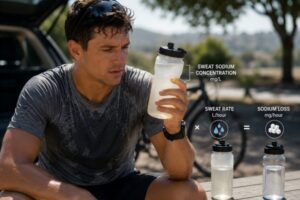
Two people can finish the same one-hour workout under the same summer sun and look as though they trained in completely different environments. One may have a lightly damp shirt and half a bottle of water left, while the other has soaked clothing and finishes every drop. The difference is not automatically fitness, effort, hydration status, or workout quality. One important variable is sweat rate, which describes how quickly fluid is being lost through sweating under a particular set of conditions.
Sweat rate is the estimated volume of sweat lost per unit of time, most commonly expressed in liters per hour. It is usually estimated from changes in body mass before and after exercise, adjusted for fluid consumed and urine produced. The measurement can help a person understand exercise-related fluid turnover and make hydration planning more specific to the activity and environment.
The useful part is not obtaining one impressive-looking number. It is discovering how that number behaves. A runner might record modest losses during a cool spring jog but substantially greater losses on a hard August long run. A cyclist may sweat heavily indoors without a fan yet lose much less fluid outdoors at the same power because moving air improves heat transfer. Once those patterns become visible, sweat rate stops being an abstract sports-science term and becomes something people can actually use when planning bottles, refill stops, and electrolyte choices.
What Is Sweat Rate?
Sweat rate describes how much fluid is lost through sweating during a defined period, usually exercise, and is commonly expressed as liters per hour. It reflects the rate of fluid turnover rather than workout quality or sodium concentration. Because heat, intensity, body size, clothing, sport, airflow, and acclimatization can change sweat output, a meaningful sweat-rate result should always be interpreted alongside the conditions in which it was measured.
What Does Sweat Rate Measure?
Sweat rate measures the speed of fluid loss through sweating, not simply the amount of weight missing from the scale after exercise. Field assessments commonly estimate sweat loss by comparing body mass before and after activity while accounting for fluid consumed and, when relevant, urine produced. This distinction matters because someone who drinks 600 mL during a workout can still finish only 0.4 kg lighter even though total fluid loss through sweating was considerably greater than the scale change alone suggests.
Total sweat loss and sweat rate also answer different questions. Losing 1.2 liters during a three-hour hike and losing 1.2 liters during a 45-minute hard run represent the same approximate total sweat volume, but the hourly rate is very different. Converting the loss into L/h allows sessions of different lengths to be compared more meaningfully. The measurement still remains an average across the test period rather than proof that sweat production remained perfectly constant from the first minute to the last.
Visible sweat should therefore not be treated as a shortcut for measuring exercise quality. A person can sweat much more in a heated studio or under heavy clothing without performing more useful mechanical work. Sweat production primarily supports thermoregulation, and its volume reflects the interaction between metabolic heat, environmental heat, clothing, airflow, and individual physiology. For consumers comparing hydration supplements, a high sweat rate can indicate greater fluid turnover, but it cannot independently establish how much sodium or any other electrolyte should be consumed.
Which Units Are Used for Sweat Rate?
The most practical unit for everyday exercise tracking is liters per hour (L/h). A sweat rate of 0.8 L/h corresponds to an estimated 800 mL of sweat per hour under the measured conditions. Milliliters per hour may also be used, while sports-science studies sometimes report relative sweat rate in mL/kg/h so that sweat output can be considered in relation to body mass rather than only as an absolute volume.
Using metric units makes field calculations easier because a short-term reduction of roughly 1 kg in body mass is commonly treated as approximately 1 L of fluid in the practical body-mass-balance calculation. For U.S. readers, 1 liter equals about 33.8 U.S. fluid ounces. A 750 mL sports bottle therefore holds 0.75 L, which makes L/h particularly easy to translate into real bottle capacity, aid-station access, and the amount of fluid carried during training.
A dataset involving 506 athletes reported a mean whole-body sweating rate of 1.21 ± 0.68 L/h, with observed values extending from 0.26 to 5.73 L/h. The same dataset reported a mean relative sweat rate of 15.3 ± 6.8 mL/kg/h. Those numbers are useful for demonstrating variability, but the population average should not be turned into an individual hydration target because the tested athletes differed in sport, body size, workload, and environmental exposure.
Why Does Sweat Rate Matter During Exercise?
The practical value of sweat rate is that it replaces a vague impression such as “I sweat a lot” with a number connected to a specific activity. NATA recommends assessing individual sweat rates under realistic environmental and exercise conditions because fluid losses differ substantially among physically active people. Repeating assessments at different intensities and in sport-specific clothing can help reveal which training situations consistently produce the largest fluid turnover.
For example, two runners could complete the same distance but experience very different hydration logistics. A person losing around 0.5 L/h during a cool recreational run faces a different fluid-access problem from someone losing around 1.5–2.0 L/h during prolonged hot-weather training. The higher number does not automatically mean that person should consume exactly the same volume each hour, but it shows that a small handheld bottle represents a much smaller proportion of the estimated loss.
The number becomes most useful when it is stored with context. A simple training record can include date, activity, duration, approximate intensity, temperature, humidity when available, clothing, fluid consumed, body weight before and after exercise, and calculated L/h. Several entries collected under comparable conditions often reveal far more than a single test. For supplement shoppers, those records also create a better foundation for comparing sodium, carbohydrate, serving size, and drink concentration instead of starting with whichever product shows the largest electrolyte number on the front label.
How Do You Calculate Sweat Rate?
Sweat rate is commonly estimated by subtracting post-exercise body mass from pre-exercise body mass, adding the volume of fluid consumed, subtracting urine produced during the measurement period, and dividing the estimated sweat loss by exercise duration in hours. Metric measurements simplify the process, and the same weighing conditions, clothing approach, scale, and drink-recording method should be used whenever possible.
What Is the Sweat Rate Formula?
A useful field equation is:
Estimated sweat loss (L) = Pre-exercise body mass (kg) − Post-exercise body mass (kg) + Fluid consumed (L) − Urine produced (L)
The estimated sweat loss is then divided by exercise time in hours:
Sweat rate (L/h) = Estimated sweat loss (L) ÷ Exercise duration (h)
NATA includes this body-mass-balance approach in its guidance for physically active people. The method is practical because it requires equipment most people already have, but it should still be understood as an estimate rather than a laboratory measurement of every drop of sweat produced.
| Measurement | Example | Role in Calculation |
|---|---|---|
| Pre-exercise body mass | 70.0 kg | Starting body mass |
| Post-exercise body mass | 69.4 kg | Subtracted from starting mass |
| Body-mass decrease | 0.6 kg | Approx. 0.6 L in field calculation |
| Fluid consumed | 0.50 L | Added back to estimated loss |
| Urine produced | 0 L | Subtracted if present |
| Exercise duration | 1.0 h | Used to normalize the rate |
| Estimated sweat loss | 1.10 L | 0.6 + 0.50 |
| Estimated sweat rate | 1.10 L/h | 1.10 ÷ 1.0 |
The table shows why the scale change alone is incomplete. The athlete finished 0.6 kg lighter but also drank 0.5 L during exercise. Assuming no urine loss during the test, estimated sweat loss is therefore about 1.1 L. If the athlete had looked only at the scale and concluded that 600 mL had been lost, the result would underestimate the amount of fluid that moved out through sweating during the session.
How Do You Measure Body Weight Correctly?
A simple equation can still produce poor information when the inputs are inconsistent. The same scale should be used immediately before and as soon as practical after exercise. Clothing should also be handled consistently because sweat trapped in a soaked shirt, socks, shorts, or protective gear remains on the scale even though the water is no longer inside the body. Sweat-testing methodology therefore favors minimal or dry clothing when circumstances allow.
Emptying the bladder before the first measurement makes the starting point easier to compare. Every beverage consumed during exercise should then be measured. A marked bottle works well, although weighing a bottle before and after can also produce a useful estimate. If someone urinates during the session, that output should be incorporated when practical because it represents body mass lost for a reason other than sweating.
Scale resolution matters more than expensive “smart” features. A device that only changes in 0.5 kg steps can introduce a large error into a one-hour test, particularly for people with lower sweat rates. A scale displaying 0.1 kg increments is considerably more useful for routine field measurements. The goal is not laboratory perfection; it is to make repeated tests consistent enough that differences between similar workouts have a reasonable chance of representing a real change rather than measurement noise.
What Can Make a Sweat Test Inaccurate?
Unrecorded drinking is one of the easiest ways to distort the result. Starting with an unknown bottle volume and taking several drinks means a critical part of the calculation is missing. Food eaten during a long session adds mass, while urination removes it. Water poured over the head should not be counted as fluid consumed. Wet clothing can retain substantial moisture, especially in humid environments where evaporation is limited.
Long sessions add further complexity because body-mass change does not come exclusively from sweat. Research reviews identify respiratory water loss and metabolic mass changes as additional factors that can become more relevant as duration increases. For most recreational field assessments, the body-mass method remains useful, but increasingly long or technically demanding tests deserve increasingly cautious interpretation.
False precision is another common problem. A spreadsheet may generate 1.07 L/h, but the underlying measurement may not justify treating the second decimal place as meaningful. Three similar summer sessions producing 1.0, 1.1, and 1.1 L/h are usually more informative than one isolated result treated as an exact lifelong value. Recording conditions and looking for repeatable ranges keeps the measurement grounded in how field data actually behave.
How Can You Calculate Sweat Rate Per Hour?
Workout duration should be converted into hours before dividing estimated sweat loss. A 45-minute session equals 0.75 hour. If estimated sweat loss is 0.75 L, the average sweat rate is 0.75 ÷ 0.75 = 1.0 L/h. A 90-minute workout equals 1.5 hours; 1.65 L of estimated sweat loss across that period gives an average of 1.10 L/h.
The word average matters because sweating can change during the session. Heat stored in the body, pace changes, sunlight, airflow, hydration status, and breaks can alter sweating as a workout progresses. Exercise-intensity research also shows that greater metabolic heat production can increase whole-body sweating and electrolyte loss, which means a hard second half and an easy first half may not contribute equally to the final average.
Keeping both total sweat loss and hourly sweat rate makes a training log much easier to interpret. Total loss shows the approximate scale of the complete session, while L/h makes different session lengths comparable. An entry such as “90-minute outdoor run, warm and humid, steady effort, 1.65 L estimated sweat loss, 1.10 L/h” will still be understandable months later. An entry that simply says “sweated a lot” provides almost no reusable information.
What Is a Typical Sweat Rate?
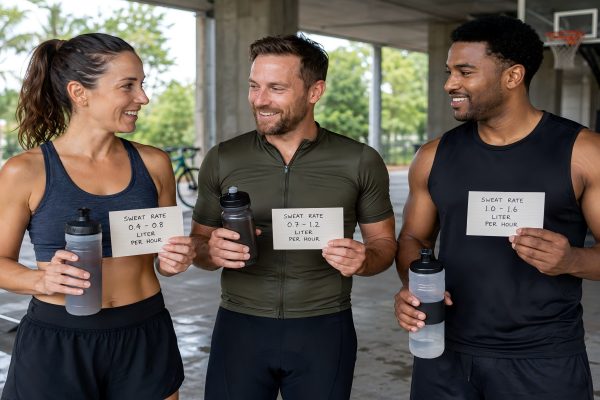
There is no universal sweat rate that everyone should aim for. Research commonly reports whole-body exercise sweat rates around 0.5–2.0 L/h, although much higher values can occur. A dataset of 506 athletes averaged 1.21 L/h and ranged from 0.26 to 5.73 L/h. The meaningful comparison is usually between a person’s own results under similar conditions rather than against one population average.
What Counts as a Low or High Sweat Rate?
Numbers from research can provide context, but they should not be converted into rigid categories that imply a particular sweat rate is healthier. A major sweat-testing review notes that whole-body sweat rates commonly fall around 0.5–2.0 L/h, while rates above 3.0 L/h occur in some circumstances. NATA also discusses adult rates that can extend to around 4 L/h, reinforcing how wide the possible range can become under demanding conditions.
Sport-specific data make the same point. An analysis of 1,303 athletes found meaningful differences in average whole-body sweating rate among sports. Those averages reflect the participants and conditions represented in the dataset rather than fixed values that every person in a sport should match.
| Sport in 1,303-Athlete Dataset | Mean Whole-Body Sweat Rate |
|---|---|
| American football | 1.51 ± 0.70 L/h |
| Endurance sports | 1.28 ± 0.57 L/h |
| Basketball | 0.95 ± 0.42 L/h |
| Soccer | 0.94 ± 0.38 L/h |
| Baseball | 0.83 ± 0.34 L/h |
A result of 1.5 L/h therefore needs context before someone labels it “high.” The number might arise during intense football practice in protective gear, a long run in summer, or an indoor cycling session with little airflow. The practical question is whether the result is repeatable under conditions that matter to the person and whether it creates a meaningful fluid-management challenge during the activity.
Is a Higher Sweat Rate Better?
More sweating is not inherently better. Sweat production supports heat loss, so the amount produced depends partly on metabolic heat and partly on how effectively the environment allows that heat to leave the body. A heated exercise room, extra clothing, direct sun, or reduced airflow can increase thermal strain without making the workout intrinsically more productive.
Body size complicates comparisons further. Larger athletes may produce more absolute metabolic heat and can show greater absolute sweat volumes. This is one reason scientific reports sometimes include both absolute L/h and relative mL/kg/h. Two people with visibly different sweat volumes may look more similar once body size and workload are considered, although individual thermoregulatory differences still remain.
For practical hydration decisions, a high sweat rate is best viewed as information about fluid turnover. It can affect how much liquid someone chooses to carry, whether a route needs refill opportunities, or whether a long event deserves more deliberate hydration planning. It should not automatically lead to the conclusion that the person needs the most concentrated electrolyte product available. Fluid volume and sweat sodium concentration are separate variables, and total diet also contributes electrolytes.
Why Do Sweat Rates Differ Between People?
Sweating varies because several characteristics influence heat production and heat loss at the same time. Exercise intensity, body size, environment, acclimatization, clothing, protective equipment, aerobic training, genetics, and other individual factors can all contribute. Research datasets demonstrate large interindividual variation even among trained athletes, making it unreliable to copy a training partner’s drinking plan simply because both people performed the same session.
The 506-athlete dataset is a useful example. Although the mean whole-body sweat rate was about 1.21 L/h, values extended from 0.26 to 5.73 L/h. That spread is too wide for the average to function as a universal personal target. It is much more useful as evidence that exercise sweating can differ substantially from person to person.
Personal comparison is therefore usually more actionable. If someone consistently records around 0.7 L/h during mild-weather easy runs but around 1.2 L/h during hot long runs, the difference can influence bottle size and refill planning even if neither number is remarkable compared with a population dataset. The person standing on the treadmill beside them may have a completely different pattern and still be responding normally to that individual’s body size, workload, environment, and heat adaptation.
Can Your Sweat Rate Change Over Time?
Sweat rate is not a permanent physiological identification number. Heat acclimatization provides a clear example of how the response can change. CDC/NIOSH describes acclimatization as a set of beneficial adaptations that develop with repeated heat exposure, including earlier onset of sweating, greater sweat production, and reduced electrolyte loss in sweat, along with cardiovascular adaptations that improve tolerance to heat.
This means sweating more after a period of heat exposure is not automatically a negative development. Earlier and more effective sweating can be part of adaptation. CDC/NIOSH guidance for workers uses gradual exposure schedules because acclimatization develops over time rather than during a single hot session, and adaptation can decline after an extended period away from heat.
Training conditions also change without acclimatization being the main reason. A harder workout, heavier clothing, indoor training without a fan, or a move from cool spring conditions to humid summer weather can alter the measurement. Rather than calling yourself a “one-liter-per-hour sweater” after one test, it is more useful to build a few situation-specific ranges: cool easy training, warm steady exercise, hard hot-weather training, or sessions performed in heavy equipment.
Which Factors Affect Sweat Rate?
Sweat rate is shaped by the heat produced during exercise and the ability of the surrounding environment to remove it. Exercise intensity, temperature, humidity, solar radiation, airflow, clothing, protective equipment, body size, sport, and heat acclimatization can all change measured sweat output. Because several of these variables often change together, the conditions of each sweat test are almost as important as the final L/h value.
How Do Heat and Humidity Affect Sweat Rate?
Environmental temperature changes how easily the body can move heat into its surroundings. As the air becomes warmer, certain forms of dry heat transfer become less effective, increasing reliance on evaporation. Sweat only contributes fully to cooling when it evaporates; liquid that drips from the skin or remains trapped in saturated clothing represents fluid loss without providing the same evaporative cooling benefit.
Humidity changes the equation because air containing more water vapor has less capacity to accept additional vapor from the skin. This can reduce evaporative efficiency and leave the skin feeling much wetter. Direct sunlight adds radiant heat, while moving air can improve convective and evaporative heat transfer. The same reported air temperature can therefore create a very different exercise experience depending on humidity, sunlight, shade, and wind.
A useful field log should capture more than “hot” or “cool.” Recording approximate temperature and humidity, whether the athlete was in direct sun, and whether airflow was strong or weak makes later comparisons much easier. A high sweat rate during a humid afternoon run may have little predictive value for a cool early-morning event unless those environmental differences are acknowledged.
How Does Exercise Intensity Affect Sweat Rate?
Harder exercise generally means greater metabolic heat production. Human movement converts only part of metabolic energy into external mechanical work, while a substantial amount becomes heat that must be dissipated. Research examining exercise intensity has demonstrated increases in whole-body sweating and electrolyte losses as metabolic heat production rises, although the size of the response continues to vary among individuals.
This is one reason a recovery jog should not automatically be pooled with a tempo run simply because both lasted 60 minutes. The same problem occurs in cycling, rowing, court sports, and gym training. Repeated high-intensity intervals can create a different thermal load from continuous low-intensity work, even when the clock time is identical.
Recording pace, cycling power, heart-rate zone, work-to-rest structure, or a simple perceived-effort rating gives a sweat-rate record far more value. The goal is not to turn an everyday athlete into a research technician. A short note such as “easy,” “steady,” or “hard intervals” is usually enough to prevent obviously different workouts from being treated as interchangeable data points.
Do Sport and Workout Type Matter?
Different sports create different combinations of movement, airflow, body position, protective equipment, work-to-rest ratio, and drinking opportunity. Outdoor cycling may generate strong airflow, while indoor cycling can produce heavy sweating if the room is warm and fans are limited. Football combines intermittent intense work with protective equipment. Basketball has repeated bursts of running with indoor conditions and breaks. Running places different mechanical and thermal demands on the body again.
The 1,303-athlete dataset supports the importance of sport context, with mean sweat rates differing across American football, endurance sports, basketball, soccer, and baseball. Those differences should not be used as universal drinking instructions, but they demonstrate that exercise format is not a trivial detail when interpreting sweat data.
The most useful test is therefore one that resembles the activity being planned for. A winter indoor strength-session result may tell a runner little about a July half marathon. Likewise, a cyclist preparing for a long outdoor event gains more from several outdoor ride measurements than from a treadmill test. Sweat-rate testing becomes much more relevant when the activity, duration, intensity, clothing, and environment resemble the real situation the person expects to face.
Does Heat Acclimation Change Sweat Rate?
Repeated heat exposure can change the timing and efficiency of sweating. CDC/NIOSH describes improved heat acclimatization as including an earlier onset of sweating, greater sweat production, reduced electrolyte loss in sweat, improved skin blood flow, and better cardiovascular stability at a given level of heat stress. These adaptations help explain why the same person can produce different sweat-rate results early and later in a hot-weather training period.
Clothing can partly override some advantages of effective sweating. Protective clothing and personal protective equipment can trap heat and moisture, reducing the body’s normal ability to release heat through evaporation. CDC/NIOSH specifically notes the additional heat burden created by PPE, a consideration that applies to occupational settings as well as some sport environments involving helmets, pads, or heavy equipment.
For personal tracking, the date and recent heat exposure deserve a place beside each result. If a sweat rate changes after two weeks of summer training, that does not automatically mean the earlier or later measurement was wrong. The body and environment may genuinely be different. Repeating a comparable session provides a more useful answer than trying to force every measurement into one permanent average.
How Can Sweat Rate Guide Hydration?
Sweat rate can estimate the scale of fluid loss during a particular activity and help determine whether fluid access deserves more planning. It does not provide an exact compulsory drinking volume. Exercise duration, environmental conditions, thirst, body-mass change, drink tolerance, opportunities to carry or obtain fluid, and the risk of overconsumption all matter when turning a sweat-rate measurement into a workable hydration approach.
How Much Fluid Are You Losing?
Once an average sweat rate is available, approximate total sweat loss for a session can be estimated by multiplying L/h by exercise duration. Someone averaging 0.8 L/h over two hours would have an estimated total sweat loss near 1.6 L if the rate remained reasonably similar. Someone averaging 1.5 L/h over the same duration would reach approximately 3.0 L, creating a very different fluid-access challenge.
| Estimated Sweat Rate | Exercise Duration | Approx. Sweat Loss | What It Helps Illustrate |
|---|---|---|---|
| 0.6 L/h | 1 hour | 0.6 L | Relatively modest session turnover |
| 0.9 L/h | 1.5 hours | 1.35 L | Duration materially increases total loss |
| 1.2 L/h | 2 hours | 2.4 L | Fluid access becomes more important |
| 1.5 L/h | 3 hours | 4.5 L | Large total turnover during prolonged exercise |
These numbers are mathematical illustrations rather than drinking prescriptions because sweat rate can change during the workout. Their real value is showing scale. A 500 mL bottle may represent most of one person’s estimated losses during a short cool session but only a small fraction of another person’s turnover during long, hot exercise.
This can change planning before it changes supplement selection. The person can ask how much fluid is realistic to carry, whether refill points exist, how long the session lasts, and how drinking feels at the intended pace. An effective hydration routine has to work during actual movement rather than only on paper.
How Can Sweat Rate Inform a Drinking Plan?
Sweat-rate information works best as one input in a larger plan. NATA emphasizes individualized fluid strategies because sweat rate, exercise intensity, environmental conditions, body size, acclimatization, and gastrointestinal tolerance can vary substantially. The objective is not to create the largest possible drinking volume but to avoid excessive fluid deficits while also avoiding overconsumption.
Suppose repeated testing produces approximately 0.7 L/h during cool easy runs and 1.2 L/h during hot long runs. Those measurements do not automatically become two exact fluid prescriptions. They show that the hot long run creates materially greater fluid turnover and may justify carrying more liquid, choosing a route with refill access, or paying closer attention to post-session body-mass change.
Drinking logistics often determine whether a mathematically neat plan is realistic. Running with several liters is impractical, cycling usually offers easier bottle carriage, and organized events may provide aid stations. Some people can drink comfortably during lower-intensity exercise but develop stomach discomfort when trying to consume the same volume at race pace. A useful plan respects both the physiology and the activity rather than treating an hourly sweat number as a command.
Should You Replace Every Drop of Sweat?
Replacing exactly 100% of measured sweat during exercise is not a universal requirement. NATA recommends strategies that limit excessive fluid deficits without encouraging overconsumption, and it specifically cautions against gaining body weight because of excess drinking during activity. This point matters because hydration advice can become unsafe when people assume that consuming more water is always better.
The digestive system also limits what is practical. A person with a calculated sweat rate of 1.4 L/h may not comfortably tolerate 1.4 L of fluid every hour while running hard. Activity type, temperature, drink composition, pace, body size, fluid access, and stomach tolerance can all influence the volume someone is comfortable consuming.
Sweat rate is therefore most useful for identifying large mismatches. A person losing roughly 1.2 L/h during several hours of hot exercise but drinking only a few mouthfuls is dealing with a different situation from someone consuming enough fluid to gain body mass during the session. The measurement provides boundaries and context. People with relevant medical conditions, medication considerations, or a history of serious hydration problems should seek individualized professional guidance rather than turning a field calculation into an aggressive fluid or sodium protocol.
How Often Should You Recheck Sweat Rate?
There is little benefit in turning sweat-rate testing into a daily ritual. Reassessment becomes useful when the conditions that meaningfully affect sweating have changed. NATA recommends multiple assessments under realistic environmental conditions, at different exercise intensities, and in activity-specific clothing or equipment rather than relying on a single population estimate.
Good reasons to repeat a test include moving from cool to hot weather, switching between indoor and outdoor training, substantially increasing workout duration or intensity, adding protective equipment, changing sports, or completing a period of heat acclimatization. The purpose is to maintain relevant information rather than accumulate numbers for their own sake.
A personal record eventually becomes more useful when it contains several ranges instead of one permanent figure. A runner may establish a typical cool-weather range and a higher summer range. A cyclist may discover that indoor fan use changes sweat losses considerably. That information can then be used when comparing hydration products by actual label fields such as serving size, sodium, carbohydrate, sugar, caffeine, and intended dilution rather than relying only on marketing terms. NRL’s editorial framework likewise favors verifiable label comparisons and use-case fit over assuming that a larger ingredient number automatically makes a supplement superior.
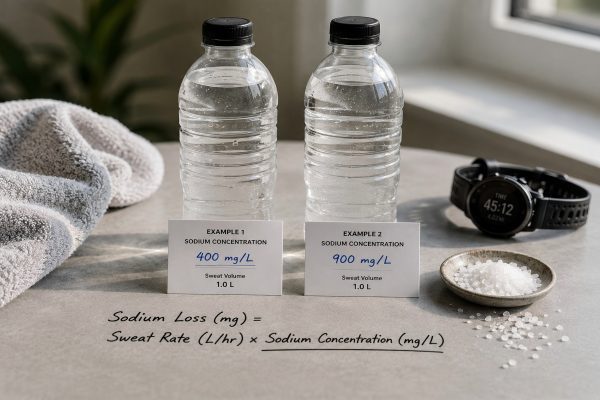
Is Sweat Rate the Same as Sodium Loss?
Sweat rate and sodium loss are related but are not interchangeable. Sweat rate measures how much sweat is lost per unit of time, while sweat sodium concentration measures how much sodium is present in a given volume of sweat. Estimating sodium loss requires both variables. Two people can have identical sweat rates but markedly different sodium losses if their sweat sodium concentrations differ.
What Is Sweat Sodium Concentration?
Sweat contains water and dissolved electrolytes, including sodium and chloride. Sweat sodium concentration describes the amount of sodium present in a given volume of sweat and is commonly expressed in millimoles per liter (mmol/L) or milliequivalents per liter (mEq/L). For sodium, the numerical value is the same in mmol/L and mEq/L because each sodium ion carries one positive charge.
Individual variation is substantial. In the 506-athlete dataset, predicted whole-body sweat sodium concentration averaged 35.9 ± 10.4 mmol/L, with observed predicted whole-body values ranging from approximately 18.2 to 70.8 mmol/L. Sweat collected from one body region can differ from a whole-body estimate, which is one reason test method and collection site matter when results are compared.
A salty crust on a shirt can suggest that meaningful sodium is being left behind after sweat water evaporates, but clothing appearance cannot provide a reliable concentration value. Standardized sweat collection and analysis are needed for a more defensible estimate. For most recreational exercisers, understanding this distinction is already valuable because it prevents a common error: assuming that someone who sweats a large volume must automatically have unusually sodium-rich sweat.
How Do Sweat Rate and Sodium Concentration Differ?
A straightforward analogy is to think of sweat rate as the volume flowing out and sweat sodium concentration as how much sodium is contained in each liter. An athlete sweating at 1.0 L/h with a sodium concentration of 30 mmol/L loses the same fluid volume as an athlete sweating at 1.0 L/h and 60 mmol/L, but the second person’s estimated sodium loss is approximately twice as large.
The opposite comparison is equally important. A person sweating 2.0 L/h at 30 mmol/L can lose roughly the same amount of sodium per hour as someone sweating 1.0 L/h at 60 mmol/L. High sodium concentration therefore does not automatically mean the highest total sodium loss; sweat volume and exercise duration can materially change the final amount.
Testing methodology adds another layer. Regional sweat patches do not necessarily reproduce whole-body sodium concentration exactly, and collection location, timing, contamination, skin preparation, and analytical method can affect results. A single consumer sweat test should therefore be interpreted according to its methodology rather than treated as an unquestionable laboratory truth. This is particularly important when a precise sodium figure is being used to justify a highly specific supplement dosage.
How Is Sweat Sodium Loss Estimated?
A simplified estimate combines sweat volume and sodium concentration:
Sodium loss rate = Sweat rate × Sweat sodium concentration
Because one millimole of sodium weighs approximately 23 mg, mmol/L can be converted into milligrams when combined with liters of sweat. The examples below show how the same concentration can produce very different losses when sweat volume changes, and how the same fluid loss can contain different sodium amounts when concentration changes.
| Sweat Rate | Sweat Sodium | Calculation | Approx. Sodium Loss |
|---|---|---|---|
| 0.5 L/h | 30 mmol/L | 0.5 × 30 × 23 | 345 mg/h |
| 1.0 L/h | 40 mmol/L | 1.0 × 40 × 23 | 920 mg/h |
| 1.5 L/h | 60 mmol/L | 1.5 × 60 × 23 | 2,070 mg/h |
| 2.0 L/h | 30 mmol/L | 2.0 × 30 × 23 | 1,380 mg/h |
These are calculation examples, not recommended sodium intakes. NATA notes that observed exercise sodium-loss rates can vary widely because sweat volume and concentration both vary. This broad range is precisely why one sodium-per-hour recommendation cannot accurately describe every athlete, climate, sport, or session.
The table also highlights a useful product-comparison principle. A sports drink containing 300 mg of sodium and another containing 1,000 mg per serving may suit different contexts, dilution volumes, diets, and users. Comparing only the front-label sodium number ignores serving size, water volume, carbohydrate, sugar, caffeine, other electrolytes, and the amount of the product someone actually consumes.
When Do Electrolytes Become Relevant?
Electrolyte replacement generally becomes a more meaningful consideration as exercise becomes longer, sweat losses become larger, and repeated training or hot conditions increase total fluid and electrolyte turnover. The relevance is not determined by sweat rate alone. Duration, diet, sweat sodium concentration, fluid intake, activity type, and the composition of the drink or food consumed during and around exercise all contribute to the larger picture.
This is where supplement labels deserve more careful reading. Sodium is often the most prominent electrolyte in exercise hydration products, but it should be evaluated alongside intended water volume, potassium, magnesium when present, carbohydrate, total and added sugars, caffeine, sweetener type, serving size, and servings per package. A product formulated around high sodium for prolonged sweaty activity is not automatically the most suitable option for a short low-sweat gym session.
A credible supplement comparison should therefore start with verified Supplement Facts rather than dramatic performance language. NutriReviewLab’s stated editorial approach emphasizes label clarity, dosage transparency, use-case fit, price and verifiable public product information, while avoiding the assumption that a higher amount of one ingredient automatically makes a product better. For readers, that approach turns sweat-rate knowledge into a more useful shopping question: not “Which electrolyte powder has the biggest number?” but “Which label actually fits the duration, sweat conditions, diet, and routine I am trying to support?”
Conclusion
Sweat rate is most useful as a personal exercise measurement rather than a universal hydration score. It estimates how quickly fluid is being lost during a specific activity and set of conditions, and a practical body-mass calculation can provide a useful field estimate when weighing, fluid intake, workout duration, and urine output are recorded consistently. One test offers a snapshot; several comparable tests across different temperatures and workloads create a much more useful picture of personal fluid turnover.
The second important lesson is that sweat volume and sweat sodium are different measurements. Knowing how many liters someone loses does not automatically reveal how much sodium is in those liters. That distinction matters when hydration products enter the conversation. Instead of chasing the largest sodium number on a label, readers can compare verified serving information, water volume, carbohydrate, sugar, other electrolytes, caffeine, and use-case fit against the conditions they actually experience during exercise.
Frequently Asked Questions
What is a good sweat rate per hour?
There is no single sweat rate that everyone should try to achieve. Whole-body exercise sweating is commonly reported around 0.5–2.0 L/h, but individual values can fall below or well above that range depending on body size, exercise intensity, weather, sport, clothing, and heat acclimatization. A 506-athlete dataset recorded values from 0.26 to 5.73 L/h. The most useful benchmark is generally your own repeated measurements during comparable workouts rather than a universal “good” number.
How do I calculate my sweat rate at home?
Weigh yourself shortly before exercise, record everything you drink during the session, and weigh again as soon as practical afterward under comparable clothing conditions. Subtract post-exercise weight from pre-exercise weight, add the volume consumed, subtract urine produced when applicable, and divide the estimated sweat loss by exercise duration in hours. Using kilograms and liters simplifies the calculation. Repeating the test several times under similar conditions gives a more useful range than relying on one measurement.
Does sweating more mean I am dehydrated?
Heavy sweating indicates that fluid is being lost, but the visible amount of sweat alone does not establish hydration status. Whether a meaningful fluid deficit develops depends on the sweat rate, exercise duration, fluid consumed, starting hydration, environment, and other factors. Someone may sweat heavily while replacing part of those losses, while another person with a lower hourly sweat rate can accumulate a substantial deficit during a much longer session. Body-mass change and recorded intake provide more context than clothing wetness alone.
Is sweat rate higher in hot weather?
Sweat rate often increases when environmental and exercise conditions increase the body’s need for evaporative cooling, but temperature is only one part of the picture. Humidity can reduce evaporation, direct sun adds radiant heat, airflow can improve heat transfer, and exercise intensity changes metabolic heat production. Heat acclimatization can also lead to earlier and greater sweating. A hot-weather sweat rate is therefore most useful when compared with other measurements taken during similar activities and environmental conditions.
How often should I test my sweat rate?
Most recreational exercisers do not need to calculate sweat rate after every workout. Testing several times under conditions that matter to your routine is more useful. Recheck when weather changes substantially, training moves indoors or outdoors, workout duration or intensity increases, protective clothing changes, or you become more acclimatized to heat. NATA recommends multiple assessments under realistic activity conditions because a single measurement may not represent the range of fluid losses experienced across different workouts.
Does a high sweat rate mean I need more electrolytes?
A high sweat rate means more sweat volume is being produced, but it does not reveal how concentrated that sweat is with sodium. Sodium loss depends on both sweat rate and sweat sodium concentration, as well as exercise duration. Two people can sweat one liter per hour and still have substantially different sodium losses. Electrolyte-product decisions should therefore consider the full context, including duration, diet, label sodium, intended water volume, carbohydrate, other electrolytes, and individual sweat characteristics rather than sweat volume alone.