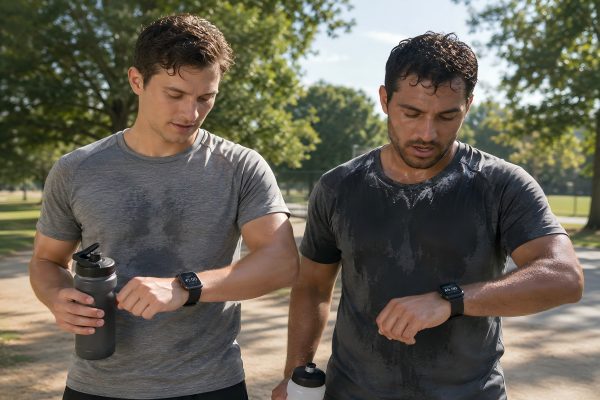
Put two people through the same summer run and the difference can look almost unbelievable. One finishes with a soaked shirt, dripping hair, and white salt marks around the collar, while the other looks only mildly sweaty. It is easy to assume the wetter person is less fit, working harder, carrying more weight, or simply “bad in the heat.” Human sweating is much more complicated. Sweat output changes with the heat your body produces, the environment around you, how well you are adapted to heat, your individual sweat-gland response, and even what happened earlier in the day.
People sweat different amounts because sweat rate is influenced by metabolic heat production, exercise intensity, genetics, body characteristics, heat acclimatization, environmental temperature, humidity, nervous-system activity, and individual sweat-gland function. Sweating more does not automatically mean someone is less fit or unhealthy. The circumstances in which sweating occurs, and how the pattern compares with that person’s normal baseline, matter far more than appearance alone.
This difference matters beyond a wet T-shirt. Two people completing the same workout can lose very different amounts of water and sodium, which means their hydration experiences may also be different. Imagine a runner who spends years assuming that everyone loses roughly the same amount of fluid because everyone follows the same training plan. The first time that runner weighs before and after a hot-weather session, a vague impression suddenly becomes measurable. That is where understanding sweat rate becomes genuinely useful.
What Controls How Much You Sweat?
Sweat production is mainly controlled by the body’s need to release heat, but there is no universal amount that everyone should produce. Core and skin temperature, metabolic workload, autonomic nervous-system signals, sweat-gland activity, clothing, airflow, heat exposure, and acclimatization all influence how much fluid reaches the skin. The same person can therefore have very different sweat rates on different days.
What Do Sweat Glands Do?
Humans are born with roughly 2–4 million sweat glands, although the number and distribution vary between individuals. Eccrine glands are especially important for temperature regulation because they release a watery fluid across much of the skin surface. When body temperature rises during exercise, hot weather, or physical work, sweat production increases so that heat can be transferred away from the body.
The cooling effect comes primarily from evaporation, not simply from being wet. Sweat that evaporates from the skin removes heat. Sweat that runs down the body, drips onto the ground, or remains trapped in clothing still represents fluid loss, but it provides less evaporative cooling. That distinction becomes particularly important in humid environments, where a person can lose a large amount of fluid without receiving the same cooling benefit they would get in dry air.
Whole-body sweating also depends on more than gland count. Researchers describe sweat output as a combination of how many glands are activated and how much fluid each active gland produces. Regional differences matter as well. The forehead, chest, back, arms, hands, legs, and feet do not necessarily produce equal amounts, so someone with a very wet face may look like the heaviest sweater in the group without necessarily having the highest whole-body sweat rate.
| Sweat Measure | Typical Context | What It Tells You |
|---|---|---|
| Sweat glands | About 2–4 million per person | Gland number varies naturally |
| Common exercise sweat rate | About 0.5–2.0 L/hour | Useful broad range, not a personal target |
| Very high exercise rates | Above 3 L/hour documented in some athletes | Possible during demanding conditions |
| Sweat pattern | Varies by body region | Visible sweat does not equal whole-body loss |
| Daily variation | Can be substantial | Heat, workload, clothing, and acclimatization matter |
The commonly cited 0.5–2.0 L/hour exercise range is useful for appreciating scale, but it is not a definition of what every person should lose. Some athletes remain below that range during cool or easy sessions, while unusually high rates above 3 L/hour have been documented in demanding sports and environmental conditions.
How Does Your Nervous System Trigger Sweating?
Sweating happens largely without conscious control. As skin and internal temperatures rise, the autonomic nervous system increases signals to the sweat glands. Physical activity accelerates the process because contracting muscles release heat as they produce energy and mechanical work. As workload rises, the body generally has more heat to remove, so sweat production often rises as well.
Thermal stress is not the only trigger. Emotional pressure can stimulate sweating even in a cool room, which is why some people notice damp palms, feet, underarms, or facial sweating before an interview, presentation, or difficult conversation. Caffeine, alcohol, spicy foods, fever, hormonal changes, and some medications can also alter normal sweating patterns. These influences help explain why a single sweaty afternoon tells you much less than a repeated pattern observed over time.
For someone trying to understand personal sweat output, context is essential. A hard morning workout after coffee, poor sleep, and a stressful commute is not physiologically identical to the same workout on a relaxed weekend. When several triggers occur together, it becomes easy to attribute the entire response to being “naturally sweaty” even though part of the difference may be temporary.
Is Sweat Rate the Same for Everyone?
Sweat rate varies widely, both between people and within the same person. An individual who loses 0.7 liters per hour during a comfortable spring run may lose well over a liter per hour when the same route is completed during summer heat. Clothing, pace, humidity, direct sunlight, recent heat exposure, and workout duration can all shift the result.
This is why comparing your shirt with someone else’s shirt is rarely useful. One person may evaporate sweat efficiently and look relatively dry, while another person’s clothing retains moisture. Even identical sweat volumes may look very different depending on fabric, airflow, and where sweat is concentrated on the body.
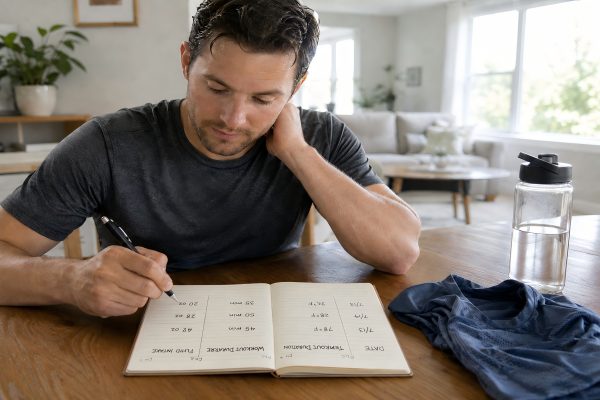
A more useful approach is to compare your own repeated sessions under similar conditions. Record the temperature, approximate humidity, exercise duration, fluid intake, clothing, and body-weight change. Over several sessions, a personal range begins to emerge. That range is far more practical for understanding hydration than asking whether you appear sweatier than your training partner.
Which Factors Make Some People Sweat More?
Differences in sweating usually come from several factors acting together rather than one simple cause. Genetics, body characteristics, workload, age, heat adaptation, stress, caffeine, food, medications, clothing, and environmental conditions can all contribute. Body weight, sex, or fitness alone cannot reliably predict who will sweat the most, particularly when people are exercising at different absolute workloads.
Do Genetics Affect How Much You Sweat?
Inherited biology contributes to individual sweating patterns, but the explanation is more complicated than saying one person was simply born with “more sweat glands.” People can differ in gland number, gland activation, secretion rate, regional sweating, nervous-system responsiveness, and sweat composition. Those characteristics are then modified by training, climate, age, hormones, medication use, and repeated exposure to heat.
Family patterns are particularly relevant in primary focal hyperhidrosis, where excessive sweating can affect areas such as the hands, feet, face, or underarms. That condition may occur in families, but ordinary heavy sweating during a difficult summer workout should not automatically be placed in the same category. A high thermoregulatory sweat rate and excessive sweating at rest are different physiological situations.
For most healthy, active adults, genetics is better viewed as part of a personal starting point. Two runners of similar age, body size, and training background can still begin sweating at different times or produce different amounts during the same session. That is one reason hydration guidance becomes more accurate when it is based on individual observation instead of assumptions based on appearance or family history.
How Do Body Size and Age Affect Sweating?
Body size can influence sweating because larger bodies may generate more absolute metabolic heat during some activities. More muscle performing more work also produces more heat. Yet the relationship is not simple enough to conclude that heavier people always sweat more. A 95-kilogram person walking at an easy pace can have a much smaller cooling demand than a 65-kilogram runner doing hard intervals.
Research controlling exercise heat production has shown that body mass, body surface area, sex, and aerobic fitness do not individually explain sweat rate as neatly as older simplified comparisons sometimes suggested. The amount of heat produced for a given task remains one of the most important pieces of the puzzle.
Age also matters, particularly when combined with differences in fitness, cardiovascular function, medications, health status, and heat exposure. Older adults may have altered heat-dissipation responses, while physically active older people can maintain stronger thermoregulatory capacity than sedentary peers. Age should therefore be considered alongside activity level and health context rather than used as a stand-alone prediction.
| Factor | Possible Effect on Sweating | Important Limitation |
|---|---|---|
| Larger body size | May increase absolute heat production | Does not always mean higher sweat rate |
| More active muscle | Can produce more metabolic heat | Depends on exercise workload |
| Increasing age | May alter thermoregulation | Fitness and medications also matter |
| Biological sex | Group differences appear in some studies | Body size and workload can explain part of the difference |
| Genetics | Influences personal sweat response | Environment and training still modify it |
| Heat exposure | Can increase and advance sweating | Response changes with acclimatization |
The practical lesson is that visible characteristics offer only clues. Sweat measurement becomes useful precisely because a person’s real response can differ from what body size, age, or fitness stereotypes would predict.
Do Hormones Affect Sweating?
Hormonal changes can alter temperature regulation and produce noticeable changes in sweating. Menopause is a familiar example because hot flashes can cause sudden warmth and perspiration that occur independently of exercise intensity or outdoor temperature. Hormonal fluctuations may also interact with sleep, stress, environmental conditions, and medication use, making the overall pattern highly individual.
It is still a mistake to explain every change in sweating through hormones. A person may simultaneously be drinking more caffeine, exercising at a harder intensity, entering hotter weather, changing medication, or sleeping poorly. These variables can overlap and make the real cause difficult to identify from a single episode.
For ordinary workout hydration, repeated sweat-rate observations usually provide more useful information than attempting to identify a hormonal explanation. If sweating suddenly changes from a person’s normal pattern, occurs repeatedly during sleep, or becomes prominent without exercise or heat exposure, the question moves beyond routine hydration and is better discussed with a qualified healthcare professional.
Can Stress, Caffeine, or Spicy Foods Increase Sweating?
Stress can produce sweating even without major heat exposure because emotional signals activate parts of the autonomic nervous system. Many people notice the effect most clearly in their palms, feet, underarms, or face. Caffeine, alcohol, and spicy foods can also increase sweating in some individuals, although sensitivity varies enough that the same cup of coffee can affect two people very differently.
These factors matter because several can appear together. A person might drink a caffeinated pre-workout, train in a warm gym, wear a non-breathable shirt, and arrive after a stressful workday. Calling the resulting sweat entirely “genetic” would miss several temporary contributors.
A simple two-week record can reveal more than memory. Note the workout, temperature, approximate humidity, clothing, caffeine intake, and unusually stressful events. Patterns often become obvious once they are written down. When heavy sweating continues without these triggers or changes sharply from a long-standing pattern, ordinary lifestyle explanations become less convincing.
Do Fitter People Sweat More During Exercise?
Fitter people may sweat earlier or more in certain situations, particularly after repeated endurance training or heat exposure, but sweat quantity is not a reliable fitness score. A trained person may produce more absolute power at the same relative effort, generating more heat, while heat acclimatization can also make sweating begin sooner. Fitness, workload, and heat adaptation need to be separated before drawing conclusions.
How Does Exercise Intensity Change Sweat Rate?
Exercise produces metabolic heat, and the harder muscles work, the more heat usually needs to be released. That is why a gentle walk, steady run, and hard interval session can produce dramatically different sweat losses even when they last the same amount of time.
Controlled exercise research has demonstrated that increasing workload can increase both total sweat output and total electrolyte loss. In one study comparing two exercise intensities, total sodium and chloride losses increased by roughly 150% at the higher workload. That figure applies to the study conditions rather than every person, but it shows how much intensity can change the hydration picture.
Two people can therefore complete what sounds like the same “60-minute cardio workout” while experiencing very different physiological loads. One may be cycling at substantially higher power, running faster, climbing a steeper incline, or carrying greater body mass. Even small differences in absolute work accumulate across an hour.
This is also why sweating is a poor measure of workout quality. A large puddle beside a stationary bike tells you that fluid was lost; it does not tell you the person achieved a better training stimulus than someone who remained relatively dry.
Does Heat Acclimation Make You Sweat Earlier?
Repeated exposure to heat can change the body’s cooling response. NIOSH describes heat acclimatization as producing several useful adaptations, including earlier sweating, greater sweat production, improved skin blood flow, and reduced electrolyte concentration in sweat. These changes help the body manage heat more effectively during repeated hot-weather exposure.
For workers entering hot environments, NIOSH generally describes an acclimatization process lasting about 7–14 days. New workers may begin around 20% of a normal heat-exposure duration on the first day, gradually increasing exposure rather than immediately completing a full workload in the heat.
This explains a situation that often surprises people. An experienced outdoor runner may begin sweating sooner than someone who has only recently started training in summer conditions. The earlier sweat response does not automatically signal poor fitness. In some circumstances it reflects a body that has become quicker at initiating evaporative cooling.
Acclimatization also fades. Time away from heat can reduce part of the adaptation, so an athlete returning after a cool-weather vacation should not assume that late-summer heat tolerance is still fully present.
Is Sweating More a Sign of Better Fitness?
No single sweat pattern proves that someone is fitter. One major problem is the meaning of “same intensity.” If two people exercise at 60% of their personal aerobic capacity, the fitter athlete may still produce much more absolute power. More mechanical work generally means greater metabolic heat, which may require more sweating.
When researchers control heat production more carefully, the apparent independent effects of fitness, body size, and sex can become smaller. That does not mean fitness is irrelevant. Training changes cardiovascular capacity, workload tolerance, and heat adaptation. It means a sweat-soaked shirt cannot isolate those effects.
A better fitness assessment uses performance variables such as pace, cycling power, lifting load, heart rate at a known workload, repeatability, or aerobic capacity. Sweat rate belongs to a different category. It helps answer questions about heat exposure and fluid loss, not whether an exercise session was successful.
People who naturally sweat heavily should therefore use that information rather than judge it. Knowing that a summer running session routinely produces large fluid losses can help someone plan water availability, clothing, and recovery more intelligently.
Does Sweating More Mean You Burn More Calories?
Sweating does not directly measure calories burned. Energy expenditure comes from metabolic processes required to perform work and maintain normal body functions. Sweating is primarily a cooling response to some of the heat generated by those processes.
The difference becomes obvious in a sauna. A person can sweat heavily while sitting almost motionless, yet energy expenditure is nowhere near what it would be during hard running. The reverse can happen during a cold-weather workout, when substantial energy expenditure occurs while visible sweating remains relatively modest.
Post-exercise scale changes create another common misunderstanding. A rapid drop in weight after a hot workout mainly reflects fluid loss. In sweat-rate calculations, an acute 1-kilogram body-mass decrease is commonly treated as approximately 1 liter of fluid loss, after accounting for drinks and urine. Once fluid is replaced, much of that scale difference returns.
Sweat can help quantify hydration demand. It should not be used as a score for calorie burn, fat loss, or the quality of a workout.
How Do Heat and Humidity Change Sweat Rate?
Heat increases the body’s demand for cooling, while humidity reduces how efficiently sweat evaporates. In a hot, humid environment, large amounts of fluid can be lost even though cooling becomes less effective. Air movement, direct sunlight, clothing, exercise intensity, and heat acclimatization further change the response, so weather temperature alone cannot predict how much someone will sweat.
How Does Hot Weather Increase Sweating?
Working muscles continuously produce heat. When air temperature rises, the difference between skin temperature and environmental temperature becomes smaller, which reduces some forms of dry heat transfer. Evaporation becomes increasingly important, especially during prolonged physical activity.
That explains why the same run can feel entirely different in April and August. Exercise sweat rates commonly fall around 0.5–2.0 liters per hour, but hotter conditions, greater workload, direct sun, larger body size, and restrictive clothing can push some people higher. Documented athlete values above 3 liters per hour demonstrate that very high losses are possible, although they are not typical for everyone.
Direct sunlight adds radiant heat that an indoor thermometer does not capture. Clothing can add another layer. Heavy work uniforms, protective gear, waterproof fabrics, and poorly ventilated athletic clothing can trap heat and moisture close to the skin.
For outdoor workers and athletes, “85°F” is therefore incomplete information. Shade, sun, humidity, airflow, clothing, work intensity, and recent heat adaptation all influence how hard the body must work to remain cool.
How Does Humidity Affect Sweat Evaporation?
High humidity makes sweat less efficient because evaporation depends partly on the difference between moisture at the skin surface and moisture in the surrounding air. When the air already contains large amounts of water vapor, sweat evaporates more slowly.
This can make humid conditions visually dramatic. Clothing becomes saturated, sweat drips from the body, and skin stays wet. In a dry climate, the same person might produce substantial sweat that disappears quickly enough to remain less obvious. Looking dry does not necessarily mean losing less fluid.
Air movement helps because moving air removes moist air from immediately above the skin, allowing additional evaporation. Cyclists often experience this effect because forward movement produces considerable airflow. Someone exercising in a still, humid indoor environment may feel much wetter despite doing similar work.
The distinction between sweat produced and sweat evaporated is therefore crucial. Both affect how a person experiences exercise, but only evaporated sweat provides its full cooling benefit.
| Environment | Sweat Behavior | Cooling Effect |
|---|---|---|
| Hot and dry | Sweat may evaporate quickly | Evaporative cooling can be efficient |
| Hot and humid | Sweat often stays on skin or clothing | Cooling becomes less efficient |
| Strong airflow | Moist air moves away from skin | Evaporation generally improves |
| Still air | Moisture accumulates near skin | Evaporation becomes more difficult |
| Direct sunlight | Radiant heat load increases | More cooling may be required |
| Heavy or protective clothing | Heat and moisture become trapped | Thermal burden can rise |
Visible sweat is therefore only part of the story. A dry shirt in a desert climate and a saturated shirt in a humid climate cannot be compared without considering evaporation.
Does Heat Acclimatization Change Your Sweat Response?
Repeated heat exposure changes both the timing and characteristics of sweating. Acclimatized people commonly begin sweating sooner and can produce greater sweat volumes while conserving more electrolytes through improved reabsorption within the sweat glands.
This adaptation is particularly relevant to athletes and people who work outdoors because their sweating pattern can change across the season. A sweat-rate measurement taken during the first hot week of spring may not perfectly describe what happens after several weeks of regular summer exposure.
The composition of sweat can change as well. Heat-acclimatized sweat tends to contain less sodium than sweat produced before adaptation, although differences between individuals remain large. That means the visible salt marks on a shirt can change with season and training history as well as with diet and sweat volume.
For practical tracking, it makes sense to repeat measurements when environmental conditions change significantly. A runner preparing for a summer race should not assume that a sweat-rate estimate collected during winter treadmill sessions remains fully representative.
Why Can Two People Sweat Differently in the Same Weather?
Two people sharing the same air temperature are not necessarily experiencing the same heat load. One may be producing more absolute power, carrying more body mass, wearing less breathable clothing, standing in direct sun, consuming more caffeine, or returning from a period without heat exposure.
Acclimatization adds another difference. Someone who has spent two weeks regularly training outdoors can respond differently from someone encountering their first hot session of the season. The more adapted person may begin sweating earlier, creating the impression that they are unusually sweaty even though the response may support better cooling.
The most informative comparison therefore uses repeatable conditions. Try the same route, duration, and approximate intensity on several days, then record temperature, humidity, clothing, body-weight change, and fluid intake. Over time, those observations can reveal whether your sweat rate consistently rises in humidity, heat, higher-intensity sessions, or particular clothing.
A statement such as “I lose around one liter per hour during easy summer runs” is useful. “I sweat more than my friend” is not.
How Does Sweating Affect Fluid and Electrolyte Loss?
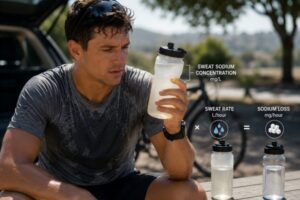
Sweating removes both water and dissolved electrolytes. Sodium and chloride are the major electrolytes lost in sweat, while potassium and smaller quantities of other minerals are also present. Total sodium loss depends on both sweat volume and sodium concentration, meaning two people who each lose one liter of sweat can still lose very different amounts of sodium.
Which Electrolytes Are Lost in Sweat?
Sweat is mostly water, but it also contains sodium, chloride, potassium, and smaller amounts of other dissolved substances. Sodium and chloride receive the greatest attention in sports hydration because they are major sweat electrolytes and because total losses can become substantial during prolonged or heavy sweating.
Sweat composition is highly individual. As sweat is produced within a gland, some sodium and chloride are reabsorbed before the fluid reaches the skin. The efficiency of that process differs between people and can change with heat acclimatization.
Research in endurance athletes demonstrates how broad the variation can be. In one study of amateur marathon runners, approximately 80% recorded sweat sodium concentrations below 60 mmol/L, leaving a meaningful minority at or above that value. Results vary by testing method, conditions, and population, so this number should not be treated as a universal cut-off.
The main point is that losing more fluid does not automatically mean having saltier sweat. Volume and concentration are separate measurements, and both influence total sodium loss.
Does Sweating More Mean You Lose More Sodium?
Greater sweat volume creates the potential for greater total sodium loss, but sodium concentration determines how much sodium is contained in each liter.
The basic relationship is:
Total sodium loss = sweat volume × sweat sodium concentration.
Research often reports sodium concentration in millimoles per liter. One millimole of sodium contains approximately 23 milligrams, so 40 mmol/L corresponds to roughly 920 mg of sodium per liter.
| Example | Sweat Volume | Sodium Concentration | Approx. Sodium per Liter | Estimated Sodium Lost |
|---|---|---|---|---|
| Lower-volume session | 0.7 L | 30 mmol/L | 690 mg/L | 483 mg |
| Moderate example | 1.0 L | 40 mmol/L | 920 mg/L | 920 mg |
| Higher-volume example | 1.5 L | 40 mmol/L | 920 mg/L | 1,380 mg |
| Saltier-sweat example | 1.0 L | 60 mmol/L | 1,380 mg/L | 1,380 mg |
These are mathematical illustrations, not intake recommendations. The table shows why two very different sweat profiles can produce the same estimated sodium loss. A high-volume sweater with moderately salty sweat and a lower-volume sweater with higher sodium concentration may finish a workout having lost similar amounts of sodium.
This point is also useful when comparing electrolyte supplements. A formula containing 1,000 mg of sodium per serving is not automatically better than one containing 300 or 500 mg. The relevant questions include exercise duration, sweat volume, diet, water volume, carbohydrate intake, and the reason the product is being used.
How Can You Estimate Your Sweat Rate?
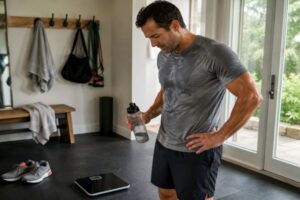
A simple field method uses changes in body mass before and after exercise while accounting for drinks consumed and urine produced. The calculation is commonly written as:
Sweat rate = (pre-exercise body mass − post-exercise body mass + fluid consumed − urine produced) ÷ exercise duration.
Consider a 75-minute run. A runner weighs 72.4 kilograms before exercise and 71.6 kilograms afterward. During the session, the runner drinks 0.5 liters and does not urinate. The body-mass decrease is 0.8 kilograms, which is treated as approximately 0.8 liters of fluid. Adding the consumed water gives about 1.3 liters of estimated sweat loss. Dividing by 1.25 hours produces an estimated sweat rate of about 1.04 L/hour.
The decimal point is less important than repetition. Measure several comparable workouts rather than relying on a single session. Dry excess sweat before the final weighing, use similar clothing, measure drinks accurately, and record environmental conditions.
Over time, you may discover that your personal range looks something like 0.7–0.9 L/hour in mild weather and 1.1–1.4 L/hour during hot summer sessions. That information is far more useful than a generic average.
Do Heavy Sweaters Always Need Electrolyte Drinks?
No. Heavy sweating does not mean every exercise session requires an electrolyte supplement. Workout duration, climate, sweat rate, diet, food timing, and total fluid loss all matter.
NIOSH workplace guidance provides a useful real-world comparison. During shorter periods of moderate work in heat, frequent water intake and ordinary meals can often provide what is needed. When heavy sweating continues for several hours, electrolyte-containing beverages may become more relevant. That distinction should not be interpreted as a universal cutoff for every athlete, but it demonstrates why context matters.
A 35-minute gym session after regular meals is very different from a four-hour hike or cycling event in summer heat. Supplement needs cannot be inferred simply from seeing sweat on a shirt.
When comparing electrolyte powders, useful label fields include sodium, potassium, magnesium, sugar, calories, intended water volume, serving size, sweetener type, and cost per serving. NutriReviewLab approaches these products through the label and use-case context rather than assuming that the largest electrolyte number automatically makes the strongest choice. For readers, that makes comparisons more relevant to real routines; for supplement brands, transparent and current product data also makes meaningful editorial evaluation much easier.
Is Heavy Sweating Always Normal?
Heavy sweating can be a normal response to strenuous exercise, environmental heat, stress, or heat acclimatization. It deserves greater attention when it develops without an obvious trigger, changes sharply from a person’s usual pattern, repeatedly occurs at rest or during sleep, or appears with other concerning symptoms. Context and change from baseline matter more than comparing yourself with other people.
What Is Hyperhidrosis?
Hyperhidrosis refers to excessive sweating that may occur even when a person is not hot or exercising. Primary focal hyperhidrosis commonly affects particular areas such as the palms, feet, face, or underarms, while secondary excessive sweating can be related to another health condition, medication, or other underlying factor.
The distinction matters because an athlete who loses 1.5 liters per hour during a demanding summer workout is not automatically experiencing hyperhidrosis. High exercise sweat rate can be an ordinary thermoregulatory response to substantial heat production.
By comparison, someone who repeatedly soaks clothing or experiences very heavy hand or foot sweating while sitting quietly in a comfortable room presents a different pattern. The amount of sweat matters, but timing and trigger matter more.
This is also where hydration content needs a clear boundary. Heavy exercise sweating naturally leads to questions about water and electrolyte loss. Unexplained sweating at rest should not be reframed as a reason to purchase an electrolyte supplement.
How Can You Tell Normal Sweating From Excessive Sweating?
There is no single liters-per-hour value that separates normal from abnormal sweating for every person. High sweat output during strenuous exercise can be entirely expected, while much smaller amounts occurring unpredictably at rest can deserve more attention.
A useful way to assess the pattern is to consider trigger, timing, change, and impact. Does the sweating mainly occur during exercise or hot weather? Has it been consistent for years, or did it begin recently? Does it happen while sleeping? Does it interfere with normal work, clothing, grip, sleep, or everyday activities?
Comparing yourself with a friend is less useful. Someone can naturally sweat more during workouts without experiencing a medical problem. The more meaningful comparison is with your own history.
If a pattern is new, unexplained, prolonged, or clearly different from normal heat- or exercise-related sweating, a qualified healthcare professional is better positioned to evaluate possible causes.
Which Changes in Sweating Deserve More Attention?
Changes from a person’s established baseline deserve more attention than simply being a naturally heavy sweater. MedlinePlus advises seeking medical guidance for unexplained excessive sweating that persists, occurs mainly during sleep, or appears alongside symptoms such as fever, rapid heartbeat, shortness of breath, chest discomfort, or unexplained weight loss.
Medication use is another important consideration because several types of medicines can alter sweating or heat tolerance. People should not stop or change prescribed medication simply because sweating appears among possible side effects; the appropriate response is to discuss the change with the prescribing healthcare professional.
During exercise or outdoor work, the situation also changes when heavy sweating occurs with dizziness, weakness, nausea, confusion, unusual fatigue, or other signs of heat stress. Sweating does not guarantee that the body is successfully controlling heat.
The safest habit is to pay attention to patterns instead of assuming every case of heavy sweating has the same explanation.
How Should You Handle Unexplained Heavy Sweating?
Start by separating predictable sweating from unexplained sweating. When heavy perspiration consistently appears during hard workouts, humid weather, stressful situations, or after caffeine, recording those conditions can reveal a stable pattern. Measuring exercise sweat rate can also show whether perceived “heavy sweating” actually represents unusually large fluid loss.
If sweating is new, persists without clear triggers, occurs predominantly at night, or appears regularly while resting, an exercise log cannot answer the entire question. That pattern deserves professional evaluation, particularly when medications or other symptoms are involved.
Electrolyte products should be kept in the right context. They can supply measurable amounts of minerals and sometimes carbohydrate during hydration routines, depending on the formula, but they do not determine the cause of unexplained sweating. For ordinary exercise, comparing labels and tracking sweat can be useful. For an unexplained physiological change, understanding the underlying reason comes first.
Conclusion
Some people sweat far more than others because sweating reflects a combination of metabolic heat production, individual sweat-gland function, genetics, body characteristics, fitness, acclimatization, temperature, humidity, clothing, stress, and activity. A soaked workout shirt does not automatically mean poor fitness, and a relatively dry athlete is not necessarily better conditioned. The most useful comparison is usually with your own repeated response under similar conditions.
For active adults, sweat becomes especially useful when it is measured rather than guessed. A basic before-and-after body-weight check can help estimate fluid loss, while understanding that sweat sodium concentration varies explains why electrolyte needs are not identical from person to person. Label information can help with hydration decisions during appropriate exercise situations, but new or unexplained heavy sweating belongs in a different category and should not be reduced to a supplement problem.
Frequently Asked Questions
Is it normal to sweat much more than other people during exercise?
Yes. Large differences in exercise sweating can occur between otherwise healthy people. Sweat rate is influenced by workout intensity, metabolic heat production, body characteristics, environmental temperature, humidity, clothing, genetics, and heat acclimatization. Exercise sweat rates commonly fall around 0.5–2.0 liters per hour, although higher and lower values occur. Comparing yourself with another person is less useful than tracking your own sweat rate during similar workouts and watching for substantial changes from your normal pattern.
Does sweating a lot mean you are out of shape?
Not necessarily. Fitness can influence thermoregulation, but sweating heavily is not evidence of poor conditioning by itself. Fitter individuals may perform more absolute work at the same relative exercise intensity and therefore generate more heat. Repeated heat exposure can also make sweating start earlier as part of acclimatization. Performance measures such as pace, power, workload, heart rate at a known effort, and progression over time provide much better information about fitness than the amount of sweat left on clothing.
Do fit people sweat more than unfit people?
Sometimes, but the relationship depends heavily on how exercise intensity is compared. A trained runner operating at 60% of personal capacity may be moving much faster and generating more absolute heat than an untrained runner at the same relative intensity. Heat-acclimatized people can also begin sweating sooner and produce more sweat. When metabolic heat production is carefully controlled, fitness alone explains less of the difference than many people expect, so sweat volume should not be treated as a simple fitness ranking.
How much sweat per hour is considered normal?
There is no single normal value for everyone, but exercise literature commonly reports whole-body sweat rates around 0.5–2.0 liters per hour. Some athletes can exceed 3 liters per hour during intense exercise or challenging environmental conditions. The same person may also move across a wide range depending on temperature, humidity, workload, clothing, and acclimatization. Personal measurements collected under similar conditions are therefore more useful than comparing one number with a population average.
Does sweating more mean you need more electrolytes?
Greater sweat volume can increase total electrolyte loss, but the relationship is not automatic because sweat sodium concentration varies widely between individuals. Someone losing 1.5 liters of moderately salty sweat can lose a similar amount of sodium to another person losing only 1 liter of much saltier sweat. Activity duration, food intake, climate, and fluid losses should all be considered. An electrolyte drink can be convenient in some prolonged or high-sweat situations, but heavy sweating alone does not mean one is required every time.
How can I calculate my sweat rate at home?
Weigh yourself before exercise, record any fluid consumed, weigh again immediately afterward after drying excess sweat, and account for any urine produced during the session. A common calculation is: pre-exercise body mass minus post-exercise body mass, plus fluid consumed, minus urine produced, divided by exercise duration. An acute body-mass decrease of approximately 1 kilogram is generally treated as about 1 liter of fluid for this field estimate. Repeating the process several times produces a more useful personal range.
When should heavy sweating be checked by a healthcare professional?
Heavy sweating deserves more attention when it is unexplained, develops suddenly, repeatedly occurs while resting or sleeping, or represents a major change from your usual pattern. Medical guidance is also appropriate when sweating appears with symptoms such as chest discomfort, fever, shortness of breath, rapid heartbeat, unexplained weight loss, confusion, or significant weakness. Heavy sweating during demanding exercise can be normal, but new or unexplained sweating should not automatically be attributed to fitness, hydration, or electrolyte intake.