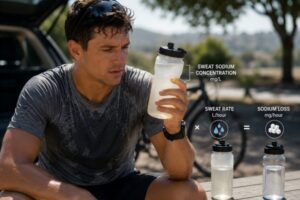

Hydration has become surprisingly complicated for something humans have managed for a very long time. A bottle of plain water now sits beside electrolyte powders, sports drinks, mineral tablets, hydration sticks, coconut-water mixes, zero-sugar formulas, endurance drinks, and products containing sodium, potassium, magnesium, vitamins, caffeine, or carbohydrates. With so many options competing for attention, it is easy to assume that water by itself is somehow incomplete. For many ordinary days and many workouts, however, that assumption does not hold up.
For most healthy adults, plain water usually makes sense when activity is short or moderate, sweating is limited, weather conditions are not extreme, and regular meals supply electrolytes. Electrolyte replacement becomes more relevant as exercise duration, intensity, heat exposure, and sweat losses rise. There is no single workout length, temperature, or sodium amount that applies equally to everyone.
The more useful question is not whether water or electrolytes are universally better. It is whether the situation creates enough fluid and mineral loss to change what needs to be replaced. Picture two people finishing identical 45-minute workouts. One leaves an air-conditioned gym with a slightly damp shirt. The other finishes an outdoor summer run with soaked clothing and visible salt marks. Their watches show the same exercise time, yet their hydration situations are clearly not the same. Understanding that difference makes the rest of the water-versus-electrolyte conversation much easier.
Is Water Enough for Everyday Hydration?
For most healthy adults, plain water is usually sufficient for routine hydration when activity is moderate, sweating is limited, meals are regular, and the environment is comfortable. Electrolytes remain essential nutrients, but that does not mean they must come from a drink mix every day. Normal food, beverages, and the body’s regulatory systems already contribute to everyday fluid and mineral balance.
What Counts as Normal Daily Hydration?
Everyday hydration includes much more than the amount of plain water poured into a reusable bottle. Total water intake comes from drinking water, coffee, tea, milk and other beverages, plus the moisture naturally contained in food. The National Academies established an Adequate Intake for total water of approximately 3.7 liters per day for adult men and 2.7 liters per day for adult women. Those figures are population reference values rather than fixed prescriptions for every individual.
The same reference data estimated that beverages provided approximately 81% of total water intake, while food supplied roughly 19%. For adult men, the reference corresponded to about 3.0 liters from beverages, and for women, approximately 2.2 liters from beverages. This is an important distinction because the frequently repeated 3.7-liter figure does not mean every man should drink 3.7 liters of plain water each day. Climate, body size, activity, diet, pregnancy, and sweat losses can all move individual needs considerably.
| Adult Reference | Total Water AI | Approx. From Beverages | Approx. From Food |
|---|---|---|---|
| Adult men | 3.7 L/day | 3.0 L/day | 0.7 L/day |
| Adult women | 2.7 L/day | 2.2 L/day | 0.5 L/day |
| Typical contribution | 100% | ~81% | ~19% |
A normal hydration day might involve several hours at a desk, commuting, preparing meals, walking a dog, shopping, and perhaps a short workout. In such circumstances, fluid is continually lost through breathing, urine, and modest perspiration, but the losses are usually very different from those created by several hours of outdoor labor or endurance exercise. The useful question is therefore whether anything unusual is increasing fluid loss, not whether every bottle needs added minerals.
Do Most Adults Need Electrolytes Every Day?
Electrolytes are necessary for normal nerve signaling, muscle function, fluid regulation, and many other physiological processes, but “essential nutrient” and “essential supplement” are not interchangeable ideas. Sodium, potassium, magnesium, calcium, and chloride are widely available through food. For someone eating regular meals and losing relatively little sweat, adding a dedicated electrolyte product throughout the day may provide minerals that were already readily available from the diet.
Sodium illustrates the issue particularly well. The FDA Daily Value is less than 2,300 mg of sodium per day, while average sodium intake in the United States has been reported at roughly 3,400 mg per day. Someone spending most of the day in a climate-controlled office should therefore not assume that more sodium automatically improves hydration. A high-sodium formula can be useful in an appropriate heavy-sweat setting while being unnecessary for another person’s ordinary afternoon.
The hydration supplement category also varies enormously. One powder may provide substantial sodium with almost no sugar, another may emphasize potassium and magnesium, and another may combine electrolytes with carbohydrates, vitamins, amino acids, botanical ingredients, or caffeine. The word “electrolytes” on the front of a package tells the reader very little about how the formula is actually built. Supplement Facts remain much more informative than front-label positioning.
How Do Activity and Environment Change Water Needs?
Hydration requirements are dynamic because activity and environment can dramatically alter water turnover. A person sitting indoors for eight hours and another person moving equipment outdoors for eight hours may both describe themselves as having had a “normal workday,” yet their fluid losses can differ by liters. Exercise intensity, duration, air temperature, humidity, airflow, clothing, protective equipment, body size, and acclimatization all affect the practical hydration picture.
Humidity deserves particular attention because sweating does not cool the body simply by appearing on the skin. Cooling depends heavily on evaporation. In a humid environment, sweat may evaporate less efficiently, so the body can continue producing substantial sweat without receiving the same cooling effect. Heavy clothing, uniforms, and protective equipment can create similar problems by trapping heat and reducing evaporation.
This is why broad rules such as “always take electrolytes after exercise” or “water is enough for every workout under one hour” should be treated as starting points rather than laws. An easy 60-minute indoor walk may involve little sweating, while 45 minutes of vigorous outdoor intervals in summer can involve substantial fluid and sodium loss. Context matters more than the number on the timer.
Is Drinking More Water Always Better?
More water is not automatically better because hydration is about replacing an appropriate amount, not maximizing fluid intake. During prolonged activity, consuming far more fluid than is lost can dilute blood sodium. Exercise-associated hyponatremia has been documented in endurance events, particularly when participants drink aggressively despite relatively low sweat losses. The lesson is not to fear water; it is to avoid treating unlimited intake as an inherently healthier strategy.
Healthy adults going through ordinary daily routines can generally use thirst, meal patterns, activity, and environmental conditions as practical feedback. During demanding endurance events, hot-weather work, or unusually high sweat losses, hydration planning can become more structured. Even in those settings, the objective is not to meet an arbitrary number of bottles. The objective is to avoid both large fluid deficits and excessive replacement.
This balanced approach also makes supplement decisions easier. If ordinary water, meals, and normal drinking behavior already match the situation, adding more minerals may offer flavor or convenience rather than a physiological necessity. When losses clearly increase, the decision changes because the replacement problem itself has changed.
Which Workouts Usually Need Only Water?
Plain water commonly works well for shorter or moderate workouts performed in normal weather when sweating remains modest. Sports nutrition guidance generally treats ordinary fitness activity differently from extended endurance exercise. Exercise duration is useful for screening hydration needs, but intensity, sweat rate, clothing, heat, and individual physiology can make two workouts of the same length very different.
Is Water Enough for Short Workouts?
A 30-minute walk, 45-minute strength session, recreational bike ride, yoga class, or moderate gym workout usually creates a different replacement problem from a marathon, long cycling session, or multi-hour summer hike. When someone begins reasonably hydrated, exercises under comfortable conditions, and finishes without major sweat loss, plain water often handles the fluid portion of the routine perfectly well.
Current ACSM educational guidance notes that most fitness exercisers and athletes training for less than approximately 60–90 minutes per day in normal weather are unlikely to become substantially depleted of fluid or electrolytes. The same guidance highlights endurance athletes, people spending long periods in the heat, athletes in heavy uniforms, and unusually heavy sweaters as situations in which more deliberate fluid and electrolyte planning deserves attention.
The key phrase is “normal conditions.” A 50-minute treadmill walk in an air-conditioned fitness center is very different from a 50-minute outdoor run in humid summer weather. Nothing biologically dramatic happens when a workout reaches exactly 60 minutes. Time is useful because losses accumulate, but the timer is only one variable in a much larger picture.
How Does Exercise Duration Change Hydration Needs?
As activity continues, modest hourly losses can become substantial cumulative losses. This is why a one-hour recreational gym session usually deserves a different hydration strategy from three hours of running, cycling, hiking, tennis, outdoor work, or tournament play. The longer the activity continues, the more opportunities there are for both fluid and sodium losses to accumulate.
A useful framework is to combine duration with what is actually happening during the session rather than relying on time alone.
| Activity Pattern | Water-Alone Fit | Main Factor to Watch |
|---|---|---|
| 20–45 min, light/moderate | Usually strong | Thirst and basic fluid access |
| 45–60 min, moderate | Often strong | Sweat level and intensity |
| 60–90 min, normal conditions | Often reasonable | Personal sweat rate and heat |
| 90+ min sustained exercise | More situation-dependent | Cumulative fluid and sodium loss |
| Multi-hour endurance activity | Electrolytes become more relevant | Sweat, sodium, carbohydrate and food access |
| Any length with very heavy sweating | Requires closer evaluation | Actual losses may outweigh workout duration |
The framework intentionally avoids a hard cutoff because the same 75-minute duration can produce very different losses. A person finishing nearly dry after a cool-weather walk is not in the same situation as someone whose clothing is saturated after 75 minutes of continuous running.
Longer exercise can also change the nutrition question beyond electrolytes. Once activity becomes prolonged, carbohydrate intake may become relevant for performance and fueling. At that point, choosing between plain water, a low-calorie electrolyte drink, and a carbohydrate-containing sports drink depends partly on what the beverage is expected to accomplish.
How Does Exercise Intensity Affect the Choice?
Exercise intensity affects metabolic heat production, and greater heat production often leads to more sweating. This explains why a relatively short but demanding session can sometimes create more fluid loss than a longer easy workout. The label attached to the activity—strength training, running, cycling, or group fitness—does not tell the entire story unless the actual workload and environment are considered.
Imagine two people training for 45 minutes. One performs controlled strength sets with two-minute rest periods in a cool gym. The other performs outdoor hill intervals with very short recovery periods. Both exercised for the same amount of time, but the second session likely involves more continuous cardiovascular work, greater heat production, and a greater chance of substantial sweating.
Individual fitness and heat acclimatization add another layer. Experienced athletes can have very different sweat responses from beginners, and people who regularly train in hot environments can adapt over time. These differences make fixed one-packet-per-workout recommendations convenient for packaging but poor substitutes for understanding the situation itself.
Do Strength and Endurance Workouts Differ?
Strength and endurance workouts often create different hydration patterns because their work-to-rest structures are different. Traditional resistance training usually includes substantial rest between sets, equipment changes, and periods of relatively low movement. Running, cycling, rowing, or similar endurance exercise can involve continuous activity for one, two, or several hours, allowing sweat losses to accumulate without long recovery periods.
That does not mean strength training never requires more than water. High-volume circuits, heated training spaces, heavy equipment, minimal rest, and unusually high individual sweat rates can make a strength session demanding from a hydration perspective. Similarly, not every endurance activity automatically requires an electrolyte formula. A casual 30-minute bike ride in mild conditions still sits much closer to ordinary recreational exercise.
Long endurance activity introduces another important distinction: some beverages supply both electrolytes and carbohydrate, while others contain minerals with little or no energy. A zero-sugar hydration powder and a carbohydrate sports drink therefore should not be judged by identical standards. One may be intended mainly for mineral replacement, while the other also serves a fueling purpose during extended exercise.
How Do Heat and Sweat Change the Answer?
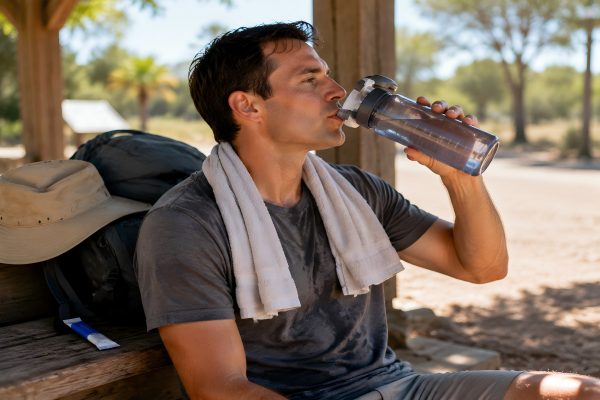
Heat and sweating can shift a water-first routine toward more deliberate electrolyte replacement, particularly when sweating continues for several hours. Temperature alone is not the deciding factor. Workload, duration, humidity, clothing, acclimatization, and personal sweat rate all influence fluid and mineral losses, which is why prolonged outdoor work can resemble endurance sport from a hydration perspective.
Does Hot Weather Mean You Need Electrolytes?
Hot weather by itself does not mean every person needs an electrolyte drink. Someone sitting in the shade for 30 minutes and someone landscaping for four hours can experience the same outdoor temperature while producing completely different amounts of sweat. The intensity and duration of physical work are therefore just as important as the number displayed by a weather app.
CDC/NIOSH heat guidance provides a useful real-world example. For moderate activity in the heat lasting less than two hours, workers are advised to drink approximately 8 ounces, or one cup, of water every 15–20 minutes. When sweating continues for several hours, balanced-electrolyte sports drinks become more relevant. The agency also advises that fluid intake generally should not exceed six cups per hour.
| Heat-Exposure Situation | General CDC/NIOSH Guidance | Approximate Amount |
|---|---|---|
| Moderate work in heat, under 2 hours | Water every 15–20 minutes | 8 oz at a time |
| Three drinking intervals per hour | Water | ~24 oz/hour |
| Four drinking intervals per hour | Water | ~32 oz/hour |
| Sweating for several hours | Balanced electrolytes become more relevant | Situation-dependent |
| General upper intake guidance | Avoid excessive fluid intake | Usually ≤48 oz/hour |
These are occupational guidelines rather than personalized sports prescriptions, but they illustrate an important principle clearly: even in the heat, water remains central. The case for electrolyte replacement becomes stronger when exposure and sweating are prolonged rather than simply because the day is warm.
How Does Heavy Sweating Affect Electrolyte Loss?
Sweat contains much more than water. Sodium and chloride are particularly important, along with smaller amounts of potassium and other minerals. Sodium receives the greatest attention in endurance hydration because a high sweat rate combined with meaningful sodium concentration can create substantial total losses over several hours.
ACSM educational material gives an illustrative figure of approximately 500–700 mg of sodium lost during an hour of vigorous exercise for some heavy sweaters. That number should not be converted into a universal instruction to consume 500–700 mg every hour. Individual sodium concentrations and sweat volumes vary considerably, and some people may fall well outside that example.
Visible clues can still be informative even when they are not laboratory measurements. Clothing that becomes saturated quickly, repeated white salt marks after workouts, frequent high-volume sweating, or a consistent pattern of large body-mass changes during exercise may indicate that a generic light-workout hydration strategy does not fit especially well.
For someone who wants a more structured estimate, pre- and post-exercise body weight can help approximate sweat loss. A 1-kilogram decrease in body mass is approximately equivalent to 1 liter of net fluid loss before adjustments for drinking and urine production. Repeating measurements under comparable conditions can provide more useful personal information than copying another athlete’s routine.
Why Do Sweat Rates Differ Between People?
Sweat rate depends on far more than fitness level. Body size, exercise intensity, air temperature, humidity, sun exposure, airflow, clothing, equipment, heat acclimatization, and individual physiology all influence how quickly a person produces sweat. This is why two people running side by side at the same pace can finish with remarkably different clothing saturation and fluid needs.
Heat acclimatization changes the response further. Repeated exposure to hot conditions can improve the body’s ability to manage heat, alter the timing and volume of sweating, and increase sodium conservation. An athlete beginning summer training may therefore experience a somewhat different sweat profile several weeks later, even when performing similar sessions.
Protective equipment is another practical example. A construction worker, firefighter, football player, or industrial employee wearing heavy clothing may experience a microenvironment that traps heat and moisture. A runner in shorts and a light shirt can dissipate heat much more easily. Describing both people simply as “exercising for one hour” hides the most important differences.
Is Workout Length More Important Than Sweat Loss?
Workout length and sweat rate answer different questions, so neither should replace the other. Duration indicates how long fluid and mineral losses have had time to accumulate. Sweat rate indicates how quickly those losses are occurring. Environmental conditions help explain why one person’s rate may be relatively low while another person’s is substantial.
Consider a simplified example. At a sweat rate of 0.3 liters per hour, one hour produces relatively modest fluid loss. At 1.2 liters per hour, the same period produces four times as much sweat. If sodium concentration also differs, the difference in electrolyte loss can become even greater. This is why the same one-hour rule does not work equally well across sports, climates, or individuals.
Duration still has practical value because anyone can read a clock. A realistic approach is to use workout length as the first filter and then look for factors that change the answer: soaked clothing, hot or humid weather, continuous high intensity, multi-hour activity, or large body-mass changes. When several of these appear together, water-only hydration deserves closer evaluation.
Do Meals Usually Provide Enough Electrolytes?
Regular food contributes meaningful amounts of sodium, potassium, magnesium, calcium, and chloride, so many healthy adults obtain their everyday electrolytes without a dedicated hydration supplement. After lighter exercise, plain water followed by a normal meal can often replace fluid while food supplies minerals. The need for targeted replacement increases mainly when sweat losses become prolonged or meals are not readily available.
Which Foods Supply Everyday Electrolytes?
Electrolytes are ordinary nutrients found throughout the food supply. Potassium occurs in potatoes, beans, fruits, vegetables, dairy products, fish, poultry, meat, and nuts. Magnesium is present in seeds, legumes, nuts, whole grains, leafy vegetables, and dairy. Calcium is abundant in milk, yogurt, cheese, fortified foods, selected vegetables, and fish such as canned sardines or salmon with edible bones.
The amounts can be meaningful. NIH nutrient data list approximately 156 mg of magnesium in one ounce of roasted pumpkin seeds, around 80 mg in one ounce of almonds, and approximately 78 mg in half a cup of cooked spinach. Recommended magnesium intake for adults generally falls around 310–420 mg per day, depending on sex and life stage, which shows how ordinary foods can make substantial contributions.
Potassium provides an even clearer example of the scale involved. Adequate Intake levels are approximately 3,400 mg per day for adult men and 2,600 mg for adult women. Many electrolyte powders provide only a fraction of those amounts because their role is not to replace the entire daily diet. The product may be designed around exercise convenience, sodium replacement, flavor, portability, or a specific mineral balance rather than complete daily nutrition.
This distinction helps consumers interpret Supplement Facts more realistically. An electrolyte powder does not need to contain the full daily requirement of every mineral to have a legitimate use, but a tiny amount of potassium or magnesium also should not be mistaken for complete nutritional coverage merely because those minerals appear on the front label.
Do You Need Electrolyte Drinks With a Balanced Diet?
For an ordinary day with regular meals and modest activity, many healthy adults do not need a dedicated electrolyte drink simply to obtain minerals. Sodium is particularly abundant in the U.S. diet, with average intake around 3,400 mg per day, above the FDA Daily Value of 2,300 mg. That makes blanket advice to consume additional sodium throughout every ordinary day difficult to justify.
The calculation changes when losses happen faster than meals can replace them. A cyclist riding for three hours, a tennis player completing repeated matches in the heat, or an outdoor worker sweating through most of a shift has fewer opportunities to depend entirely on the next meal. A portable electrolyte beverage can become more useful because minerals and fluid can be consumed during the period when losses are occurring.
Convenience should not be dismissed as trivial. Single-serve packets, predictable sodium amounts, measured mixing instructions, and flavors that encourage regular drinking can all have practical value. The important distinction is whether the product is solving a genuine use-case problem or simply being added to a routine because electrolyte supplementation has become fashionable.
NutriReviewLab applies the same principle when evaluating hydration products. Electrolyte profile, sugar and sweetener profile, ingredient transparency, use-case fit, serving information, and value are more meaningful than broad front-label terms. A product that fits a sweaty endurance routine should not automatically receive the same recommendation for ordinary desk-based hydration.
Is Water Plus Food Enough After Light Exercise?
For many light or moderate workouts, water followed by a normal meal is a straightforward recovery pattern. Water replaces fluid, while food contributes minerals and macronutrients. A meal containing potatoes, vegetables, dairy, beans, grains, fish, meat, nuts, or seeds can provide sodium, potassium, magnesium, calcium, carbohydrate, and protein without requiring those nutrients to come from one beverage.
This is why “plain water after exercise” can be a misleading phrase. Someone drinking water after a 45-minute gym session and eating dinner 30 minutes later is not relying on water for every nutrient involved in recovery. Fluid comes from the beverage, while minerals and energy come from the meal. That is very different from completing several hours of endurance exercise with no food access.
FDA Daily Values provide helpful label context: 2,300 mg sodium, 4,700 mg potassium, 420 mg magnesium, and 1,300 mg calcium for adults and children age four and older. These are daily labeling references, not per-workout replacement targets. A powder containing 500 mg sodium contributes about 22% of the sodium Daily Value, but whether that amount matches a particular workout depends on actual losses.
The distinction between daily nutrition and sweat replacement is one of the easiest places for hydration marketing to become confusing. A meaningful label review asks what the formula provides, what the person has lost, and what the rest of the diet is already contributing.
Does Diet Change Hydration Needs?
Diet changes the context surrounding hydration even when it does not directly determine sweat rate. Someone eating three regular meals has repeated opportunities to replace sodium, potassium, magnesium, and other nutrients. Someone training for several hours without food access has fewer. That difference affects whether an electrolyte beverage offers meaningful convenience during the activity.
Fasting schedules, low-carbohydrate diets, unusually salty diets, very low-sodium meal patterns, and heavy reliance on processed foods can all change what a person consumes before a hydration product is added. Those patterns do not automatically create a need for a particular supplement, but they show why the rest of the diet belongs in the discussion.
Food also contributes water. National Academies data estimate that roughly one-fifth of total water intake in U.S. adults comes from food. Water-rich foods can contribute considerably: oranges are around 87% water, broccoli around 89%, and cantaloupe around 90% by weight. A person eating soups, fruit, vegetables, yogurt, and other moisture-rich foods may therefore obtain more total water from meals than someone eating mostly dry packaged foods.
Hydration is best viewed as a complete daily system involving beverages, food moisture, minerals, activity, climate, and sweat loss. Looking only at the water bottle misses a large part of the picture.
When Are Electrolytes More Useful Than Water?
Electrolytes become more useful when sustained sweating creates meaningful mineral losses alongside water loss. Multi-hour endurance exercise, repeated sessions in hot weather, long outdoor work shifts, tournaments, and unusually heavy sweating are common examples. The relevant question is not whether exercise occurred, but whether enough fluid and sodium were lost to make targeted replacement useful before normal meals can catch up.
How Does Prolonged Exercise Change the Choice?
Time magnifies small hourly losses. A moderate sweat rate that seems insignificant during a 30-minute workout can become meaningful over three or four hours. For illustration, a person sweating at 0.75 liters per hour for three hours would produce approximately 2.25 liters of sweat. Actual rates vary widely, but the calculation demonstrates how duration can transform a modest rate into a substantial cumulative fluid loss.
Long-duration exercise can also make the beverage responsible for more than hydration. Endurance athletes may need carbohydrate during extended training or competition, which is one reason conventional sports drinks often combine sodium with sugar or other carbohydrates. By contrast, many modern electrolyte powders provide little or no carbohydrate because they are designed for consumers prioritizing mineral replacement without meaningful calories.
Those two types of products should not be evaluated using identical criteria. A zero-sugar electrolyte mix can be entirely appropriate for a user who does not need exercise fuel from the beverage. A carbohydrate-electrolyte drink can make more sense during prolonged endurance exercise where energy intake is part of the plan.
From a product-review perspective, the first question should therefore be what job the formula is designed to perform. Sodium, carbohydrate, calories, caffeine, mixing volume, serving size, and intended activity provide much clearer answers than phrases such as “advanced hydration” or “maximum electrolyte support.”
Do Heavy Sweaters Need a Different Strategy?
Heavy sweaters can accumulate water and sodium losses quickly enough that generic hydration rules become less useful. ACSM educational material uses roughly 500–700 mg of sodium lost during an hour of vigorous exercise as an example for some heavy sweaters. The figure illustrates how meaningful losses can become, but it is not an instruction for every person to consume that amount every hour.
Sweat loss depends on both the amount of sweat produced and its mineral concentration. Someone who sweats 0.5 liters per hour with relatively low sodium concentration has a different replacement problem from someone producing 1.5 liters per hour with saltier sweat. Duration, food intake, weather, and the ability to drink during activity further change what replacement strategy is practical.
A simple field estimate can make personal patterns more visible. Sweat loss can be approximated from the change in body mass while accounting for fluid consumed and urine produced. For example, if someone finishes an hour 0.8 kg lighter, drinks 0.4 liters during the session, and does not urinate, estimated sweat production is approximately 1.2 liters for that hour.
Repeated observations under similar conditions are more useful than one measurement because sweat rate changes with temperature and workload. This is also why two products providing 100 mg and 1,000 mg sodium per serving should not be presented as interchangeable “electrolyte powders.” Their formula profiles suggest very different potential use cases.
Are Electrolytes Useful During Long Hours in the Heat?
Several hours of sweating in the heat is one of the clearest situations in which electrolyte-containing beverages become more relevant. CDC/NIOSH distinguishes shorter heat exposure from prolonged sweating by recommending water for moderate heat work under two hours and balanced-electrolyte drinks when sweating continues for several hours.
Outdoor workers deserve the same attention as athletes. Construction crews, landscapers, warehouse employees in hot facilities, agricultural workers, delivery personnel, and people wearing protective equipment can experience prolonged fluid losses without ever describing the activity as exercise. The physiology does not care whether the sweating came from a marathon or a demanding work shift.
Long summer hikes, cycling events, tournaments, and repeated outdoor training can create similar conditions. Access to shade, food, fluid, breaks, and cooling often becomes part of the practical challenge. A portable electrolyte packet can be useful in these environments because it supplies predictable amounts of minerals without requiring the user to carry multiple foods.
Electrolyte beverages, however, do not make unlimited work or exercise in extreme heat safe. Hydration remains only one part of heat management. Acclimatization, work-rest schedules, shade, cooling opportunities, appropriate clothing, and attention to heat-related symptoms remain important. A supplement should never be positioned as a substitute for basic heat-safety practices.
Which Electrolyte Label Details Matter Most?
Once an electrolyte product actually fits the situation, comparing labels becomes much more useful than comparing slogans. Sodium usually deserves the first look in sweat-replacement products because it is the major electrolyte lost in sweat. A formula providing 50 mg sodium and one providing 1,000 mg per serving are fundamentally different despite belonging to the same retail category.
| Label Field | What to Check | Why It Matters |
|---|---|---|
| Sodium | mg per serving | Helps show whether formula is light or high-sodium |
| Potassium | mg per serving | Adds context to overall electrolyte profile |
| Magnesium | mg and ingredient form | Useful for dose and formula transparency |
| Carbohydrate | grams per serving | Shows whether drink also provides exercise fuel |
| Total/Added Sugar | grams per serving | Helps distinguish sports fuel from low-sugar hydration |
| Calories | kcal per serving | Useful when comparing daily vs endurance products |
| Caffeine | mg per serving | Distinguishes hydration-only from energy formulas |
| Mixing volume | oz or mL water | Changes concentration and drinking experience |
| Servings | count per package | Needed for value calculations |
| Price per serving | current price ÷ servings | More useful than package price alone |
Potassium and magnesium should also be interpreted carefully. Higher quantities do not automatically make a better hydration product. Their daily nutrition requirements are much larger than the small quantities contained in many drink mixes, and the role of a sports hydration product is not necessarily to deliver a complete day’s intake.
Sugar and carbohydrate reveal whether a formula doubles as exercise fuel. Caffeine reveals whether the product is really a hydration-energy hybrid. Sweetener type can influence taste and consumer tolerance, while mixing volume determines how concentrated the final beverage will be. These details often explain more about a product’s intended use than the marketing copy on the front of the package.
NutriReviewLab’s product-review framework emphasizes verifiable SKU-level data, current labels, consistent comparison fields, price-per-serving calculations, clear use-case fit, and transparent commercial disclosure. Products associated with commercial relationships are expected to be evaluated under the same comparison standards rather than receiving automatic preference.
How Can You Choose Water or Electrolytes?
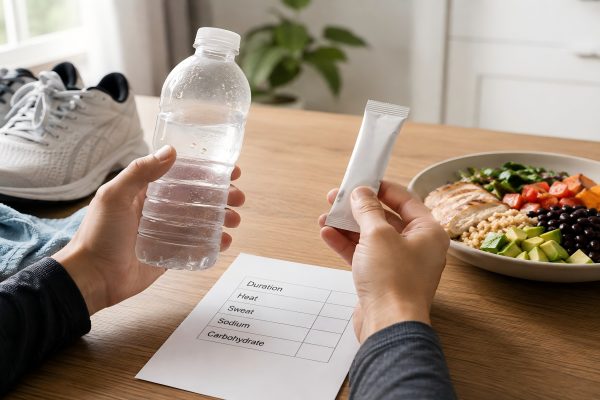
Start with the situation rather than the supplement. Plain water is a practical default for ordinary days and many shorter workouts. Electrolytes deserve greater attention as duration, intensity, environmental heat, and sweat losses increase. When a product is considered, compare its actual sodium, carbohydrate, sugar, caffeine, serving size, and intended use instead of assuming that more minerals automatically mean better hydration.
What Questions Should You Ask First?
The simplest way to choose is to begin with what the activity demands. Ask how long it will last, how hard the effort will be, how hot or humid the environment is, and how much you normally sweat. Those four questions often reveal whether the situation still resembles ordinary hydration or has moved into a more demanding replacement problem.
Then consider what happens around the activity. Will you eat a regular meal shortly afterward? Can you carry food? Are you training repeatedly during the day? Is the activity continuous for several hours? A 40-minute gym session followed by lunch and a three-hour summer ride with no easy access to food should not lead to the same beverage choice.
The goal is not to calculate every milligram perfectly. It is to recognize broad differences in demand. Water works very well when losses are modest. Electrolyte products become more relevant when sweating is sustained. Carbohydrate-containing sports drinks deserve separate consideration when long-duration exercise also creates a fueling requirement.
For consumers comparing products, this sequence prevents buying the formula first and inventing a reason for using it afterward. For brands developing hydration products, it also encourages more precise positioning around measurable use cases rather than claiming that every person needs a complex formula every day.
Is More Electrolyte Always Better?
More is not automatically better because electrolyte quantity only becomes meaningful in relation to the use case. A high-sodium product can be well suited to sustained heavy sweating while offering little advantage to someone completing a short, light workout. A lower-sodium product may better fit an everyday flavored hydration routine while being less useful for someone experiencing large sweat sodium losses.
The same reasoning applies to magnesium and potassium. Adult magnesium recommendations generally range from approximately 310–420 mg per day, yet those requirements are normally met across the entire diet rather than through a single hydration drink. Potassium needs are measured in several thousand milligrams per day. A product’s 50 or 100 mg contribution can be legitimate without meaning it is a comprehensive potassium supplement.
Consumers should therefore be cautious when marketing turns total electrolyte milligrams into a quality score. A number such as “1,000 mg electrolytes” tells relatively little unless the label identifies how much is sodium, potassium, magnesium, calcium, or another mineral. The formula may be dominated by one ingredient while providing only small quantities of the others.
A stronger comparison looks at the complete label: mineral amounts, carbohydrate, sugar, sweetener type, caffeine, mixing instructions, serving count, allergens, portability, and price per serving. The best-matched product is the one whose profile fits the activity and preferences, not necessarily the product with the largest number on the package.
How Can You Avoid Overcomplicating Hydration?
Hydration does not need to become a multi-product ritual. On an ordinary day, keeping water available, drinking normally, eating regular meals, and adjusting intake when activity or heat rises remains a sensible foundation. A specialized hydration product becomes worth comparing when there is a clear reason for needing more than ordinary fluid and food.
Product serving directions should also be interpreted correctly. “One packet daily” explains how a particular manufacturer intends its product to be used. It does not prove that every person loses the exact minerals contained in one packet each day. Likewise, the phrase “daily hydration” on packaging describes product positioning rather than demonstrating that plain water is inadequate for daily life.
Consumers can also avoid complexity by separating hydration, electrolyte replacement, and exercise fueling. Sometimes only fluid is needed. Sometimes fluid and sodium become relevant. During long endurance activity, carbohydrate may also matter. Treating those as three separate questions makes the shelf much easier to understand.
The same clarity benefits the supplement industry. A product positioned precisely for its intended environment—daily flavored hydration, heavy sweating, endurance fueling, travel convenience, or another defined routine—is easier to evaluate and more credible than one presented as the solution for every hydration situation.
When Should You Seek Individual Guidance?
General hydration guidance works best for generally healthy adults dealing with normal life, exercise, and environmental conditions. It becomes less appropriate when fluid or electrolyte needs are affected by pregnancy, medications, medically directed sodium restrictions, kidney function, heart conditions, or another situation in which fluid and mineral intake is already being actively managed.
People who have been advised to restrict sodium, potassium, or total fluid should not replace individualized professional guidance with a generic sports-drink recommendation. Certain medications can also influence fluid and electrolyte balance, making a seemingly ordinary high-sodium or high-potassium product more complicated than its marketing suggests.
The same caution applies to unusually demanding endurance activity. Athletes repeatedly completing multi-hour sessions, experiencing very high sweat rates, or dealing with recurrent hydration difficulties may benefit from a more individualized plan based on measured sweat patterns rather than broad product serving instructions.
For everyone else, the decision usually stays much simpler. If the day involves regular meals, comfortable conditions, modest activity, and relatively little sweating, plain water often remains completely reasonable. As workload, environmental stress, and cumulative sweat losses move further from that baseline, targeted hydration planning becomes progressively more useful.
Conclusion
Plain water remains one of the most appropriate hydration choices for ordinary daily life, short or moderate workouts, comfortable conditions, and situations where sweat losses are limited and regular meals provide minerals. Electrolytes do not become necessary simply because exercise occurred or because hydration products are widely marketed. The important variables are duration, intensity, environmental heat, sweat rate, access to food, and individual circumstances.
Electrolyte products become more relevant as losses become sustained, particularly during multi-hour activity, heavy sweating, and prolonged work or exercise in the heat. When a product fits the situation, the Supplement Facts panel matters more than the front label. Sodium, potassium, magnesium, carbohydrate, sugar, caffeine, mixing volume, serving size, and price all help reveal what the formula is actually designed to do. A good hydration decision is therefore less about choosing water or electrolytes as permanent sides and more about matching the simplest appropriate option to the conditions in front of you.
Frequently Asked Questions
Is Water Better Than Electrolyte Drinks?
Neither option is universally better. Plain water usually makes more sense for ordinary daily hydration and many short or moderate workouts because additional minerals may not be needed when sweating is limited and normal meals are available. Electrolyte drinks become more useful when substantial sweating continues long enough for sodium and other mineral losses to matter. The best choice therefore depends on activity duration, heat, sweat rate, diet, and the actual formula being compared.
Do I Need Electrolytes for a One-Hour Workout?
Many healthy adults completing approximately one hour of moderate exercise in normal weather can rely primarily on water, especially when they do not sweat heavily and will eat normally afterward. The one-hour mark is not a strict biological cutoff, however. A vigorous outdoor workout in high heat may produce substantial losses within an hour, while an easy indoor session lasting slightly longer may produce relatively little sweat. Duration should always be interpreted alongside intensity and environment.
How Much Water Should an Adult Drink Each Day?
The National Academies established total water Adequate Intake values of approximately 3.7 liters per day for adult men and 2.7 liters for adult women, but these figures include water from both beverages and food. Roughly 81% was estimated to come from beverages and 19% from food in the reference data. Individual requirements vary with activity, climate, body size, diet, pregnancy, and other factors, so these values should not be treated as mandatory plain-water quotas.
When Should I Drink Electrolytes Instead of Water?
Electrolyte drinks become more relevant when sweating is sustained or substantial, such as during multi-hour endurance activity, repeated exercise in hot weather, demanding outdoor work, or unusually heavy sweating. They may also be convenient when normal meals are not available during prolonged activity. Short, light activities with limited sweat generally create a different replacement need, which is why water often remains the simpler choice under those conditions.
Can Food Provide Enough Electrolytes?
For many healthy adults during ordinary daily life, food supplies substantial amounts of sodium, potassium, magnesium, calcium, and chloride. Potatoes, beans, vegetables, fruit, dairy, nuts, seeds, fish, whole grains, and normal seasoned meals can all contribute. Food does not eliminate the possible usefulness of electrolyte drinks during prolonged heavy sweating, but it explains why a person eating regular meals does not necessarily need an electrolyte supplement simply to obtain essential minerals every day.
Are Electrolyte Drinks Necessary Every Day?
Most healthy adults do not automatically need an electrolyte drink every day. Daily necessity depends on actual fluid and mineral losses rather than the fact that electrolytes are essential nutrients. Someone spending a normal day indoors with regular meals has a very different need from an endurance athlete or outdoor worker sweating for several hours. Regular use may still be chosen for convenience or flavor, but those preferences should be separated from a physiological requirement for extra electrolytes.
Can You Drink Too Much Water During Exercise?
Yes. Drinking far more fluid than is being lost can be problematic during prolonged exercise because excessive water intake may dilute blood sodium. This is one reason modern sports-hydration guidance focuses on appropriate replacement rather than forcing unlimited fluid. The practical goal is to avoid both substantial fluid deficits and excessive intake. Longer endurance events and unusually demanding environments may warrant more individualized planning than a simple instruction to drink as much water as possible.