
What Happens to Electrolytes When You Sweat?
Sweat is easy to think of as water leaving the skin, but the physiology is more interesting than a wet shirt suggests. Every time you sweat, water leaves the body together with dissolved electrolytes, particularly sodium and chloride. For someone taking a short walk on a cool afternoon, the total loss may be modest. During a long run, outdoor shift, cycling session, heated fitness class, or humid summer tournament, fluid and sodium losses can accumulate much faster. Research also shows that two people doing the same workout can have dramatically different sweat rates and sweat sodium concentrations, so there is no single electrolyte-loss number that fits everyone.
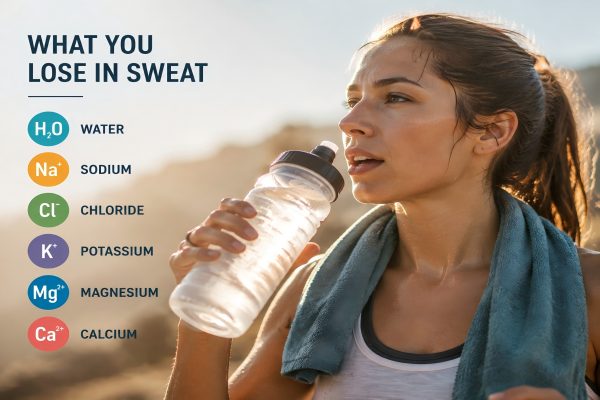
When you sweat, you primarily lose water, sodium, and chloride, along with smaller amounts of potassium, magnesium, and calcium. The importance of replacing those losses depends on total sweat volume, electrolyte concentration, exercise duration, environmental conditions, food and fluid intake, and recovery time. Sodium usually deserves the most attention when sweat losses become substantial because its concentration varies considerably between individuals.
Picture two runners finishing the same 90-minute summer workout. One has a slightly damp shirt and drinks some water before lunch. The other has soaked through every layer, white salt marks around the collar, and another training session later in the day. They technically performed the same activity, yet their hydration questions are not the same. Understanding what actually leaves the body through sweat makes it much easier to decide when ordinary water and food are reasonable and when electrolyte amounts on a supplement label become worth examining more closely.
This article provides general educational information rather than individualized medical advice. People who have a medical condition, take medication, have been advised to monitor sodium or fluid intake, or are pregnant or nursing should discuss major changes in hydration or supplement use with an appropriate healthcare professional.
What Happens to Electrolytes When You Sweat?
Sweating moves water and dissolved electrolytes from sweat glands onto the skin, where evaporation helps release body heat. Sodium and chloride account for most of the practical electrolyte loss, while potassium and smaller amounts of other minerals are also present. Total loss rises with sweat volume, so prolonged or heavy sweating can create a very different hydration situation from light everyday perspiration.
How Does Sweating Cool Your Body?
Sweating is primarily a temperature-control mechanism. When muscles work, much of the energy involved eventually appears as heat, and the body needs a way to move that heat into the environment. Eccrine sweat glands release a water-rich fluid onto the skin. The crucial step occurs when that fluid evaporates. Evaporation consumes heat energy and transfers it away from the body, helping keep internal temperature within a workable range during exercise and environmental heat exposure. Sweat that simply runs off the skin or drips onto the floor still represents fluid loss, but it does not provide the same evaporative cooling benefit.
Humidity makes the difference particularly noticeable. In dry air, sweat can evaporate relatively efficiently. When humidity rises, the surrounding air already contains more water vapor, which limits evaporation. A person may therefore sweat heavily, feel soaked, and lose a substantial amount of fluid without receiving an equally large increase in cooling. Clothing, airflow, direct sunlight, exercise intensity, body size, fitness, acclimatization, and environmental temperature can all alter the sweating response, which helps explain why hydration needs can change considerably between an air-conditioned gym session and a summer workout outdoors.
Sweat volume should not be interpreted as a score for workout quality. Producing more sweat does not automatically mean a person burned more calories, trained more effectively, or requires a particular supplement afterward. Research in athletes has documented very broad sweat-rate ranges, including predicted whole-body rates from 0.26 to 5.73 liters per hour in one large dataset. The extreme upper end is not typical of most everyday exercise, but the range demonstrates how strongly sweating can differ between individuals and conditions.
Why Do Electrolytes Leave the Body in Sweat?
Sweat does not begin inside the gland as pure water. The initial fluid contains water and dissolved ions, including sodium, chloride, and potassium. As it travels through the sweat duct toward the skin, sodium and chloride are partially reabsorbed. This conservation system means final sweat is generally more dilute than the fluid circulating in the bloodstream, but reabsorption is incomplete. Some sodium, chloride, potassium, and smaller quantities of other minerals therefore leave the body whenever sweat reaches the skin.
The amount of sodium reaching the skin can differ substantially. A major review of sweating research reports regional sweat sodium concentrations commonly around 10–90 mmol/L, while whole-body values are generally somewhat narrower, approximately 20–80 mmol/L. Because one millimole of sodium weighs about 23 mg, a concentration of 20 mmol/L represents roughly 460 mg sodium per liter of sweat, while 80 mmol/L represents approximately 1,840 mg per liter. These numbers illustrate the possible scale of variation; they are not universal replacement recommendations.
Sweat rate can also influence composition because faster secretion leaves less time for sodium and chloride to be recovered in the duct. This is one reason the same person’s sweat concentration may change with exercise intensity, heat, and other conditions. It also explains why visible salt deposits are useful clues rather than precise measurements. White marks on clothing show that minerals remained after water evaporated, but they cannot reveal an exact milligram-per-liter value without proper testing.
What Happens to Fluid Balance as Sweating Continues?
The effect of sweating becomes more important as losses accumulate. A person who loses 300 mL during a short workout faces a different situation from someone who loses two or three liters during several hours of exercise or physical work. If fluid intake does not keep pace with output, total body water gradually decreases. For field assessment, changes in body mass before and after activity can provide a useful estimate of fluid loss when drinks, food, urine, and clothing are accounted for appropriately.
Electrolyte loss accumulates in exactly the same way. If a person’s sweat contains about 900 mg of sodium per liter, losing 0.5 L corresponds to approximately 450 mg sodium, while losing 2 L corresponds to approximately 1,800 mg. Nothing about the sweat concentration needs to change for the total loss to quadruple. This relationship is one of the most useful ideas for understanding why product labels cannot be evaluated in isolation.
A hydration powder providing 300 mg sodium, for example, may represent a meaningful portion of one person’s modest loss and only a small fraction of another person’s prolonged hot-weather loss. Conversely, a high-sodium formula designed for demanding endurance conditions may provide more sodium than another person wants for a short low-sweat activity. Normal meals also supply sodium, potassium, magnesium, calcium, chloride, carbohydrate, and water, so beverage intake should be understood as one part of the day’s complete hydration and nutrition pattern.
Which Electrolytes Do You Lose Most in Sweat?
Sodium and chloride are generally the most significant electrolytes lost through sweat. Potassium is also present but usually at lower concentrations, while magnesium and calcium losses are considerably smaller. This hierarchy matters when evaluating electrolyte products because a long list of minerals does not automatically make a formula more closely matched to sweat. Sodium quantity and intended use often deserve closer attention.
Which Electrolyte Is Lost the Most?
Sodium receives the most attention in exercise hydration because both its concentration in sweat and total hourly loss can become substantial. In a dataset involving 506 athletes, predicted whole-body sweat sodium averaged 35.9 ± 10.4 mmol/L, with individual values ranging from 18.2 to 70.8 mmol/L. Converted into consumer-friendly units, that corresponds to roughly 418 to 1,628 mg of sodium per liter of sweat. The same athletes had an average whole-body sweat rate of 1.21 L/h, again with wide individual variation.
The combination of concentration and volume is more meaningful than either number alone. A person sweating 0.6 L/h at 30 mmol/L loses approximately 414 mg sodium per hour, while someone producing 1.5 L/h at 60 mmol/L loses roughly 2,070 mg per hour. Both people can accurately say they “sweat a lot,” yet the second person’s estimated hourly sodium loss is about five times larger.
This variation also explains the broad sodium range found across commercial electrolyte products. Some formulas provide relatively small amounts of sodium and function mainly as flavored hydration products, while others contain several hundred milligrams or more per serving and are positioned around prolonged activity or heavy sweating. A higher milligram number is not automatically superior. The relevant comparison includes intended use, water volume, serving size, carbohydrate or sugar content, other electrolytes, normal dietary intake, and individual circumstances.
How Much Chloride Is Lost With Sodium?
Chloride is the negatively charged ion most closely associated with sodium in sweat. Together they account for much of the familiar salty taste of perspiration and the white mineral residue that can remain on dark clothing when sweat evaporates. Research on sweat composition identifies sodium, chloride, and potassium as the principal electrolyte ions in thermoregulatory sweat, with sodium and chloride showing especially large variation between individuals.
Consumers see sodium highlighted more often because it is routinely displayed on U.S. nutrition and supplement labels, while chloride may receive less attention on front-of-package marketing. Ingredient sources also matter. Sodium chloride supplies both sodium and chloride, while sodium citrate supplies sodium without the same chloride contribution. Potassium chloride contributes both potassium and chloride, so reading the complete ingredient list can provide context that a front-label phrase such as “five electrolytes” does not.
For general nutrition-label interpretation, the FDA currently lists Daily Values of 2,300 mg for sodium and 2,300 mg for chloride for adults and children four years and older. These numbers provide standardized labeling context; they are not targets for replacing exercise losses. A product showing 20% Daily Value for sodium does not necessarily replace 20% of a person’s workout sodium loss, because sweat loss is determined by that individual’s sweat rate and sodium concentration.
Do You Lose Potassium, Magnesium, and Calcium Too?
Potassium is another recognized sweat electrolyte, but its concentration is normally lower and substantially less variable than sodium. In one study examining individual sweat electrolyte variability, average sweat potassium concentration was approximately 6.0 ± 0.9 mmol/L, compared with an average sodium concentration of 42.9 ± 18.7 mmol/L in the same group. This difference shows why sodium generally dominates discussions of sweat replacement even when products advertise several electrolyte minerals together.
Magnesium and calcium also appear in sweat, although their total loss is generally much smaller. Measurements of these lower-concentration minerals are more vulnerable to skin contamination and sampling technique, so exact whole-body replacement calculations are less straightforward than they are for sodium. A hydration product containing meaningful magnesium may have nutritional value for other reasons, but its magnesium content should not automatically be interpreted as evidence that heavy magnesium replacement is needed every time a person perspires.
The FDA Daily Values below provide useful label context, but they should not be confused with sweat-replacement targets. Daily Values are designed to help consumers interpret an entire day’s nutrition, whereas exercise losses depend on activity and individual physiology.
| Electrolyte | Importance in Sweat | U.S. Daily Value | Useful Label Context |
|---|---|---|---|
| Sodium | Major sweat electrolyte with large individual variation | 2,300 mg | Often the first mineral to compare in sweat-focused formulas |
| Chloride | Major sweat anion closely associated with sodium | 2,300 mg | May come from sodium chloride or potassium chloride |
| Potassium | Present at lower concentrations than sodium | 4,700 mg | Useful secondary electrolyte comparison field |
| Magnesium | Normally a much smaller sweat loss | 420 mg | Higher amounts are not automatically necessary because of sweating |
| Calcium | Present in smaller quantities | 1,300 mg | Usually secondary in sweat-replacement decisions |
In the supplement aisle, this hierarchy can prevent an easy mistake: counting ingredients instead of interpreting amounts. A formula containing sodium, potassium, magnesium, calcium, and several trace minerals may look more comprehensive than one emphasizing sodium and chloride, yet that does not establish that it is better suited to a sweaty workout. The most informative labels state actual amounts clearly enough that the minerals can be evaluated rather than simply listed.
How Much Electrolyte Do You Lose When You Sweat?
There is no single amount of electrolyte that everyone loses through sweat. Total loss is determined by two variables: how much sweat is produced and how concentrated that sweat is. Research shows wide differences in both measures, meaning two adults completing the same activity can finish with very different fluid and sodium losses. Estimating both values provides much better context than judging sweat by appearance alone.
How Much Sodium Can Sweat Contain?
Exercise research commonly expresses sweat sodium concentration in millimoles per liter. Since one millimole of sodium weighs approximately 23 mg, these laboratory values can be converted into the milligram quantities used on U.S. supplement labels. Whole-body sweat sodium values are frequently reported somewhere within approximately 20–80 mmol/L, although variation beyond a simple average remains important. That range corresponds to about 460–1,840 mg sodium per liter of sweat.
The table below shows how quickly total sodium loss changes when sweat volume changes. These are arithmetic examples, not recommended replacement amounts. They are useful because they place commercial electrolyte labels into scale. A 500 mg sodium serving could be more sodium than one person loses in a short cool-weather workout while representing considerably less than another person’s loss during a long summer session.
| Sweat Sodium Concentration | Approx. Sodium per Liter | Sodium in 0.5 L Sweat | Sodium in 1.5 L Sweat |
|---|---|---|---|
| 20 mmol/L | 460 mg | 230 mg | 690 mg |
| 40 mmol/L | 920 mg | 460 mg | 1,380 mg |
| 60 mmol/L | 1,380 mg | 690 mg | 2,070 mg |
| 80 mmol/L | 1,840 mg | 920 mg | 2,760 mg |
This is one reason claims such as “replaces everything you lose in sweat” deserve careful reading unless the assumptions are defined. A fixed serving cannot precisely mirror an unknown sweat volume and an unknown sodium concentration for every consumer. A more useful product description tells readers the amount per serving, the expected mixing volume, and the intended usage context, allowing them to compare the formula against their own activity pattern.
Why Does Sweat Sodium Vary Between People?
Sweat sodium concentration reflects several interacting influences. Sweat glands vary in their ability to reabsorb sodium and chloride, and genetics appear to contribute to these differences. Sweat rate matters because higher flow can reduce the time available for sodium recovery in the duct. Environmental heat, exercise intensity, acclimatization, dietary factors, body characteristics, and measurement method can further alter the number recorded in a sweat test. An analysis involving 1,944 sweat tests found that multiple individual, environmental, and exercise factors contributed to variation rather than one simple predictor explaining everything.
The body location used for testing also matters. In the 506-athlete dataset, mean forearm sodium concentration was 43.6 mmol/L, whereas predicted whole-body concentration averaged 35.9 mmol/L. A regional patch therefore cannot automatically be interpreted as an exact whole-body value unless the testing method has been validated for that purpose.
This makes casual labels such as “salty sweater” useful but incomplete. White deposits on a shirt or very salty-tasting sweat can suggest meaningful sodium loss, yet they cannot distinguish between 500 mg and 1,500 mg per liter. The phrase “heavy sweater” describes volume, not concentration. Someone can be a heavy sweater with moderate sodium concentration, a light sweater with high sodium concentration, or high in both categories.
For most people doing ordinary recreational exercise, those distinctions do not need laboratory-level precision. They become more useful when several hours of training, competitive endurance activity, hot-weather work, or short recovery intervals turn small estimation errors into much larger cumulative differences.
How Do Sweat Rate and Sodium Concentration Work Together?
The relationship becomes clearer through a simple calculation. Estimated sodium loss per hour equals sweat rate multiplied by sodium concentration and then multiplied by approximately 23 mg per mmol. Consider someone who sweats 0.7 L/h with a sodium concentration of 60 mmol/L. Estimated sodium loss is roughly 966 mg per hour. Another person sweating 1.5 L/h at only 35 mmol/L loses approximately 1,208 mg per hour.
The first person has saltier sweat, yet the second loses more sodium because significantly more fluid leaves the body. That distinction matters when people focus only on salt marks or a sweat-test concentration. Volume can change the final result just as much as concentration, and duration multiplies the difference further.
Commercial formulas become easier to understand after this calculation. If a product contains 250 mg sodium per serving, it may be closer to the scale of a modest short-session loss. A 1,000 mg formula represents a very different nutritional profile. Neither number has meaning in isolation, and neither should be described as appropriate for every exercise session.
The same reasoning applies to daily diet. Someone who finishes training and eats a normal sodium-containing meal has another source of electrolyte replacement that is absent from the front panel of a hydration packet. The goal is therefore not perfect one-for-one accounting but understanding whether losses are modest, substantial, or occurring repeatedly enough to justify more deliberate planning.

What Changes Electrolyte Loss During Exercise and Heat?
Electrolyte loss changes whenever sweat volume or sweat composition changes. Heat, humidity, exercise intensity, activity duration, airflow, clothing, acclimatization, and individual physiology can all affect the final amount. The same person can therefore lose far more fluid and sodium during a humid July run than during a similar winter workout, even though the exercise distance and duration appear almost identical.
How Do Heat and Humidity Affect Sweat Loss?
As environmental temperature rises, evaporation becomes increasingly important for moving heat away from the body. Sweat production usually rises to support that process. Humidity adds another challenge because the air can accept less additional water vapor, reducing evaporative efficiency. A person may become extremely wet in humid conditions while much of the sweat drips from the skin instead of evaporating effectively, creating considerable fluid loss without proportional cooling.
The size of this response can be striking. The large athlete dataset discussed earlier included testing environments from 15°C to 50°C, while individual whole-body sweat rates ranged from 0.26 to 5.73 L/h. These values came from athletes across different sports and should not be used as a normal range for every consumer, but they demonstrate how broad the physiological response can become under varying environmental and exercise conditions.
This principle extends beyond competitive sports. Construction crews, warehouse employees in hot facilities, hikers, tennis players, landscapers, delivery workers, cyclists, and people attending prolonged outdoor events can accumulate considerable sweat loss without thinking of themselves as endurance athletes. Research involving work in moderately hot conditions has also documented large cumulative sodium losses across long shifts, reinforcing that duration and environment matter outside formal exercise settings.
For supplement comparisons, season and setting therefore matter as much as the word “workout.” A high-sodium product designed for prolonged, heavy-sweat conditions may not make sense for every office day or light exercise session, while a low-sodium flavored beverage may provide only a modest amount relative to very large summer losses.
Does Exercise Intensity Change Electrolyte Loss?
Increasing exercise intensity generally increases metabolic heat production, which often increases sweat rate. Studies specifically examining intensity have found that total sweat electrolyte losses can rise as sweat output increases. Sodium and chloride are especially relevant because their losses vary considerably both within and between individuals across training conditions.
Concentration alone can therefore be misleading. If someone maintains sweat sodium near 40 mmol/L but sweat rate rises from 0.5 L/h to 1.2 L/h, estimated sodium loss rises from approximately 460 mg/h to 1,104 mg/h even though the sweat itself is no saltier. The body is losing more sodium simply because much more sweat is leaving the skin.
Duration can reverse intuitive comparisons as well. A short interval session may feel extremely intense and leave someone dripping with sweat, yet an easy three-hour cycling ride can create a larger cumulative fluid deficit. Activity type affects airflow and heat dissipation too. Outdoor cyclists may receive substantial convective cooling from moving air, while indoor riders can become drenched without a fan despite riding at a similar power output.
These differences are why categories such as “electrolytes for HIIT” or “electrolytes for running” should not be treated as fixed dosage rules. Two runners can have more different hydration needs from each other than a runner and cyclist exercising under similar conditions.
How Does Heat Acclimatization Affect Sweat Sodium?
Repeated heat exposure can gradually change the way the body handles thermal stress. Adaptations may include earlier sweating, greater sweat capacity, and improved conservation of sodium within the sweat gland. Reviews of heat acclimatization research describe falling sweat sodium concentration as a recognized adaptation, even while total sweat production may increase.
The important detail is that a lower sodium concentration per liter does not automatically mean a small total sodium loss. Suppose an acclimatized athlete lowers sweat sodium from 55 to 40 mmol/L but begins sweating considerably more each hour. Greater fluid volume can offset some of the improved salt conservation, leaving cumulative sodium loss meaningful during a long session.
Heat acclimatization also means that a sweat test should not be viewed as a permanent personal number. A measurement collected in early spring after months of indoor training may not perfectly represent sweat composition later in summer after repeated outdoor exposure. Testing conditions, training intensity, temperature, humidity, and acclimatization status all provide useful context for interpreting a result.
The practical implications can be summarized without turning physiology into a fixed formula:
| Factor | Common Effect on Sweat Volume | Possible Effect on Sweat Sodium | Practical Meaning |
|---|---|---|---|
| Higher heat | Usually increases sweating demand | Can change with rising sweat rate | Greater total fluid and potentially sodium loss |
| High humidity | Reduces evaporative efficiency | Mostly indirect | Heavy visible sweating can occur with inefficient cooling |
| Higher intensity | Often increases sweat rate | May increase concentration in some conditions | Hourly sodium loss can rise |
| Longer duration | Accumulates losses | Concentration may stay similar or change | Moderate hourly losses can become large totals |
| Heat acclimatization | Often improves sweating response | Commonly lowers sweat sodium concentration | Better salt conservation per liter, but volume still matters |
Do Workout Duration and Sweat Rate Matter?
Duration is what turns hourly numbers into cumulative losses. A sweat rate of 0.7 L/h produces only about 0.53 L over a 45-minute session, but approximately 2.8 L over four hours if conditions remain similar. At a sweat sodium concentration equivalent to 900 mg per liter, those examples correspond to about 473 mg versus 2,520 mg of sodium leaving through sweat.
The calculation does not mean that every milligram should be replaced immediately. Food consumed before, during, and after activity contributes sodium and other minerals, and the kidneys continually regulate water and electrolyte balance. It does explain why a single hydration rule cannot apply equally well to a short lifting session, a marathon, a summer hike, and a full day of outdoor work.
Recovery time changes the significance of loss as well. Someone who finishes at 6 p.m., eats dinner, drinks according to normal cues, and has no demanding exercise until the next evening has many hours for restoration. A tournament athlete competing again in three hours has a much narrower recovery window, making fluid, sodium, carbohydrate, and meal timing more relevant.
This is where product labels become genuinely useful rather than decorative. Sodium per serving, sugar or carbohydrate content, water volume, caffeine, other minerals, and packet size can be compared against a specific situation instead of being ranked by whichever formula has the largest ingredient panel.
Is Water Enough After You Sweat?
Plain water can be enough after shorter or lighter activity when sweat losses are modest and normal meals follow. Electrolytes become more relevant as fluid and sodium losses increase, particularly during prolonged activity, heavy sweating, heat exposure, or short recovery windows. More fluid is not automatically safer either, because excessive drinking during prolonged exercise can dilute blood sodium and create a serious imbalance.
When Is Plain Water Usually Enough?
There is no evidence-based reason for every visible bead of sweat to trigger an electrolyte supplement. Water remains the foundation of hydration, and an ordinary diet provides sodium, potassium, chloride, magnesium, calcium, carbohydrate, and additional fluid. For relatively short or low-sweat activities followed by normal meals, replacing fluid with water can be perfectly reasonable.
The meal afterward deserves more attention than many hydration discussions give it. Bread, dairy foods, soups, eggs, meat, sauces, prepared foods, fruits, vegetables, nuts, and other everyday choices can collectively supply substantial minerals. A person who drinks water after a workout and then eats a normal meal is not recovering with “water alone” in a nutritional sense; food is part of the replacement process.
Studies of post-exercise rehydration illustrate the importance of context. Sodium-containing fluids can improve fluid retention when rapid restoration is needed after meaningful exercise-related water loss, which is particularly relevant when another demanding session follows soon afterward. Reviews commonly discuss consuming approximately 125–150% of the volume lost during rapid post-exercise rehydration to account for continued urine production, but this recommendation applies to specific recovery situations rather than every person who perspires.
Someone completing a comfortable 40-minute workout before dinner therefore has a very different problem from someone finishing a multi-hour event with a large measured body-mass loss and another competition later the same day.
When Do Electrolytes Become More Relevant?
Electrolytes become more worth considering when sweat loss becomes substantial enough that ordinary casual drinking and meals may not conveniently restore what has been lost within the available time. Prolonged endurance events, repeated practices, outdoor work in heat, tournaments, very high measured sweat rates, and consistently salty sweat are examples where sodium quantities become more informative.
Consider two people exercising for two hours. Someone sweating at 0.6 L/h with 25 mmol/L sodium loses approximately 690 mg sodium in total. Someone sweating at 1.5 L/h with 60 mmol/L loses roughly 4,140 mg over the same two hours. The difference is approximately sixfold despite identical exercise duration. Those calculations are illustrative rather than suggested intake amounts, but they demonstrate why time alone is a poor basis for a fixed electrolyte recommendation.
This variability is also why products occupying different positions in the electrolyte market can all have legitimate uses. A mix with 200–300 mg sodium per serving may fit consumers seeking lighter flavored hydration, while a formula supplying substantially more sodium may be built around heavy sweating or endurance activity. Sugar-free formulas serve a different preference from products intentionally providing carbohydrate for prolonged exercise.
Rather than asking which formula has the highest number, consumers can compare sodium, sugar, carbohydrate, sweetener type, potassium, magnesium, serving size, recommended water volume, and price per serving against the context in which they actually intend to use the product.
How Does Prolonged Sweating Change Rehydration Needs?
Large sweat losses create a more complex recovery problem because water consumed after exercise does not remain entirely inside the body. Some replacement fluid will be lost through urine, particularly if a large volume of plain water is consumed quickly. Sodium-containing food and beverages can improve fluid retention during recovery, which is one reason post-exercise guidance for athletes facing a short turnaround can differ from advice for ordinary daily activity.
Reviews of athlete rehydration commonly discuss replacing 125–150% of measured fluid loss when the goal is rapid restoration before another bout of exercise. In practical terms, a 1 kg acute body-mass loss represents roughly one liter of fluid deficit, so a rapid-rehydration plan might involve approximately 1.25–1.5 L over the recovery period rather than exactly one liter. This is a sports-recovery framework, not an everyday requirement to deliberately overdrink after a normal gym session.
Food again changes the calculation. A normal sodium-containing meal can contribute both electrolytes and water, while carbohydrate may become useful during prolonged endurance activity because the nutrition problem includes energy as well as hydration. This is why commercial sports beverages vary so much: some are nearly calorie-free electrolyte products, while others deliberately combine sodium and carbohydrate for longer-duration exercise.
A useful product comparison should acknowledge those differences rather than reducing every formula to a single “hydration score.” The right composition depends on what the person is doing, what else they are eating, and how quickly they need to recover.
Can Drinking Too Much Water Affect Sodium Balance?
Yes. One of the most important counterpoints to “stay hydrated” messaging is that consuming more fluid than the body loses can become unsafe during prolonged exercise. Exercise-associated hyponatremia involves abnormally low blood sodium in association with physical activity. Reviews identify excessive water or hypotonic-fluid consumption, together with impaired excretion of excess water, as major mechanisms.
This means that aggressively drinking large volumes “just in case” is not necessarily better than responding to real needs. Drinking according to thirst has been described in contemporary reviews as an individualized strategy that can help avoid dangerous disturbances in water and sodium balance during exercise. The message should not be misread as ignoring planned hydration in every athletic situation; rather, it warns against treating maximum possible fluid intake as the goal.
Adding electrolytes does not make unlimited fluid consumption harmless. Most sports drinks and electrolyte mixes are still predominantly water after preparation, and consuming fluid greatly in excess of loss can remain problematic. Body-mass gain during a long endurance event can be a useful warning that intake has exceeded net fluid loss.
Serious headache, repeated vomiting, confusion, seizures, altered mental status, or other severe symptoms during or after prolonged exercise require appropriate medical evaluation rather than self-correction with additional water, salt, or supplements. General hydration information cannot reliably distinguish exercise-associated hyponatremia from heat illness or other medical problems based on symptoms alone.
How Do You Estimate Your Sweat and Electrolyte Loss?
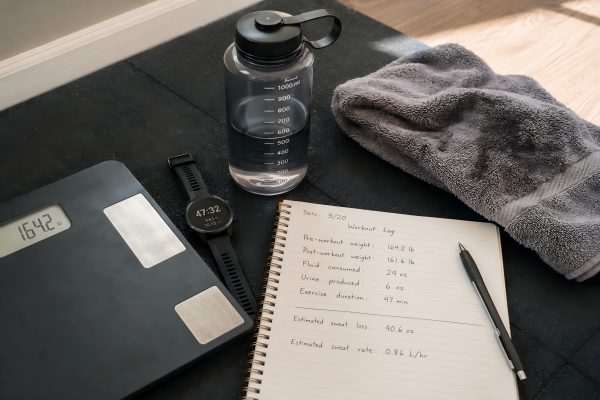
The simplest field estimate uses body mass before and after exercise, adjusted for fluid consumed and urine produced. Dividing the resulting fluid loss by exercise duration gives an approximate sweat rate. Estimating sodium loss requires a separate sweat sodium measurement or a cautious assumed range. These tools are most useful when repeated under conditions similar to the activity you actually want to plan for.
How Do You Estimate Your Sweat Rate?
A reasonably accurate field estimate can be made with a body-weight scale and a few measurements. Weigh yourself shortly before activity in minimal dry clothing, record everything you drink, account for any urine produced during the session, and weigh yourself again afterward under similar conditions. A loss of approximately one kilogram of acute body mass is commonly treated as roughly one liter of net fluid loss for this type of practical calculation.
The basic calculation is:
Estimated sweat loss = pre-exercise mass − post-exercise mass + fluid consumed − urine produced
Estimated sweat rate = total sweat loss ÷ exercise duration in hours
Wet clothing can hold substantial water and distort the final number, so changing into dry clothing or weighing with minimal clothing improves consistency. Food consumed during activity also changes body mass and should be included when precision matters. Repeating the process is more useful than relying on a single session because temperature, humidity, training intensity, clothing, and season can all shift sweat production.
A worked example makes the method easier to follow:
| Measurement | Example |
|---|---|
| Pre-exercise body mass | 72.0 kg |
| Post-exercise body mass | 71.3 kg |
| Fluid consumed | 0.60 L |
| Urine produced | 0.10 L |
| Exercise duration | 1.5 hours |
| Estimated sweat loss | 1.20 L |
| Estimated sweat rate | 0.80 L/h |
The calculation is 72.0 − 71.3 + 0.60 − 0.10 = approximately 1.20 L of sweat loss, followed by 1.20 ÷ 1.5 = approximately 0.80 L/h. A second measurement during much hotter conditions might produce a very different result, which is precisely why repeating the test under relevant conditions adds value.
What Do Salty Sweat Marks Tell You?
White streaks around a shirt collar, chalky residue on a hat, salty-tasting skin, or sweat that frequently stings the eyes can all indicate that sodium chloride remained after sweat water evaporated. They are useful observations, especially when the pattern repeats, but none of them gives an exact sweat sodium concentration.
Visible residue depends on both concentration and volume. Someone with moderately salty sweat producing three liters can deposit a large amount of salt on clothing, while a person with highly concentrated sweat producing only half a liter may leave less. Fabric color, material, evaporation, location of sweat accumulation, previous washing, and environmental conditions also affect how obvious the residue becomes.
This is the distinction between being a “salty sweater” and a “heavy sweater.” The first term refers loosely to concentration; the second refers to volume. The two characteristics can occur together, but they do not have to. Research consistently shows broad individual variability in both sweating rate and sweat sodium, which is why visual signs are better treated as clues than as measurements.
For someone exercising casually for less than an hour and eating normally afterward, knowing whether sweat contains 700 or 1,000 mg sodium per liter may not materially change the routine. For an endurance athlete repeatedly losing several liters, more accurate information can become considerably more useful.
Is Sweat Sodium Testing Useful?
Sweat sodium testing can provide useful information when a person repeatedly experiences large losses and the result could change a hydration strategy. Endurance athletes, tournament competitors, people doing long training sessions in summer, and individuals working for extended periods in heat are more likely to gain practical value from a carefully performed test than someone completing occasional short workouts.
Methodology matters considerably. Whole-body washdown techniques are valuable research methods but difficult to perform routinely. Regional patches and wearable technologies are more convenient, yet the result from the forearm, back, or thigh does not automatically equal whole-body sweat composition. Validated regional-to-whole-body relationships are therefore important when test results are interpreted as estimates of total sodium loss.
Sample contamination can further affect results. Residual minerals on the skin, excessive patch duration, evaporation, cosmetics, incomplete sealing, and differences in sweat flow can alter collected concentrations. These issues become particularly important when measuring minerals present in smaller amounts. A seemingly precise number is only as useful as the collection method behind it.
Testing conditions should also travel with the result. A reading obtained during moderate indoor cycling in cool conditions should not automatically define sodium losses during a hard summer race after several weeks of heat acclimatization. A useful record includes exercise type, duration, temperature, humidity, approximate intensity, sweat rate, and testing method.
How Do You Decide Whether Electrolyte Replacement May Matter?
Start with the activity rather than the package. Ask how long you will be active, how much you normally sweat, whether the environment is hot or humid, whether you will eat afterward, and how quickly you need to perform again. A short workout that produces modest fluid loss creates a different decision from several hours of activity with kilograms of body-mass change.
After that, the Supplement Facts or Nutrition Facts panel becomes far more informative. Sodium per serving is particularly relevant for heavy-sweat use cases, while potassium, magnesium, carbohydrate, sugar, caffeine, serving size, mixing volume, sweetener system, packaging format, and servings per container can all change how a formula fits a particular routine. FDA Daily Values provide general nutrition context but do not represent a calculation of individual exercise loss.
For consumers comparing several products, standardized label fields are much more useful than broad claims such as “advanced hydration” or “complete electrolytes.” NutriReviewLab’s review framework emphasizes verifiable label information, ingredient amounts, use-case fit, price and serving information, and clear distinctions between published product facts and editorial interpretation. Brand-supplied documentation can also help keep product records current, but commercial relationships should remain separate from editorial conclusions.
That last point matters to both consumers and supplement companies. Readers benefit when a review makes the comparison method clear, and responsible brands benefit when current Supplement Facts, packaging versions, product specifications, and relevant documentation can be checked rather than guessed. The most useful question remains simple: What am I actually trying to replace, and does the formula on the label make sense for that situation?
Conclusion
Sweating removes water and electrolytes, but the size of those losses is not predictable from a wet shirt alone. Sodium and chloride account for most of the practical electrolyte loss, while potassium, magnesium, and calcium are generally present in smaller amounts. Research shows wide individual differences in sweat rate and sodium concentration, which means exercise duration, heat, humidity, intensity, acclimatization, diet, and personal physiology can turn apparently similar workouts into very different hydration situations.
For lighter activity, water and normal meals may cover recovery comfortably. Longer or heavier sweating can make sweat-rate estimates and sodium information more useful, particularly when recovery time is short. The goal is not to replace every milligram mechanically or choose whichever electrolyte powder shows the largest number. A better approach is to understand the scale of the loss, read the complete label, consider food and fluids together, and match the product to the conditions in which it will actually be used.
Frequently Asked Questions
Do You Lose Electrolytes Every Time You Sweat?
Yes. Sweat contains water plus dissolved electrolytes, including sodium, chloride, and potassium, with smaller amounts of additional minerals. The important question is not whether electrolytes are lost but how much. A light walk that produces minimal perspiration creates a much smaller total loss than several hours of running, cycling, outdoor labor, or sport in hot weather, so the practical need for deliberate replacement can differ considerably.
Which Electrolyte Do You Lose the Most When Sweating?
Sodium and chloride generally account for the largest practical electrolyte losses in sweat, with sodium receiving the most attention in sports-hydration research and commercial labeling. Potassium is present at lower concentrations, while magnesium and calcium usually contribute considerably smaller amounts. Individual sodium concentration varies widely, so the amount lost in a liter of sweat can differ several-fold between people even before differences in sweat volume are considered.
How Much Sodium Do You Lose in One Liter of Sweat?
There is no single value. Whole-body sweat sodium concentration commonly falls roughly within 20–80 mmol/L in exercise research, corresponding to approximately 460–1,840 mg sodium per liter. Individual measurements can fall outside simplified ranges, and regional sweat tests may differ from whole-body concentration. The useful number for an individual depends on both sodium concentration and how many liters of sweat are actually lost.
Is Water Enough After a Sweaty Workout?
Water may be entirely adequate after shorter or lighter workouts when fluid loss is modest and a normal meal follows. Food provides sodium and other minerals that also contribute to recovery. More deliberate electrolyte replacement becomes increasingly relevant as activity becomes longer, hotter, or sweatier, particularly when another demanding session follows soon afterward. The appropriate choice therefore depends on total loss and recovery context rather than sweating alone.
Does More Sweat Mean You Need More Electrolytes?
Greater sweat volume generally means greater total electrolyte loss if sweat composition remains similar, but volume is only half of the equation. Two people can sweat the same amount while losing very different quantities of sodium because their sweat concentrations differ. Likewise, someone with relatively salty sweat may still lose less sodium overall than a person producing much more moderately salty sweat. Sweat rate and sodium concentration need to be interpreted together.
Are White Salt Marks on Clothing a Sign of High Sodium Loss?
White residue usually reflects minerals, particularly sodium chloride, left behind after sweat water evaporates. Repeated visible salt marks can be a useful clue that sodium loss may be meaningful, but clothing cannot measure concentration precisely. A large volume of moderately salty sweat may leave substantial residue, while smaller volumes of more concentrated sweat may leave less. Accurate total loss still requires an estimate of sweat volume and, when useful, properly performed sodium testing.
Can You Drink Too Much Water After Sweating?
Yes, particularly during prolonged endurance activity if fluid intake substantially exceeds losses. Excessive consumption of water or other hypotonic fluids is a major factor in exercise-associated hyponatremia, a potentially serious disturbance in blood sodium. More drinking is therefore not automatically safer, and adding electrolytes does not make unlimited fluid intake harmless. Severe neurological or gastrointestinal symptoms during prolonged exercise warrant medical assessment rather than self-treatment with additional water or supplements.